Friday, January 13, 2023

My Response to the January 13th 2023 statement by Wizards

 NUTS!

- With all due respect to General Anthony McAuliffe of the 101st Airborne

A link to the Wizard's statement

The relevant section

The next OGL will contain the provisions that allow us to protect and cultivate the inclusive environment we are trying to build and specify that it covers only content for TTRPGs. That means that other expressions, such as educational and charitable campaigns, livestreams, cosplay, VTT-uses, etc., will remain unaffected by any OGL update. Content already released under 1.0a will also remain unaffected. 


Says nothing about being able to continue to use the OGL 1.0a license, Or whether we can make new content using the license. Or what we have to do to get this safe harbor.

Update:

(Removed because it is a distraction from the larger issues at hand)


Thursday, January 12, 2023

A Network of One, Three Little Words, and an appreciated Victory.


A lot has been going on 


Next a couple of things from my neck of the wood. 

A Network of One

Over on the Roll for Combat channel they had an excellent interview with Ryan Dancey. I recommend jumping to around the 18:00 minute mark where Ryan says this
one of the things we identified as a problem was that there were all kinds of game systems that were active in the market that weren't very successful and every one of those games was a little bubble a little social network of people that played that game and because they were playing a game that was small and unprofitable and the companies that were supporting those games were not able to make those businesses get bigger the sizes of those bubbles were shrinking and getting smaller and smaller and smaller and because they were not well connected to other bubbles the overall Market as a whole was shrinking and getting smaller and smaller and role-playing games are fair to a very unusual economic phenomenon called in the network externality which means that the value of the thing you sell the product is actually external to the thing that you sell it's in the network of people that use that thing
The value of the OSR is in the fact that the classic editions we focus on are but a hop and a skip from each other. So while ADnD, B/X, ODnD, etc. all had their fans, our "network" was much larger as we can freely share useful material with each other.

And because most of us used the OGL 1.0a those of us who focused on sharing and publishing could build off of each other work. I didn't have to start my own Majestic Fantasy RPG from scratch as Matt Finch graciously shared Swords and Wizardry for all to use under the OGL. Plus Autarch shared a lot of ACKS as open content which helped me with started with the mechanics of worldbuilding my Majestic Fantasy Realms.

The Post OGL World
In the coming days, I think it is important to carefully consider what licenses we adopt for our current and future works. Regardless of the outcome of the situation with Wizards we can never trust their word again. If too many of us pick too many licenses then we lose the advantages of the fact that classic edition clones were all under the same license. Our network will fragment and I fear the OSR  as a whole will shrink, and reduce the number of players of these excellent editions. 

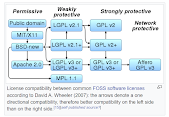
I am a computer programmer and have been involved in software development since the late 80s. I saw the rise of open source and participated in it in a small way. And the open source licensing situation is a sea of compatible and incompatible licenses. Just read the Wikipedia article to see how much of a mess it is. I don't want to see people in the OSR having to use a chart like below just to see if they can build and remix someone's content.


Maybe Paizo's ORC is the answer maybe it isn't. We should think about what we want before we split into an archipelago of hundreds of islands. 

I admit it won't be easy because the vast majority of us, including myself, like to march to the beat of our own drummer.  Many early OSR community efforts collapsed into arguments and factions. But I think it is important that we try to do something together for this particular issue. 

The result doesn't have to be a one size fit all solution. See Creative Common for how a standard system of options can be worked out. Keep in mind that some of us, while small, work with licensed content that will not be opened. OGL with the distinction between product identity and open content was great for that.

Three Little Words
On a different topic, I am pleased to say that a situation regarding the Community Content Programs that OnebookShelf runs on DriveThruRPG appears to have been resolved. I first reported this back in January of 2018. 

To summarize in Section 4 of the license that the OBS boilerplate used stated.

Except for short promotional excerpts used to promote your Work, you may not display, recreate, publish, distribute, or sell your Work (or derivatives thereof) outside of the Program administered on Roll20 websites or through other platforms or channels authorized or offered by the Publisher.

The three bolded words meant if I wrote Tower of the Dark Sage for the Glorantha setting used by Chaosium's Jonstown Compendium, I couldn't turn around and adapt my original IP (characters, maps, room descriptions) and released it under the OGL for Swords and Wizardry. Or for another CCP program like the Savage Worlds Adventurer Guild using Savage Worlds system. This was confirmed by OBS \in this blog post. 

Over the years I kept complaining to OBS and got nowhere. I had better luck with some of the programs themselves. I helped the Genesys community get the clause removed from the Genesys Foundry. But to be clear their community did most of the work.  

I talked to Daniel Fox of Zweihander and the folks at Hero Games about Hall of Champions. While both didn't change their license, they did let the contributors know they were free to adapt their original IP elsewhere. So I count those as partial wins. 

An Appreciated Victory
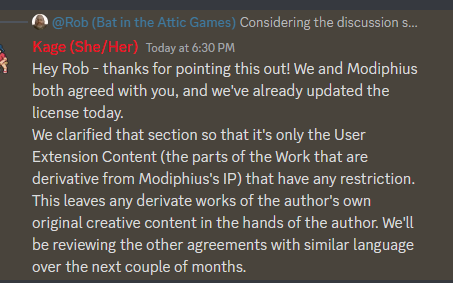
So two days ago, I heard that Modiphus was starting up their 2d20 Community Content program. As I usually do I contacted Modiphus privately and laid out my argument about getting rid of those three words. With OBS because I got nowhere before, I called them out publicly and politely on their discord server. 

And guess what thanks to the work of Chris Birch on the behalf of Modiphus and Kage on the behalf of OBS, the Modiphus license, and the OBS boilerplate are being changed! And OBS is going to work with other publishers to change their licenses.


This going to be great news for all the CCPs that remove this clause. This means contributors who are fans of multiple systems can adapt their original IP for other CCPs. Thus they benefit from the Network Externalities effect that Ryan Dancey talked about. They cease to be isolated islands doomed to rise and fall on their own.

To be clear the 50% royalties is still in place (30% to OBS and 20% to the publisher), and the work for that specific program still can only be released within that program. Also, Chris wanted everybody to know that Modiphus 20% is going into buying art and assets for all to use in the 2d20 World Builders program.

We still have the bigger problem of the OGL 1.1 and Wizards of the Coast to deal with. But this is a small victory we can enjoy. It is a good example of what can happen when a bunch of folks with good intentions can get together to hash out a solution to a problem.

Fight On!
 

Sunday, January 8, 2023

Concerning Bat in the Attic Games, Steady as She Goes along with further comments on the OGL.

Update: The text of OGL 1.1 has dropped at the below link. I verified this with some folks but always as with this kind of situation double check everything in anything I say or share. OGL 1.1

I have been commenting on the recent news regarding the OGL 1.1 along with debating the ramifications on various forums and social media platforms. As a result I seen a lot of publishers making their fans and customers aware of their future plans. I figure this will be a good time for me as well.

I am not known for my production speed. I am very concerned with usability and not wasting people's valuable hobby time when publishing or sharing material.  So I tend to fuss around a bit when it comes to my products.  This has left me in a semi-fortunate place as my next major project is Into the Majestic Fantasy Realms. I am in the middle of 3 of 4 maps and making slow but steady progress every day. 

Due to the nature of my Points of Light style setting,  I don't have to use the OGL In fact, Blackmarsh is already dual licensed under the OGL and CC-BY. My plan was and remains to do the same with the maps and text of Into the Majestic Fantasy Realms.

So in the absolute worst timeline where everybody's fears are realized about the termination of the OGL 1.0a license then Blackmarsh and the Majestic Fantasy Realms will be shared under the CC-BY license.

Next, my adventures both published and unpublished. I plan to release a 2nd edition of Scourge of the Demon Wolf set in the Majestic Fantasy Realms, and have Deceits of the Russet Lord mostly done. Those will also get released but their exact form is dependent on events.  

The Majestic Fantasy RPG, as I stated here on my blog and elsewhere, I dragged my setting across a dozen systems starting with ADnD 1e, an extended stay with GURPS, and currently a mix of 5e and my own Majestic Fantasy Rules. What this means I have a lot of experience in adapting what I do to an arbitrary system. You can see this in action with my Fate playtest posts. I am linking to the last one as it has the index.

So whatever happens I am confident that the full version of the Majestic Fantasy RPG will come up in some form. There will still be viz to burn as mages, but it will still be a tad more detailed than most OSR systems. It will still allow characters to do anything except some will be better at certain things. Whether it will be a d20-based system, a 3d6 based, or a d100-based system remains to be seen. But there are plenty of successful projects that don't use the OGL to serve as a template for what I can and can't do.

For those who are interested I still have where I left off with Fate here. 

Further comments on OGL 1.1

Trust

Trust in OGL 1.0a has been shattered regardless of the outcome. Dozens if not hundreds are seeking alternative licensing for their works. If you do so yourself, I understand. My recommendation is to use CC-BY and add a comment in the front to outline what is definitely not covered by the grant, like your publishing name. Using CC-BY will offer the best compatibility with the OGL 1.0a content if the license survives. But given the circumstance totally understandable if you go with one of the share-alike licenses.

Withdrawing the License

More than a few gamers in the legal profession had stated with near certainty that Wizards has the authority to withdraw their own license. That without term irrevocable in the copyright grant, perpetual doesn't mean forever. Just means it until the licensor revokes it. 

When I pressed them on this and asked which decision was the key case for this. It turns out the earliest citation is a 2010 decision in the United Kingdom. Note that because the UK is a common law country, the US Courts will use the decision as a resource, but it is not binding.

Here is a good summary on Enworld. It is post #569.

However, the interesting part was not that it was made in 2010 or ruled in the UK. But rather it was held that a termination clause was still relevant despite the perpetual license grant. As it so happens the OGL has an explicit termination clause. And de-authorization is not one of the grounds. More so Section 13 holds that sublicenses are still valid.

This is not a slam dunk. But it may mean that the continued existence of the OGL has some foundation.

It is Groundhog Day but worse

Sometimes I feel like it 2008 all over again with 4e and the GSL. When I first heard about this I said it going to play out pretty much like the 4e and GSL debacle. Except Wizards gave us a year's notice to do something about it.

But I think I was wrong. The degree of anger I have seen Wizard provoke in everybody is far greater than the 4e debacle.

Steady as She Goes

Right now I feel like the captain who just spotted the hurricane on the horizon. I don't where the winds are taking it but I am preparing and letting others know about it. But it hasn't hit yet. It may blow in a different direction. And if it doesn't I am going to keep the lights open until I get a cease & desist. 

Fight On

Thursday, January 5, 2023

Section 9 of the Open Game License

Update: I talk about the impact of recent events on me here.

 There is been a lot of discussion over whether Wizards can revoke the OGL by de-authorizing it. This came about because of Section 9 of the open game license.

9. Updating the License: Wizards or its designated Agents may publish updated versions of this License. You may use any authorized version of this License to copy, modify and distribute any Open Game Content originally distributed under any version of this License.

I highlighted in bold the operative section. The theory goes if Wizards de-authorized the license then everybody who ever used OGL 1.0 or OGL 1.0a will be forced to go to OGL 1.1 even folks who made their stuff open content that had nothing to do with any of Wizard's offerings like the d20 SRD, or the d20 Modern SRD, for example, Cepheus, Mongoose Legends and so on.

I am not a lawyer but like any layman, especially one involved in making creative content, I learned enough so I can ask my attorney intelligent questions to make sure what I want to do has all the i's dotted and t's crossed. 

What I learned is that while the letter of the contract is important, the courts give great weight to intent. What the parties intending to do to when the license or contract was made. If you google contract law and intent you will find several excellent summaries of what intent means in common law countries like the US.

As for the OGL, this means that the old d20 FAQ becomes highly relevant.

The D20 FAQ captured on April 29th, 2001

While not a legal document it does show the intent of Wizards circa 2001 when they released the OGL.

Q: What is meant by the term "Open Gaming"?

A: An Open Game is a game that can be freely copied, modified, and distributed, and a system for ensuring that material, once distributed as an Open Game will remain permanently Open.

This is further supported by the fact that when Wizards released the highly restrictive Game System License several years later, they did not try to revoke the OGL although they did sunset the d20 Trademark License.

Next, is the fact what is meant by an authorized license? Many contend it means that the OGL can be revoked. Or some like myself, argue that it means that the version had to have been authorized by Wizards at some point. The fact that Wizards does not wish to continue offering it for its own stuff is irrelevant to its use for current and future material.

I believe my point of view is further supported by how ambiguity is handled in the US Courts. A person in 2001 and in 2022 would reasonably assume they can use the OGL and any associated open content as long as they met the terms of the license. 

This is further supported by the references in the d20 FAQ to what the term "Free" means in the context of the OGL.

Particularly this

This use of the term "free" is a recognition of the philosophy of the roots of the Open Source software movement. The Free Software Foundation and the GNU Project, founded by Richard Stallman were the first formal efforts to codify the philosophy of Open Source software. It is the preference of the Free Software Foundation and Mr. Stallman to use the term "Free Software" rather than "Open Source", to keep the focus on the idea that the important part of the philosophy is the freedom to copy, modify and distribute computer software, rather than the more utilitarian objective of simply giving users access to the source code.

And the above is supported by the fact that the d20 page referred to the Open Gaming Foundation which is still in existence and has been recently updated.

Section 9 is, in my opinion, is a badly rewritten version of Section 9 of the GNU Public License  Ver 2 (the then current version) which reads. 

9. The Free Software Foundation may publish revised and/or new versions of the General Public License from time to time. Such new versions will be similar in spirit to the present version, but may differ in detail to address new problems or concerns. Each version is given a distinguishing version number. If the Program specifies a version number of this License which applies to it and "any later version", you have the option of following the terms and conditions either of that version or of any later version published by the Free Software Foundation. If the Program does not specify a version number of this License, you may choose any version ever published by the Free Software Foundation.

Finally as for Wizards making all open content magically use OGL 1.1 by focusing on authorized licenses. I submit folks are forgetting about 

You may use any authorized version of this License to copy, modify and distribute any Open Game Content 

That is a choice, if the worst case scenario comes to pass, you can decline to use OGL 1.1 and omit the open content that is not original to your work and then release it other another license or under traditional copyright.

I can't say how things will go but I hope this helps as a more hopeful view of the possibilities than some of the other commentary that is out there.

Update

This was pointed out to me that was in the OGL FAQ as well.

Q: Can't Wizards of the Coast change the License in a way that I wouldn't like?

A: Yes, it could. However, the License already defines what will happen to content that has been previously distributed using an earlier version, in Section 9. As a result, even if Wizards made a change you disagreed with, you could continue to use an earlier, acceptable version at your option. In other words, there's no reason for Wizards to ever make a change that the community of people using the Open Gaming License would object to, because the community would just ignore the change anyway.

This gives weight to my assertion that Section 9 of OGL 1.0a is intended to operate like Section 9 of the GPL rather than a "scrap it" clause.

Also 

Concerning Bat in the Attic Games, Steady as She Goes

Wednesday, December 21, 2022

The proposed OGL 1.1 is not an open license. Fight for your hobby.

 Today Wizards of the Coast on DnD Beyond released an article called OGLs, SRDs, & One D&D. It talks about Wizards plans for a new version of the OGL. 

The recap the OGL stands for the Open Game License. According to Creative Commons, an open license means the content is free to use how you want it. In practice, this has meant that content was shared to let people use the content in any way, including commercially, the main requirements being that there is proper attribution of the original content used, and that any modifications are released under the same license. With the author listed as the creator of the modification.

The current two versions of the OGL v1.0 (3.X) and v1.0a meet the above criteria except for specific elements. 

  • You are allowed to designate part of the work as product identity which basically saying I am not releasing this part of my book as open content. This is often used for licensed IP like Lord of the Rings or Star Trek. It is sometimes used when the author doesn't want to share their setting but wants to use and modify a popular system.
  • You also explicitly agree to give up your right to cite compatibility to a trademarked product. This is something that you normally have the right to do when releasing a work when it is your content. I could have done this with Blackmarsh as I mostly used common monster names rather than anything specific out of the DnD editions.
The Changes

So what are the proposed changes?

First, we’re making sure that OGL 1.1 is clear about what it covers and what it doesn’t. 

What OGL 1.1 will cover are electronic files like PDF, and printed books this right off mean that OGL 1.1 is no longer an open license as it restricts how you can use the open content. As the definition of open content means you can use it in the manner you see fit.

The next change

Second, we’re updating the OGL to offer different terms to creators who choose to make free, share-alike content and creators who want to sell their products.  

They list a number of requirements that amount to you having to report any sales of any products licensed under the OGL 1.1 as well as a description of what it is you are selling.  And if you make over a threshold ($750,000) then you will be expected to pay royalties by 2024. 

Wrapping it up

This will further bifurcate the third party publisher market. OGL 1.0 and OGL 1.0a content can't be used with OGL 1.1 content as a result of Section 12 of the current OGL.

12. Inability to Comply: If it is impossible for You to comply with any of the terms of this License with respect to some or all of the Open Game Content due to statute, judicial order, or governmental regulation then You may not Use any Open Game Material so affected.

Right now the world of 3PP is divided into those who use open content like Pathfinder, Cepheus, OSRIC, Old School Essentials, and those who publish in community content programs like the DM's Guild.  In fact, I predict there will be three major 3PP communities for Dungeons and Dragons, the ones that continue to use the OGL 1.0a license, those who use the OGL 1.1 license, and those who use community content programs.

I realize there is a lot of speculation and criticism out there that are made because OneDnD is the news of the days. I limited myself to what the article said. At various times in the history of open source and creative commons, unscrupulous companies and individuals tried to put out their own licenses including ones with terms very much like the above. Each and every time this has not ended well for the bad actors and their licenses. Either they reverted back to a traditional commercial license and ceased their use of the open content. Or they came into compliance. 

If you value your freedom to produce and more commonly share the content you create for Dungeons and Dragons then let Wizards know that you find these proposed terms unacceptable. Let them know that the community has the tools right now to fix the issue on their own and will do so as shown by what happen with DnD 4e, the GSL, and Pathfinder.

This is your hobby and your game now. Don't let Hasbro try to take that away from you.

Fight On!


Update

I added some comments on Section 9 of the OGL which appears to be a point of attack by the Wizards' legal team to shut down the OGL.

Section 9 of the OGL

Concerning Bat in the Attic Games, Steady as She Goes and further thoughts on the OGL
For those who are new.

I have long been an advocate of open content released under the open license. Blackmarsh is free for any of use in any manner you see if. Likely the entire content of the Basic Rules for the Majestic Fantasy RPG is open content. 

Some past posts.

You are free now so go enjoy it.

An OGL Primer

A tale of two OGLs

Zweihander, Open Content, and a reply to Daniel Fox.

Ryan Dancy on the Open Game License

Finally some practical effects of making Blackmarsh open content. I would not have had the time or skills to do any of these projects but now folks who read Spanish, French, Italian and Hungarian can enjoy Blackmarsh in their languages as well as fans of Heroes and Other Worlds. 

And because these were solely the work of their respective author who put the work into making a version of Blackmarsh, they get to reap 100% of the financial rewards. Something I am fine with when I shared Blackmarsh as open content.

Blackmarsh in Spanish!

Périlleuses contrées: Fangenoire (Blackmarsh in French)

Italian version of Blackmarsh

Blackmarsh in Hungarian!

Blackmarsh for Heroes & Other Worlds

Sunday, December 4, 2022

A Fantasy Sandbox in Detail Part XXIII

 Part XXII  Index Page

This is the twenty-third post in a series detailing the 34 steps I recommended for making a Fantasy Sandbox Campaign. 

Today's post will cover steps 29 to 32. 

  1. Pick the 12 most important NPC or Monsters 
  2. Write a paragraph describing each and fully stat them. 
  3. Pick the most six common encounter type. (City Guard, Border Warders, Bloody Hand, Orcs) Write a paragraph and fully stat them.
  4. Scan your description for any regional organization and write a paragraph on them. Fully stat the most common encounters involved with them.

My choice of using a small example like the Isle of Piall constrains my choices of what to pick for important NPCs, Monsters, encounters, and organizations. It does illustrate an important point about making a sandbox, its scope. 

The details increase geometrically with the area covered by the setting. Piall is five hex columns by five hex rows and has about 27 entries. Blackmarsh has 27 hex columns and 19 hex rows and has 94 entries. Finally my upcoming "Into the Majestic Fantasy Realms" has four maps each with 31 hex columns 41 hex rows along with 200+ entries each. The amount of detail grows geometrically as the size of the map grows. Make the map twice the size in terms of hex rows and columns, and you will have to put in four times the work. 

If you pick a smaller number of locales to flesh out on a larger map this will mean more to make up as the campaign progresses. For your first sandbox make it a size that you feel comfortable with. The time estimate that accompanied the first posts of this series was based on an area the size of Blackmarsh, a map the size of a regular piece of paper, with about 100 entries total.

What to Detail?

The most important NPCs or monsters on the Isle of Piall should be the ones that the players are likely to interact with. Once you determined this list then describe their capabilities and/or plans in detail. Given the limited scope of the Isle of Piall I opted to describe 14 individuals and their associated organizations.

The NPCs of Piall

Tuesday, November 8, 2022

Now for the news about Space the Final Frontier

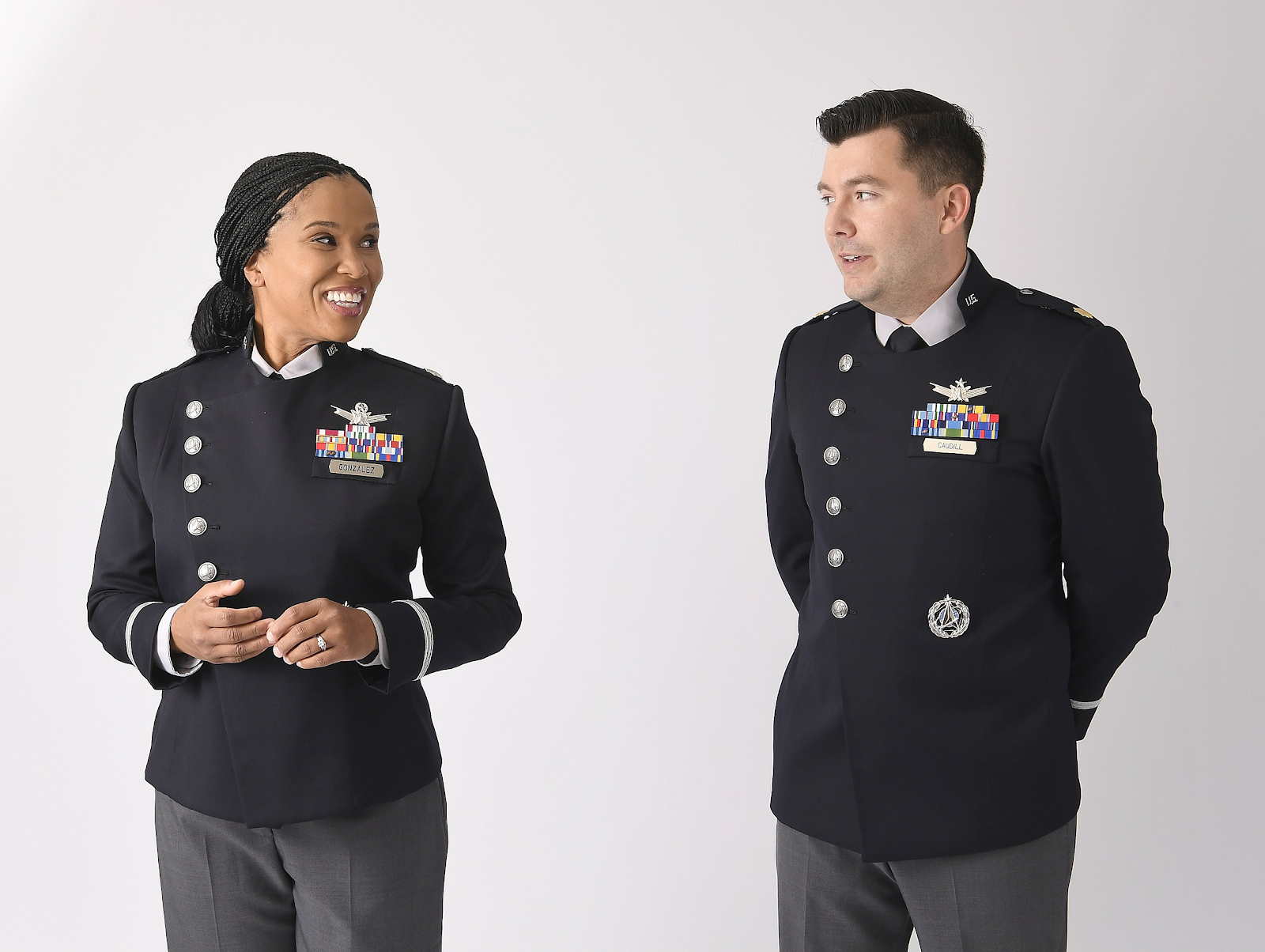
Updating everybody on the pressing irrelevant question of the day. What uniforms will the US Space Force pick?

A bit of background. So among world's aerospace units, the triangular delta symbol is somewhat popular. So when the US Space Force was formed they went with this. Whose popularity probably is no small part influenced by a certain beloved late 60s series. 


So the question now is where their uniform will come from? From which navy of American sci-fi they will draw inspiration from?  Well, we now have our answer.


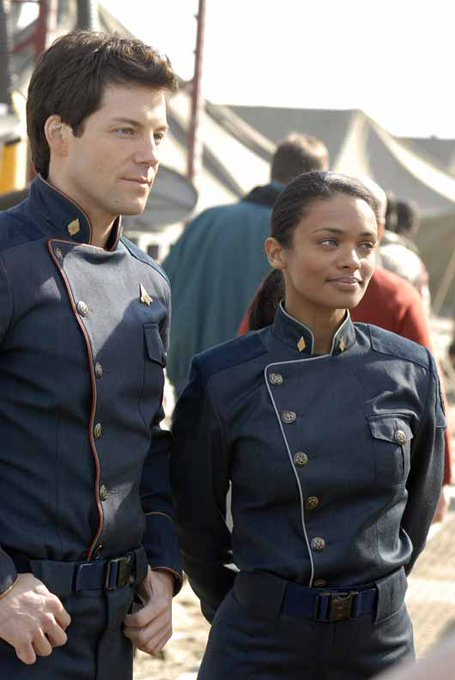
Another beloved sci-fi tv series but not the original but the reboot version. 


Enjoy!