Showing posts with label Advice. Show all posts

Saturday, September 19, 2026

Why is the Ogre there?


Joe's post on the Quantum Ogre raises an old question about sandbox play: when does moving an encounter around interfere with players' freedom to decide what their characters do?

I agree with a lot of what he says, especially that information matters. In my Living World Sandbox, I stress the importance of the Initial Context.

Where I disagree is that players' choices matter. It doesn't matter to me whether they made an informed choice or the choice resulted from blind chance. What matters is the consequences of that choice. 

Suppose there is a fork in the road. They know nothing about either path. They choose the left fork. Joe argues that if they know nothing about either path, then putting a prepared encounter, like an ogre, on either road doesn't cost them anything. 

For me, the question is different.

Why is the ogre there?

To answer that, I look at how I described the setting and the campaign's current circumstances. But another factor is particularly relevant in Joe's post. Whether anything was prepared at all; thus, both roads could represent a blank slate.

Part of my Bag of Stuff consists of prepared encounters that aren't tied to a particular region or location. So how is using something from my Bag of Stuff any different from what Joe is doing by placing the ogre encounter regardless of which fork is taken?

The difference is that Joe's procedure allows the ogre to be placed on whichever road the players choose because nothing distinguished the roads beforehand. What I do instead is look at what I know about each road, make a short list of what could be there, and roll to see if the result is an ogre on the list, since the chosen road runs through some hills. Then I will use that ogre encounter in my Bag of Stuff.

I do this to discipline myself so that I always follow through on the consequences of the players' choice instead of changing the circumstances because I have something prepared that would be convenient to use. To be clear, rather than treating the "blank slate" as permission to use something I prepared, I treat it as an uncertain part of my setting that I need to resolve during the session.

That said, I like and agree with quite a bit of Joe's post. 

There is a section where he had a goblin cave prepared. The goblins were causing trouble for some local halflings, but the players opted to deal with some orcs instead. As the campaign progressed, Joe adjudicated that the halflings took care of the goblins themselves.

Joethelawyer, Quantum Ogre

Another variation on this I’ve experienced as a GM is where the encounter is more than just a basic bullshit ogre on the road or goblin ambush. For example, I made up a large cave complex where a clan of goblins lived, and they were raiding the halfling lands around. The PC’s had a choice to go there, or to orc caves, or a couple more places. They went to the orc caves, kicked their asses. Through roleplaying later, the halfling village they saved said they’d take care of the goblins, thanks for the help. 

In my view, this represents World In Motion, an aspect of a Living World Sandbox. That is, as players make their choices and act accordingly, the other inhabitants aren't standing still but making decisions themselves. In this case, to finally deal with those pesky goblins once and for all.

As for the prep, it went back into his Bag of Stuff and was repurposed later with different inhabitants and circumstances, which is exactly what the Bag of Stuff is for.

The goblin caves went unused. It would be a bullshit move as a GM to have the PC’s encounter the goblin caves in the next encounter. But there’s nothing wrong with using it in the future. I reskinned it a bit, added a two-headed troll, and used it as an encounter with a different group. I could have used it with the same group once enough time had passed, and it was in a different place.

If you are interested in my ideas behind my Living World Sandbox. I have a blog post below summarizing what that type of sandbox campaign entails.

The Living World Sandbox.

And I collected all my posts on Sandbox Campaigns on this page.

Managing Sandbox Campaigns


Thursday, September 10, 2026

Development of the Majestic Fantasy RPG, Part 4

Sandbox Campaigns often fail when players feel they lack information and that their choices are little better than throwing darts at a board in the dark. In the decades I have been running Sandbox Campaigns, one key tool I use to combat this issue at the start of a campaign is working with the player to establish their character's initial context. This helps them make informed choices as their characters the moment the campaign begins. 


Creating Characters

Creating characters for the Majestic Fantasy RPG involves deciding on an initial context, rolling attributes, picking a character class, choosing a character background, allocating skill points, and finally choosing equipment and spells. The following outlines each of these in detail.

The Initial Context

The players’ choices as their characters propel sandbox campaigns. However, to make choices, the player has to understand the circumstances and the character’s context. Otherwise, the options are no better than making a random dice roll.

The Initial Context is particularly important at the start of the campaign, when there are no past events for the players to reference when making decisions as their characters. The Initial Context establishes the character's circumstances at the start of the campaign, enabling players to make informed choices from the outset.

The Initial Context doesn’t have to be elaborate. It only has to be sufficient. What is sufficient varies from player to player. I have had players come up with detailed histories and backstories, as well as those who found a single sentence sufficient. “Max likes to hang out at bars in Eastgate and likes to get involved in trouble.” This player decided to make a Human Thug in a campaign set in the City-State of Eastgate.

Most players find a paragraph or two of personal background sufficient, along with a handout of the region or city they will be starting out in.

Ideally, with the Initial Context, the players should know or have created:

  • Where is the character starting?
  • Who does the character know?
  • What are the character’s immediate goals?
  • What kind of trouble is the character in at the start?

The Pre-game

I encountered this in HârnWorld, released by Columbia Games in 1983. The basic idea is that you sit down one-on-one with each player before the first session to flesh out the character’s background. Mostly, this is some discussion intermixed with a bit of light roleplaying.

This technique effectively minimizes the write-up required for handouts. The discussion and roleplaying often work better and are more fun than reading a document, particularly for players or groups who want detailed backgrounds at the start of the campaign.

If this feels too formal or you don’t have the time, that’s OK. The key is that the Initial Context fits the group’s time and interest.

Definition Note

Initial Context: The circumstances, location, and relationships that define where the character is at the beginning of the campaign.


Previous Section: Part 3

Next Section: Part 5

RPGPub Forum Thread

Wednesday, September 2, 2026

Development of the Majestic Fantasy RPG, Part 3

I find it useful to include a brief note on the assumptions behind why I design things the way I do. In the case of the Manual of the Three Adventuring Arts, I help the reader with information so they can weigh the benefits of the different options I write about for character creation and adjudication.


Rule Assumptions

The following is a summary of the assumptions used by the rules of the Majestic Fantasy RPG. They are useful to know as you work your way through the various lists of available options, such as classes, backgrounds, skills, and spells.

Combat Actions

In combat, every character gets two actions during their six-second turn. Each character rolls a 1d6 initiative roll to determine the order in which they act. The character’s Dexterity bonus and other abilities may modify the initiative roll. Monsters may use half of their Hit Dice as an initiative modifier.

The basic principle is that characters can take a half move as a regular action and make an attack as an attack action. A character can only take one attack action per round, whether it is melee, missile, or spell casting.

If the character chooses not to use an attack action, they may take another regular action instead. For example, they may take two half moves in succession to move their full modified movement during a combat round. See the Combat chapter for further details.

Skills

When the odds of success are uncertain due to limited time, such as during a combat round, limited resources, or when the consequences of failure are significant, such as climbing a great height, make a skill roll. The basic chance of success is 15 or better on a 1d20 roll. Add a relevant attribute bonus to the skill bonus to modify the roll. 

Two other basic principles of the Majestic Fantasy RPG are that any character can attempt any skill and that if a character has sufficient time and resources, they will succeed. When failure is a remote possibility, the player still rolls 1d20, but it only fails on a natural 1.

Experience

In the Majestic Fantasy RPG, characters earn experience in one of two ways. The first is by defeating or overcoming opponents in combat or other forms of conflict. The second is by achieving the goals the players set out for themselves. Tougher opponents and more difficult goals award more experience.

Backgrounds

A character’s background consists of inherited traits and culture. Inherited traits determine physical and, in some cases, mental characteristics. A character’s culture reflects the social environment that shaped them and may modify their attributes or grant bonus skill points.

Roleplaying

Generally, campaigns in the Majestic Fantasy RPG begin with the referee describing the circumstances in which the players find themselves as their characters. The players then, as their characters, describe or roleplay their responses. The referee decides what rolls, if any, are required and adjudicates the results. Following that, the referee either roleplays the non-player characters or describes how the circumstances change.

Repeat this process throughout the session and the campaign.

The Living World Sandbox chapters of the Tome of the Mundane, Strange, and Arcane provide specific techniques and advice for managing this process.

Spellcasting

The Majestic Fantasy RPG centers the bulk of spellcasting on the traditional Vancian system of spell memorization. However, two major additions extend how magic works: Rituals and Focused Arts.

Rituals

In the Majestic Fantasy RPG, a spellcaster can cast spells as 10-minute rituals without memorizing them, but must first inscribe them in a ritual book or spell book. Rituals also incur costs in their components. Each type of spellcaster has its own rules regarding rituals. Ritual Casting represents an older, less developed form of magic.

Focused Art

Spells are more effective when cast by a cleric or magic-user with a focus in that art. The spell description provides the details at the end of each entry in the section labeled Focused Art.

These rules categorize spells into nine arts of magic. Nine of these arts are associated with one of the chromatic crystals used to seal the entrance to the Abyss. The tenth is the original ambient magic of the Majestic Fantasy Realms.

Viz

Viz is a magical substance that takes many forms, from a flask of pure spring water to a newly blooming flower or an iridescent rock. All these items share one trait in common: pure magic infuses them. Viz is typically harvested, refined, and measured in units for spellcasting. When casting spells or creating magic items, spellcasters can use units of Viz to assist the process. See the entry for Viz in the Treasure chapter for further details. 

Vim

Magic permeates everything throughout the Majestic Fantasy Realms, including the souls of sentient beings and various creatures. Intertwined with a sentient being's soul or spirit is a form of Viz known as Vim. For most, the amount of Vim is not enough to manifest any magical effects. Some creatures or individuals can create magical effects by having more than the usual amount of Vim as a result of birth or training.

Rob’s Note: Unlike Viz, Vim has no explicit mechanics unless specified by a class or ability.


Previous Section: Part 2

Next Section: Part 4

RPGPub Forum Thread

Tuesday, September 1, 2026

Development of the Majestic Fantasy RPG, Part 2

 The Manual of the Three Adventuring Arts

Foreword

Welcome to the Majestic Fantasy RPG. What is it, and what sets it apart? It is meant to do a few things. It supports my setting, the Majestic Fantasy Realms. It is built to run sandbox campaigns. And it is written to be useful for people running fantasy games regardless of edition, setting, or rule system.

The Majestic Fantasy Realms grew out of the fantasy campaigns I have been running for my friends for over four decades. I kept the same setting across successive campaigns, with different groups and even different systems. Over time, that produced a fair amount of original material. The Majestic Fantasy Realms is the setting portion of that work. The Majestic Fantasy RPG is the rules portion, adapted to classic Dungeons & Dragons.

What makes this a sandbox RPG? In a sandbox campaign, the players act as their characters and decide what matters. The direction of the campaign comes from the choices they make. The referee builds the setting and serves as a neutral arbiter. My book How to Make a Fantasy Sandbox explains how to build a setting. The Majestic Fantasy RPG focuses on how to describe that setting in game mechanics, how to adjudicate the players' choices, and how to keep the world in motion. What it does not do is tell you how the campaign ought to go or what choices the players ought to make.

I have always kept my campaigns grounded in the medieval fantasy of classic Dungeons & Dragons, no matter what system I was using at the time. Decades later, medieval fantasy and D&D tropes still sit at the heart of most fantasy roleplaying games.

Throughout the text you will see Rob's Notes. These are short comments explaining why I wrote certain sections the way I did. By laying out the thinking behind the rules, I hope the material remains useful even if you do not adopt the system as written.

Over the years, and after reading more about how Dungeons & Dragons developed, I came to believe that most campaigns are hybrids to some degree. By including Rob's Notes and structuring the Majestic Fantasy RPG as four books, I want this game to be useful even if you only use parts of it.

Thank you for reading. Let's step together through the door and see what kind of world you and your players will build.

Introduction

The Majestic Fantasy RPG consists of four books: The Manual of the Three Adventuring Arts, The Doomsday Codex, The Legendarium of the Fantastic, and The Tome of the Mundane, Strange, and Arcane. The book you hold, The Manual of the Three Adventuring Arts, is the player's handbook of the Majestic Fantasy RPG.

Here you will find the rules that govern the Martial, Mundane, and Magical Arts as they apply to creating characters and adjudicating their actions. This includes the classes they may pursue, the workings of arcane and divine magic, the equipment available to them, the resolution of combat, and advice for players exploring the Majestic Fantasy Realms or any setting your referee creates.

Everything here assumes a medieval fantasy setting. Its historical foundation rests between the fall of Rome and the Age of Reformation and Exploration, when firearms and long ocean voyages began to appear. Onto that foundation are added the familiar elements of Dungeons & Dragons: Vancian magic, dragons, and the strange creatures found across its various editions.

With modest work, these rules can also support campaigns set in earlier periods or later ones up to the first industrial revolution.


Previous Section: Part 1

Next Section: Part 3

RPGPub Forum Thread

Tuesday, July 14, 2026

The Living World Sandbox Campaign

So for a couple of years, I've been slowly putting together an explanation of how I run tabletop roleplaying campaigns, and I finally got a good intro and summary that tie everything together and give me a foundation for organizing the details of what I do.


The Living World Sandbox

A Sandbox Campaign is a way to run a tabletop roleplaying campaign in which the players, rather than the referee, determine the campaign's focus. The referee creates the world, its characters, locales, and geography. During play, the referee role-plays the creatures and non-player characters and adjudicates the players' attempts as their characters. The players are free to pursue whatever catches their interest or go wherever they believe will further their goals.

A Living World Sandbox extends the Sandbox Campaign by bringing the setting to life. The goal is to let the players feel as though they have stepped through a wardrobe into a living, breathing world while pursuing the adventures that interest them.

A Living World Sandbox is not a game system. It is a way to organize and run a campaign. The referee presents a setting whose inhabitants have their own motivations, resources, relationships, and plans. The players decide what their characters attempt, and the referee uses the rules and the setting's established circumstances to determine what happens next.

The referee does not prepare a predetermined story for the players to follow. Instead, the referee prepares the circumstances, places, and people that make up the setting. The campaign develops from the interaction between what the players attempt and how the setting's inhabitants respond.

Because of this, a Living World Sandbox can be run using many fantasy roleplaying systems, including the original 1974 rules, AD&D First Edition, GURPS, Fantasy Hero, Dungeons & Dragons Fifth Edition, or others.

Some systems are easier to use than others. Generally, the more a system focuses on describing what characters can do rather than defining a story path or narrative structure, the easier it is to use for a Living World Sandbox. In my experience, most traditional roleplaying games lend themselves readily to this style of campaign.

How the Campaign Unfolds

The referee describes the characters' current circumstances. The players respond by describing or roleplaying what they attempt as their characters. The referee decides what happens, using the rules when the outcome is uncertain, and then describes how the setting's circumstances change or role-plays how its inhabitants react.

This process repeats throughout the session and throughout the campaign

After the session, the referee considers what the players changed, who knows about it, and what the affected characters (or creatures) will do next. Those consequences become part of the circumstances presented during the next session.

The result is a continuing cycle of choices, consequences, and new circumstances propelling the campaign forward.

Elements of the Campaign

A Living World Sandbox has four important elements:

  • Locales where events and adventures can occur.
  • Characters with whom the players can interact.
  • Plans made by characters and factions.
  • Natural or supernatural events that occur independently of those plans.
These elements do not need to be detailed in advance of play. The referee only needs enough material to begin the campaign and respond to the players' initial choices.

These elements do not need to be detailed in advance of play. The referee only needs enough material to begin the campaign and respond to the players' initial choices.

Locales

The iconic adventure locale is the dungeon, a maze of rooms that may be empty or contain monsters, deadly traps, strange features, or glittering treasure. Dungeon mazes can be stacked upon one another to form multiple levels, with the danger of the monsters and the value of the treasure increasing as the characters venture deeper.

In the world outside of the dungeon, locales are just as varied. There are natural locales like creature lairs and hazardous terrain (deserts, icefields, and jungles). Some locales are built, like villages and towns, camps and castles. Some locales are old and no longer used, creating ruins that may be inhabited by monsters and their treasure.

At the beginning of a campaign, create or detail about half a dozen locales. These may be original creations or places taken from an existing setting.

About half should be places where the characters can seek adventure, such as dungeons, monster-haunted forests, abandoned mines, or ruined monasteries. The remainder should be inhabited locales that the party can use as bases or visit for aid and information. Examples include a large village, a castle belonging to a local lord, a roadside inn, a market town, or a druid circle hidden deep within the forest.

These locales establish the immediate geography of the campaign. They give the players places to explore, people to meet, and resources to use.

Characters

The characters encountered during the campaign are the key element that allows the players to make their mark upon the setting. Some may become allies. Others will remain neutral unless circumstances change. A few will oppose the player characters from the beginning.

Prepare about a dozen notable characters. As a starting point, three might be potential allies, six might be neutral, and three might be potential enemies. These are only the characters' initial attitudes. Do not be surprised when the players, through good or poor decisions and roleplaying, completely rearrange the list.

Examples include:
  • A village reeve.
  • A castle lord.
  • A master druid.
  • The chief of an Orc tribe.
  • A merchant who controls the local smuggling ring.
  • A priest of an evil god who commands a band of outlaws.
  • A disgruntled old farmer who knows everybody within a day's travel.
  • An ambitious yeoman seeking adventure.
  • A retired Magic-User who sells potions from a cottage at the end of the lane.
Create a few relationships among these characters, but keep their number low at first. The old farmer and the castle lord may have been rivals for the love of the same woman when they were young and remained enemies ever since. The young yeoman may yearn for adventure so he can gain the fighting skill needed to avenge his family against the Orc chief.

Just as the passages and chambers of a dungeon provide natural avenues of exploration, the relationships among the characters provide social paths for the players to follow. At the end of these paths may be allies, enemies, information, resources, and complications that lead to further adventures.

Plans

The inhabitants of the setting have lives of their own. They possess hopes, fears, ambitions, and plans for the future.

The players decide the plans of their own characters. The referee decides the plans of the non-player characters and factions. Together, these plans become forces that shape the campaign.

Detailing the plans of three to five important characters or factions adds enough complexity to fuel numerous adventures.

For example, an evil priest has taken up residence in the forest. His god has commanded him to exact vengeance upon the region. Two generations ago, followers of the goddess of justice purged the dark god's worshippers and drove them from the area. The priest has now attracted a collection of outlaws and desperate peasants and organized them into a gang of bandits.

Most of the wealth and supplies stolen by the bandits are given to the priest. He uses these resources to search the forest for the lost axe of Chernak, a legendary Orc chief who led his tribe into the forest long ago. The priest hopes to use the axe to gain the allegiance of the present-day Orcs. Together, the priest, the axe, and the Orcs will become his god's instrument of vengeance against the followers of the goddess of justice.

Some plans are modest. A farmer may want to purchase another field. A merchant may want to eliminate a rival. A young knight may want to earn enough renown to receive a fief.

Other plans may threaten an entire region.

Regardless of their scope, these plans represent what could happen, not what will happen. They are not plots that must be completed. The actions of the players may advance a plan, delay it, change it, or make it impossible.

When that happens, the referee considers the character's motivations, knowledge, resources, and current circumstances and decides what they will attempt next.

Events

Events are natural or supernatural occurrences that happen for reasons largely independent of the choices made by the setting's characters (PC or NPCs). Some events may be anticipated or prevented through timely action, but a character's plan does not normally cause them.

Natural events can include droughts, floods, fires, disease, severe storms, harsh winters, or earthquakes that devastate the countryside.

Supernatural events might include the opening of a passage into the realm of Faerie, a surge in the local flow of magic that makes spells dangerously effective, the awakening of a slumbering taigh, or a conjunction that allows the dead to walk abroad.

Events should occur because they follow from the setting's conditions, not simply because the referee wants to create excitement. Their number should be sufficient to make the campaign feel like a living world, but not so great that the players constantly feel beleaguered.

Too many natural disasters will cause the campaign to become focused on people struggling against nature. Too many supernatural disruptions will make extraordinary events feel ordinary.

Use events sparingly enough that they remain significant.

Running the Living World Sandbox

Once the groundwork has been laid, it is time to begin the campaign.

Three primary techniques help create the feeling that the players have stepped into the setting as their characters:
  • The Initial Context establishes where the characters are and what they know at the beginning of the campaign.
  • World in Motion manages how the setting changes as the campaign progresses.
  • The Bag of Stuff provides material when the players do something unexpected, and the referee has no time for detailed preparation.

The Initial Context

The players' choices as their characters propel the Living World Sandbox forward. To make meaningful choices, however, the players must understand their circumstances and their characters' place within them. Otherwise, their choices are little better than random dice rolls.
This is particularly important at the beginning of a campaign, when there are no previous sessions or events for the players to use as reference points.

The Initial Context establishes the characters' circumstances at the beginning of the campaign and provides players with enough information to make informed choices from the outset.

The Initial Context does not have to be elaborate. It only has to be sufficient.

What is sufficient varies from player to player. I have had players create detailed histories and backgrounds. Others found a single sentence sufficient.

"Max likes to hang out at bars in Eastgate and gets involved in trouble."

That player decided to create a Human Thug for a campaign set in the City-State of Eastgate.

Most players find a paragraph or two of personal background sufficient, along with a handout describing the region, town, or city where the campaign begins.

When the players are uncertain about the available options, prepare three to five rumors, pieces of lore, problems, or contacts for them to investigate. Anything their characters would certainly know should be included in a short handout or explained by the referee.

Keep the handout as brief as possible while still covering what the players need to know.

Ideally, the Initial Context should answer the following questions:
  • Where is the character starting?
  • Who does the character know?
  • What are the character's immediate goals?
  • What social complications exist for the character at the beginning?
The answers do not have to point toward a specific adventure. Their purpose is to give the player enough context to begin making decisions as the character.

The Pre-game

The basic idea of the pre-game is to sit down one-on-one with each player before the first session and flesh out the character's background. This usually consists of discussion mixed with a little light roleplaying.

The referee might ask how the character knows a local merchant, why the character left home, what obligation they owe to a temple, or why a local lord considers them troublesome.

This technique reduces the amount of written material needed for handouts. Discussion and roleplaying often work better and are more enjoyable than reading a document, particularly for players or groups who want detailed backgrounds at the beginning of the campaign.

If this feels too formal, or if the time is not available, that is fine. The important point is that the Initial Context is sufficient for the group's time and interest.

Setting the World in Motion

After each session, review the plans of the important characters and factions affected by what occurred.

Begin with what the players did as their characters. Then consider:
  • Who knows what happened?
  • What do they believe happened?
  • How does it affect their plans?
  • What resources do they have available?
  • What will they attempt next?
  • What signs of their response will the players be able to observe?
The distinction between what happened and what the inhabitants believe happened is important. Characters act upon what they know, what they have been told, and what they can reasonably discover. They do not automatically possess the referee's knowledge of events.

You do not have to manage the entire world at once, or even an entire region.

The players' choices usually affect their immediate social circle first. This includes the characters with whom they directly interacted, followed by those connected to them. Beyond that, your notes only need to be updated when you have the time or when events make those distant characters relevant.

For most purposes, characters more than two degrees removed from the player characters are beyond the campaign's social event horizon for a session or two.

As the player characters gain experience, wealth, allies, and authority, their actions will begin to affect a wider area. A fight in a tavern may concern only the owner, the local watch, and the participants. Killing a baron, destroying a temple, or founding a mercenary company may concern an entire realm.

After each session, review the relevant plans in light of what the players did or failed to do. Sometimes an NPC's existing plan will become impossible. When that happens, consider the character's personality and motivations and determine what they now want from the future.

This process helps the referee avoid forcing the players along a predetermined path. The non-player characters may pursue their own goals, but they need to respond to changing circumstances just as the player characters do.

When you suspect that your preferences are influencing the outcome too strongly, use a good set of random tables you like. Random results can help you create unexpected reactions, complications, decisions, or new plans that you would not have considered.

Balance random results with judgment.

Overreliance on judgment may cause the campaign to reflect the referee's biases. Too much reliance on random tables can make events feel disconnected from the personalities, motives, and circumstances already established.

The purpose of the random result is to address uncertainty, not to replace the setting's logic.

The Bag of Stuff

When acting as their characters, players do the unexpected all the time.

They may decide to visit a shrine you noted but did not detail. They may abandon the dungeon you prepared and explore the forest instead. They may take an interest in a nameless guard, travel down a road you never expected them to use, or attempt to speak with a monster you assumed they would fight.

When this happens, the referee must improvise.

The Bag of Stuff is a collection of locales, characters, plans, situations, and other material that can be pulled out and used to run part of the campaign without preparation.

The material does not need to be elaborate. It only needs to give you enough information to adapt the material, begin describing the situation, and roleplay with the players.

Once something from the Bag of Stuff enters play, take notes. It is now part of the setting. If the players return to it, you can develop it further between sessions.

Locales

Prepare or gather six to twelve generic locations that commonly appear in the campaign.

Examples include:
  • A shop.
  • A crossroads.
  • A forest clearing.
  • A section of swamp.
  • A peasant's hut.
  • A roadside shrine.
  • A ruined tower.
  • A small cave.
  • A merchant camp.
  • A manor house.
These locations do not need extensive descriptions. A sketch map, a short list of features, and a note about who may be present are usually sufficient.

When you use one, alter a few details to make it fit the circumstances. A generic forest clearing may contain an abandoned cart in one session and a weathered stone idol in another.

Take notes during play if the locale is likely to be revisited. Later, when you have time, develop it into something more distinctive.

Characters

A major section of these rules describes common non-player character types in the same general format used for monsters. These entries are useful when preparing an adventure or locale, and when you need to draw something from your Bag of Stuff.

When the players unexpectedly interact with someone, choose an appropriate NPC entry and change a few details.

Give the character a name, a mannerism, an immediate concern, and a reason for being present. That is usually enough to begin roleplaying the encounter.

If the character becomes important, make a note of what happened and develop them further after the session.

Plans

Prepare a short list of personality types, immediate concerns, and broad goals. Add to the list whenever you have a useful idea.

Examples include:
  • Wants recognition from a superior.
  • Needs money to pay a debt.
  • Is concealing a past crime.
  • Wants revenge against a rival.
  • Is afraid of losing social standing.
  • Wants to protect a family member.
  • Is searching for forbidden knowledge.
  • Wants to leave but lacks the courage.
  • Is loyal to an institution but distrusts its leader.

These ideas provide a starting point for players interacting with someone you did not expect to become important.

As with locales and characters, use only enough detail to serve as a memory aid. The character's fuller personality and plans can develop through play.

Afterword on the Living World Sandbox

What started me on the path of running campaigns as Living World Sandboxes was a willingness to let the players trash my setting.

In the early 1980s, I gained a reputation as the referee who allowed the players to kill the king, build wizard towers, and become magnates controlling the underworld of a city-state. The referee who let his players trash his setting.

Much of this came from my background in early wargaming. My friends and I would set up scenarios and battle them out to see what happened. When I was introduced to Dungeons & Dragons, that same fascination carried over into my campaigns.

I built the world, detailed the characters, let the players decide where to begin, and then ran the campaign to see what happened. I had no particular destination or conclusion in mind.

My creativity was engaged not by writing stories, but by considering what could happen and then accepting the constraints of roleplaying the non-player characters under the same circumstances and rules as the players.

The results were often unexpected, surprising, and memorable for the entire group.

Across the decade, that remained the heart of the Living World Sandbox. The referee creates the setting and brings its inhabitants to life. The players step into the setting as their characters and decide what interests them and what adventures to pursue.

And they will trash your setting as a result.

Thursday, October 9, 2025

What is the point of the OSR?


 Over on Reddit, Kaliburnus asks What the point of the OSR is? He concludes his post with some questions.

So, honest question, what is the point of OSR? Why do they reject modern systems? (I’m talking specifically about the total OSR people and not the ones who play both sides of the coin). What is so special about this movement and their games that is attracting so many people? Any specific system you could recommend for me to try?

My answers

Saturday, September 20, 2025

Game Balance: RPGs Aren’t Games. And That’s the Point


In my last post, I argued that “rulings, not rules” wasn’t a gap to be patched but a foundation for how tabletop roleplaying works. The early hobby assumed referees would make calls, and in doing so, developed a craft of rulings. That craft became the foundation for the rulesets that shaped the hobby in the mid and late ’70s.

In this post, I want to build on that idea by asking a deeper question: what are tabletop roleplaying games, really? Why do I approach them differently from most game design frameworks? And how is my approach just one path among many for running campaigns and writing systems?

Throughout the decades I've been playing and refereeing, I've read many of the seminal books and essays on game design. Crawford, Costikyan, and other academic works like Playing at the World and Rules of Play are all outstanding, and they offer detailed and useful analyses of games, including tabletop roleplaying.

Where I depart from those frameworks is in how I classify tabletop roleplaying. I don't view tabletop roleplaying as a game. It is a means for people to pretend to be characters having adventures in other places and times. The "game" elements tabletop roleplaying uses are not the end in themselves, but a crucial aid; they make the experience more engaging than Let's Pretend, and more accessible and entertaining for the average person to enjoy within the time they have for a hobby.

In Salen & Zimmerman's Rules of Play, the issue of game balance is discussed. In Chapter 20, in the opening paragraph of "The Level Playing Field of Conflict," they write:

Competition and cooperation, goals and struggle, victory and loss: how does it all add up? What are the general conditions of a game conflict? One core principle of conflict in games is that it is fair. Game conflict is impartial conflict: it is premised on the idea that all players have an equal chance at winning, that the game system is intrinsically equitable, that the game's contest takes place on a level playing field, which does not favor one side over the other. Anthropologist Roger Caillois points this out in speaking about competitive forms of play: "A whole group of games would seem to be competitive, that is to say, like a combat in which equality of chances is artificially created, in order that the adversaries should confront each other under ideal conditions, susceptible of giving precise and incontestable value to the winner's triumph."

This is excellent advice, and I agree that this is one of the central pillars of designing a good game.

However, I don't view what I do with tabletop roleplaying as designing games. Rather, I view what I do as designing something to be experienced, experienced by people pretending to be characters looking for adventures. Game design considerations are not ignored. For tabletop roleplaying to be enjoyable and feasible as a leisure activity, a good game needs to be part of the package. However, the game elements are subordinated to the larger goal of creating an experience. Anything that gets in the way of that goal is jettisoned.

Next, we need to consider the experience I focus on. There are many ways this can be handled, but every tabletop roleplaying designer has their own creative focus. My particular focus is on crafting products that enable referees to create campaigns that leave players feeling as though they have visited a setting as their characters, while having interesting adventures. 

For example, in a Middle-earth campaign, my goal is satisfied if the players feel they have visited Tolkien's world. However, my goal isn't to leave them feeling like they experienced a Tolkien novel. I'm not interested in recreating particular narrative structures. However, I am deeply interested in bringing worlds to life in a way that feels real to the players.

Given this focus, what does it mean for the tabletop roleplaying material I publish or share? It means that often what I design isn't "fair" to the players. It is not impartial conflict. The players will not always have an equal chance at winning, the system isn't equitable, and the playing field isn't level. Certain aspects of the setting,or sides within it,are favored over others.

Instead, my material is consistent with how the setting is described. It is consistent with its own internal logic, not with the idea of equity and fairness that the concept of game balance addresses.

Now, others, when designing their campaigns for players to experience, or when publishing and sharing material, may not handle things in the same way. I've encountered many who feel that game balance is crucial to the creation of a good tabletop roleplaying campaign and its supporting material. That works as a creative goal; however, it is just one entry among many in the arena of ideas that form our hobby and industry.

And I have no quarrel with designers who go that route and focus on making the game behind their rules or campaigns balanced. Where the rules are judged to be fair, impartial, and create a level playing field. As long as they are upfront about their creative goals and acknowledge that other approaches work just as well for different creative goals and have their own fans. While I have my criticisms of RPGs like D&D 4e, one thing I don't criticize is its quality as a game on its own merits. It is an outstanding example of an RPG that focuses on game balance, and I recommend it to any group that views balance as crucial to their enjoyment of tabletop roleplaying.

Rulings, not rules,” was about equipping referees with craft, not just tools. This follow-up is about why I use that craft: to build campaigns where the setting’s logic takes precedence over balance. Where some designers seek a level playing field, I seek the living world. That’s the design philosophy behind my work, and the experience I want players to step into.

Previous: Rulings, Not Rules: A Foundation, Not an Oversight

Saturday, July 26, 2025

Rulings, Not Rules: A Foundation, Not an Oversight

There's been a lot of discussion over the years about how Original Dungeons & Dragons handled (or didn't handle) the common situations you'd expect in a tabletop role-playing campaign. Things like jumping a chasm, climbing a wall, or fast-talking a city guard. The critique often boils down to: OD&D wasn't complete, it left too much out.

What people forget is that Gygax wasn't writing OD&D for newcomers to gaming. He was writing for the early '70s wargaming community, people already creating their own scenarios, modifying rules, and running campaigns. His audience wasn't looking for a complete, airtight system with exhaustive coverage. They wanted a framework they could expand on, the kind of framework that would let them run the campaigns they'd heard about, like Blackmoor or Greyhawk.

That mindset shaped the game. Gygax and Arneson distilled what worked in their campaigns into OD&D, trusting referees to fill in the rest. What they didn't anticipate was how quickly the hobby would grow beyond that core group, or how differently newer players would approach rules and systems.


"Rulings, Not Rules" Is a Design Philosophy
When people talk about "rulings, not rules," they sometimes frame it like it's a patch, something you do because the game didn't cover enough. I don't see it that way. I see it as a deliberate design choice.

A campaign that starts with just a dungeon and a village isn't "incomplete." It's a starting point. The assumption was that the referee and players would build outward together. The game wasn't meant to hand you a world fully realized and mechanized; it was meant to give you a structure for making your own.

OD&D Worked Because of the Gaps
By modern standards, OD&D has "gaps." But those gaps weren't always accidental. They existed because Gygax knew his readers already had the habits and mindset to fill them. Wargaming referees knew how to adjudicate oddball situations, because that's what they'd been doing for years on their sand tables.

What looks like an omission today was often just a silent assumption: "Of course the referee will handle that."

That's why OD&D led to so many variant campaigns. There was no ur-text, no canon, it was a culture of iteration. Try something, tweak it, keep what works. That was the DNA of the early hobby.

The Problem When the Hobby Grew
This is where things broke down. OD&D didn't teach the process of making rulings. Once the game spread beyond wargamers, that missing guidance became a real issue.

Take the example of jumping a chasm. A wargaming referee in 1974 might've looked up Olympic jump distances, considered the character's stats, the gear they were carrying, the terrain, and improvised a ruling from that. That was normal.

But for a brand-new player or referee in 1977? That same situation could turn into a frustrating dead end. There wasn't a shared framework for how to think through it, so rulings felt arbitrary, or worse, like pulling numbers out of thin air.

Coaching and Guidance
The early hobby would have been better served by teaching how to make rulings, not just listing rules. Coaching newcomers through the process of handling novel situations and coming up with rulings, both in general, and using the designer's own mechanics, would have gone a long way.

It's not difficult to do, and it doesn't undermine the open-ended style that made early D&D so creative. In my Basic Rules for the Majestic Fantasy RPG, I wrote a chapter, "When to Make a Ruling," to address this very issue using the mechanics of the Majestic Fantasy RPG. I plan to expand on this and more when I finish the full version.


Rulings Are Not a Stopgap, They're the Point
Hobbyists aren't wrong for wanting more structure. Games like GURPS, Fate, Burning Wheel, or Mythras provide extensive out-of-the-box support, and that's valuable.

But here's the truth: even those systems eventually run into edge cases, a weird situation, a new setting, or something the rules don't cover. When that happens, you need the same tool OD&D assumed from day one: the ability to make a ruling.

And that's why "rulings, not rules" isn't just a slogan or an excuse for missing content. It's the foundation of how tabletop roleplaying was intended to work.

What we need going forward is more coaching and less telling from designers. Hand a referee a Difficulty Class, and they have what they need for that one situation. Teach them how to craft rulings along with Difficulty Classes, and they’ll have a skill they can apply to every campaign they run from that day forward.

Because rules give you tools, but rulings give you craft, and that craft is what makes tabletop roleplaying campaigns truly come alive.

Saturday, June 7, 2025

The Old School Renaissance

 Debates about what the OSR is have been going on since at least the late 2000s. Lately I seen more rounds of discussion on this topic on various forums and on youtube like this panel discussion.

What sets the OSR apart, from the beginning, is that, unlike most corners of the hobby, it hasn’t been driven by a single author, company, or creative vision. While it grew from interest in out-of-print editions of D&D, its creative output quickly became rooted in open content under open licenses. That foundation created not a canon, but a commons.

And from that commons emerged a kaleidoscope of creative visions: rulesets, zines, hacks, adventures, philosophies, and play styles. The movement thrived not because it had a unified voice, but because it didn’t. It was, and remains, a productive chaos of competing, overlapping, and deeply personal creative visions.

Digital publishing supercharged this. The barriers to creating and distributing game content collapsed. Suddenly, anyone with the time and drive could turn their vision into a PDF, a print-on-demand book, a boxed set, or a full-blown system, no approvals required.

The OSR is shaped daily by those who publish, those who share, those who play, and those who promote. You can see just one slice of this activity on DriveThruRPG, with nearly 15,000 titles tagged OSR. Itch.io adds another 5,000+ projects under the same banner, each one a different take on what an “old school renaissance” can mean.

Many have tried to define the OSR. All of them fail, because definition implies boundaries, and the OSR has none that aren’t self-imposed. At its core, the OSR is an invitation. If you have the interest, the ideas, and the willingness to build, then it’s yours.

That’s the point. The OSR is what you make of it.


Wednesday, December 21, 2022

The proposed OGL 1.1 is not an open license. Fight for your hobby.

 Today Wizards of the Coast on DnD Beyond released an article called OGLs, SRDs, & One D&D. It talks about Wizards plans for a new version of the OGL. 

The recap the OGL stands for the Open Game License. According to Creative Commons, an open license means the content is free to use how you want it. In practice, this has meant that content was shared to let people use the content in any way, including commercially, the main requirements being that there is proper attribution of the original content used, and that any modifications are released under the same license. With the author listed as the creator of the modification.

The current two versions of the OGL v1.0 (3.X) and v1.0a meet the above criteria except for specific elements. 

  • You are allowed to designate part of the work as product identity which basically saying I am not releasing this part of my book as open content. This is often used for licensed IP like Lord of the Rings or Star Trek. It is sometimes used when the author doesn't want to share their setting but wants to use and modify a popular system.
  • You also explicitly agree to give up your right to cite compatibility to a trademarked product. This is something that you normally have the right to do when releasing a work when it is your content. I could have done this with Blackmarsh as I mostly used common monster names rather than anything specific out of the DnD editions.
The Changes

So what are the proposed changes?

First, we’re making sure that OGL 1.1 is clear about what it covers and what it doesn’t. 

What OGL 1.1 will cover are electronic files like PDF, and printed books this right off mean that OGL 1.1 is no longer an open license as it restricts how you can use the open content. As the definition of open content means you can use it in the manner you see fit.

The next change

Second, we’re updating the OGL to offer different terms to creators who choose to make free, share-alike content and creators who want to sell their products.  

They list a number of requirements that amount to you having to report any sales of any products licensed under the OGL 1.1 as well as a description of what it is you are selling.  And if you make over a threshold ($750,000) then you will be expected to pay royalties by 2024. 

Wrapping it up

This will further bifurcate the third party publisher market. OGL 1.0 and OGL 1.0a content can't be used with OGL 1.1 content as a result of Section 12 of the current OGL.

12. Inability to Comply: If it is impossible for You to comply with any of the terms of this License with respect to some or all of the Open Game Content due to statute, judicial order, or governmental regulation then You may not Use any Open Game Material so affected.

Right now the world of 3PP is divided into those who use open content like Pathfinder, Cepheus, OSRIC, Old School Essentials, and those who publish in community content programs like the DM's Guild.  In fact, I predict there will be three major 3PP communities for Dungeons and Dragons, the ones that continue to use the OGL 1.0a license, those who use the OGL 1.1 license, and those who use community content programs.

I realize there is a lot of speculation and criticism out there that are made because OneDnD is the news of the days. I limited myself to what the article said. At various times in the history of open source and creative commons, unscrupulous companies and individuals tried to put out their own licenses including ones with terms very much like the above. Each and every time this has not ended well for the bad actors and their licenses. Either they reverted back to a traditional commercial license and ceased their use of the open content. Or they came into compliance. 

If you value your freedom to produce and more commonly share the content you create for Dungeons and Dragons then let Wizards know that you find these proposed terms unacceptable. Let them know that the community has the tools right now to fix the issue on their own and will do so as shown by what happen with DnD 4e, the GSL, and Pathfinder.

This is your hobby and your game now. Don't let Hasbro try to take that away from you.

Fight On!


Update

I added some comments on Section 9 of the OGL which appears to be a point of attack by the Wizards' legal team to shut down the OGL.

Section 9 of the OGL

Concerning Bat in the Attic Games, Steady as She Goes and further thoughts on the OGL

For those who are new.

I have long been an advocate of open content released under the open license. Blackmarsh is free for any of use in any manner you see if. Likely the entire content of the Basic Rules for the Majestic Fantasy RPG is open content. 

Some past posts.

You are free now so go enjoy it.

An OGL Primer

A tale of two OGLs

Zweihander, Open Content, and a reply to Daniel Fox.

Ryan Dancy on the Open Game License

Finally some practical effects of making Blackmarsh open content. I would not have had the time or skills to do any of these projects but now folks who read Spanish, French, Italian and Hungarian can enjoy Blackmarsh in their languages as well as fans of Heroes and Other Worlds. 

And because these were solely the work of their respective author who put the work into making a version of Blackmarsh, they get to reap 100% of the financial rewards. Something I am fine with when I shared Blackmarsh as open content.

Blackmarsh in Spanish!

Périlleuses contrées: Fangenoire (Blackmarsh in French)

Italian version of Blackmarsh

Blackmarsh in Hungarian!

Blackmarsh for Heroes & Other Worlds

Thursday, September 8, 2022

1D&D: The 5E Skill System Is not broken, but it may not work out for you.


 On the Alexandrian, Justin Alexander writes a 2,500-word review that tears apart the DnD 5e skill system. This appears to have been prompted by the fact that the One DnD playtest added a rule that 1 is a failure on ALL d20 rolls and a 20 is a auto success (and grants a point of inspiration) on ALL d20 rolls. In the current rules natural 1's and 20's only matter on the to-hit roll. Although myself and others I know apply it to ability checks, saves, and skill checks. 

The review is quite detailed in goes into some of the math behind the DnD 5e skill system. 

And it misses the entire point of the skill system. 

First off for those interested, here is a link from back in the day explaining what bounded accuracy is about and includes a link to the original article from Wizards explaining it.

Are peoples' competencies really as flat in D&D 5e as its math suggests?

What it boils down to is what is the author's view of the fantasy genre? (since DnD 5e is meant to handle various fantasy settings). In DnD case the specific question, is what is a 1st level character is like? What is a 6th level character like? A 12th level character? And so on up to the maximum level the author wants to write about. In 5e's case that is 20th level.

It is not apparent from Justin's review what he views what characters should be doing in non-combat situations at various levels. He references low-level 3.X a lot but doesn't say why. I am left with the impression that he feels somehow the 5e target numbers should match those of low-level 3.5?

For me the 5e authors take is apparent. You start out so-so: 55% success for easy (DC 10), 30% for moderate (DC 15), and 5% for Hard (DC 20). With a +4 attribute bonus and a +2 proficiency, you can get those up to 85% success for easy, 60% for moderate, and 35% for hard. This is at 1st level. 

To me, this means the authors feel when it comes to non-combat tasks that 5e 1st level characters have some measure of competence. If your view of the capabilities of first-level characters is not the same then the above isn't going to work for your campaigns.

At 20th level for most characters, the odds shift. Now characters often have a +5 attribute bonus, and a +6 proficiency bonus.   You going to automatically succeed at DC 10 (Easy) task. 85% success for DC 15 (Moderate) tasks, and 60% success for DC 20 (Hard) tasks.

If these odds don't reflect what you think 20th-level characters are capable of then 5e isn't going to work out. 

Bards and Rogues along with two feats in the later books give expertise. Rogues also have Reliable Talent at 11th level. Expertise doubles the proficiency bonus for some skills. This shifts the odds of success in skill and ability checks considerably. 

At 1st level, we are talking about a +10% improvement with any skills that have expertise. At 20th level Rogue and Bards with expertise will automatically succeed on DC 10 (Easy), and DC 15 (Moderate) tasks, and have a 90% chance of success on DC 20 (Hard) tasks. 

With Rogues, when they get Reliable Talent at 11th level, the player can declare that they roll a 10 with a skill check. This means they will succeed with everything up to a Hard task? 

Justin fail to mention that there are two more task levels DC 25 (Very Hard), and DC 30 (Almost Impossible). A 20th-level Rogue with reliable talent will always succeed at DC 25 task (10 + 17 = 27).

Is this bad? Is this poor math on the designer's part? No, it fits with their view of what Rogues (and Bards) are capable of at 1st, 11th, and 20th level. This is why I put a reference to something that I and others have written back in 2014. To show why 5e authors wrote up the classes and mechanics the way they did.

As for the change in the One DnD playtest, it is more about making the system reflect how hobbyists like you and me actually play 5e rather than trying to fix a non-existent math issue.

If that is not how you view the capabilities of a Rogue or a Bard then 5e isn't going to work for you. 

And certainly not for Justin Alexander.


Friday, August 19, 2022

One D&D, Character Origins

 As part of their announcement yesterday, Wizards of the Coast released the first playtest document for One DnD, Character Origins.


One Dnd Playtest

The bulk of the document is about how they are going to handle Character Races and Backgrounds in the next version of DnD. Interestingly they include snippets of other sections of the rules to give some context for the other mechanics they mentioned in the section about Origins.

Rob's Notes: So folks understand where I am coming from I care far more that the mechanics reflect the nuances of a setting or genre than "game balance. I am a strong proponent that having a consistent view of the genre or setting is more important. As opposed to making Option A, B, and C have equal weight in the campaign. 

Character Origins

It looks like they want to bind Character Race and Background more tightly in One DnD. Emphasize roleplaying more by giving background equal weight to character weight. In core 5e, background is almost an afterthought. Later Adventures in Middle Earth ditched the idea that the two are separate and combined them into cultures. For example, a dwarf of the Lonely Mountain has some things in common with a Dwarf of the Blue Mountain and some things are different. Each has its own section in the AiME books.

Controversially they shifted some of the benefits around race and background. A character race still grants distinct special abilities but now the attribute bonuses are determined by the background the player chooses. For example, picking the Guard background will get you +2 strength and +1 wisdom in addition to a set of skill proficiencies, tool proficiencies, an additional language, and what they calling a 1st level Feat. 

I think this was a poor creative choice. In DnD fantasy it is well established that elves are more dexterous, dwarves are hardier, and so on. This change doesn't feel very DnDish to me. But my choice would have been to split the bonuses between race and background. Just like in AiME a dwarven guard would have of some the same bonuses as a Dwarven Pilgrim and some that were different.

My final analysis is that in comparison to 5e core, characters are going to get a tad bit more with Character Origins. Like AiME there is more emphasis on the roleplaying details. That the difference between the 5e Core and One DnD is small and incremental in this area of the rules.

Starting Languages

One DnD Character will know common, a language from their background, and a language from the list of Standard Langauge: Common, Common Sign Language, Dwarvish, Elvish, Giant, Gnomish, Goblin, Halfling, and Orc.

I find the addition of Sign Language interesting and plan to do some research into the historical use of sign language and incorporate that as an option for my Majestic Fantasy RPG. I also watched the movie Prey and the protagonists of the film, Comanches, also used a type of sign language.

Feat Description.

In my 5e campaigns, I didn't often use feats having a negative experience with the mechanic as a result of 3.X. But 5e's take on feat is far more laid back overall so sometimes when a player makes a good case that a particular feat fit his character background, I will allow the pick.

However when it came to AiME, they recast the feat mechanic as virtues. And it worked rather well and really enhances the feel of the system as a Middle Earth RPG.

This section includes feats like Alert, Crafter, Lucky, Magic Initiate, Musician, Savage Attacker, Skilled, Tavern Brawler and Tough. I find it to be a varied mix of combat and non-combat options that are somewhat laid back overall like the core 5e feats. Some like skilled may have to be tested in actual play to see if they are too generous or not. Skilled give three proficiencies in skills. 

Given the limited of 5e skills that could be overkill or maybe it is just right. I would judge this on the basis of "Does this make sense for the DnD fantasy genre that a character starting out to be proficient in this many skills?" compared to the overall skill list.

Feats also have a level requirement baked in as part of the standard description. Will have to see the full description of feats before making a call on whether this works out or not. 

Rules Glossary

The author explains some of the mechanics they referenced in the preceding sections.

Types of Magic

There are not three instead of two types of magic. Primal joins Arcane and Divine. Could be a good roleplaying flavor.

Tool Proficiency

They list Artisan's Tools, Gaming Set, Musical Instrument, and notes on Tool Proficiencies in general. Some observations.  

  • If you have proficiency in a relevant tool and skill you gain an advantage on the d20 roll
  • It appears One DnD is simplifying the price list and acquisition of equipment. 
  • Their attempt at terminology to avoid naming editions is to say "see 2014, Player's Handbook".

Creature Types

Like the 2014 rule books, there are creature types and certain ability may work differently for a specific type of creature.

D20 Test

One DnD will introduce D20 Test as a term to describe any use of the 1d20 high mechanics. Ability Checks,  Saving Throws, To-Hit Rolls, etc. It appears to be a way of consolidating the die rolling mechanics under a single header.

Observations

  • Rolling a 1 on anything a D20 Test is a failure
  • Rolling a 20 on anything grants inspiration.
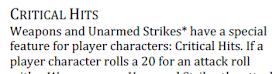
  • Critical Hits rolling a 20 on a weapon or unarmed attack will double the damage dice. 
There is currently a lot of controversy over whether the last this applies to monsters or not. Ever since I have been involved with later editions of DnD starting with 3.0 in 2000. There have been two broad camps regarding the system. One side believes that X can happen only if it is explicitly allowed. The other side believes that unless it is specifically not allowed  X can happen. I happened to be part of the latter camp. 

The text in question says

As you can have NPCs with class and level taking this literally will lead to logical inconsistencies as to how the genre and setting are depicted. 

Grappled Condition
I think it is written up better in One DnD than in the 2014 rules. Speed is zero, attacks on anybody but the grappler are at a disadvantage, you can be moved except the grappler is considered slowed, and the escape conditions are expanded and explained better.

Incapacitated Condition
The original 2014 rule is intact and the following has been added; concentration is automatically broken, can't speak, and if you have to roll initiative while incapacitated then you roll at a disadvantage. 

Mentioning concentration is probably wise, while it stated in concentration that you lose it if you are incapacitated it makes the rulebook more user-friendly to mention it in the condition as well.

The can't speak part is stating the obvious in my opinion. 

I can see a point in mentioning the last. Combat can ensue when the character is already incapacitated and the 2014 rules taken literally would mean that the character makes a normal init roll.

Inspiration
Many aspects of Inspiration are the same as the 2014 rules. Spending it grants advantage on what is now called a D20 Test. It still can be awarded as a result of good roleplaying. You can only have one. There are now additional opportunities to gain Inspiration like the crit roll.  However, now you lose any Inspiration when you take a long rest.

Inspiration was a controversial part of 5e from the start. My view of this take it is that more akin to luck mechanics or system that give you some type of ongoing benefit as a result of a critical.

I used Inspiration occasionally as part of my 5e campaign. I don't see any particular issue incorporating this as an additional crit result. 

Long Rest
The same with a new addition that if you are interrupted over an hour in, you get the benefits of a short rest.

Slowed Condition
One DnD adds a new condition Slowed. 
  • spend 1 extra foot of movement for every foot you move using your Speed.
  • Attackers have advantage on you
  • Disadvantage on Dex Saves
Tremorsense
A new sense has been added. Basically you can locate (but not see) anybody in a radius around you as long as they are in contact with the same surface as you are on.

Unarmed Strike
They combined the 2014 version of Unarmed strike, grappling, and Shove into a single ability with three choices for when you make a successful attack. Also to escape a Grapple is DC 8 + strength mod + proficiency bonus. Not the opposed skill check of the 2014 rules.

New Spell Lists
Take the cantrips and 1st level spells from the 2014 rules and divides them into the three categories of Arcane, Divine, and Primal.

Wrapping it Up
So far it looks like pretty much still 5e. If I had to guess I bet for most of you reading this it reads like somebody's list of house rules or even your own house rules. A bunch of tweaks and reformatted sections to suit the author's sensibilities. Still seems like 5e to me and more importantly doesn't alter how easy it is to hack or tweak 5e into the system you want to use. Plus some of it makes sense and would be useful like the Slowed Condition and the grappling changes. 

Next are some thoughts on DnD Digital.

Thursday, March 31, 2022

Multiple Fighter attacks revisited for Swords & Wizardry

Inspired by the classic edition rule where a fighter gets one attack per level when attacking 1 HD or lower foes (or in ADnD lower than 1 HD starting at 1-1 HD). I came up with the following rule for my Majestic Fantasy RPG.

Can use a melee weapon to attack a number of creatures with a total hit dice equal to the Fighter’s level. There is always a minimum of one attack allowed. If the creature has a modifier to their hit dice, round up to the nearest whole number. For example, a giant fire beetle has HD 1+3; treat this the same as a creature with HD 2.

In addition, Fighters are allowed to add their to-hit bonus (or the difference between hitting AC 0 at 1st level and their current chance of hitting AC 0) to the initiative die roll. 

The conjunction of the two has given fighting in my Majestic Fantasy campaign a much welcome boost in effectiveness without being overpowered in the way the ADnD multiple attacks and Unearthed Arcana options are.

One thing I did think of when I wrote the basic rules was writing about how I applied the multiple attack rule during play.

One thing learned from my career writing software for metal cutting machines is that folks find division harder. While I can do division pretty fast, I do subtraction even faster. So the way I apply the multiple attack rule is as follows.

  • The players pick a target and resolve their attack.
  • I subtract the target's hit dice from the character level and there is nothing left over. I see if it equals or exceeds the target's hit dice.
  • If it does then the character gets to resolve another attack on the target. 
  • If it does not then I look to see if anything is within melee reach or within the reach of a single five footstep. If there are I look at their hit dice. If equal to or less than the remaining total. I narrate the result by saying "You see an opening on targets to your left and right, which do you choose?" 
  • The player can elect to follow up with another attack or a step and attack. If they do they get to resolve that attack.
  • This is repeated until the players exhausted all the hit dice they can attack.
Since I need to know monster hit dice (or character level) anyway to resolve their attacks, it doesn't require me to come up with any more information than what is already there. Because it involves subtraction it is easy to keep track of the total.  Because the totals are small (for example 5 HD worth of attacks at the 5th level) it doesn't take many steps to resolve in most cases. 

The times where it is most decisive is when you have a leader type and a bunch of minions. This rule allows the fighter to attack the leader, but also takes out one or two of the adjacent minions.

Monsters
I haven't applied these rules to monsters despite the multiple attack rule on page 5 of Monsters and Treasures from the original rules. I feel that this was in part superseded by the grant of multiple attacks in the Greyhawk supplement to various monsters.

However after a recent playtest of my Deceits of the Russet Lord adventure, I may add this as an explicit ability to certain monsters. For example, a Sidhe Lord with 10 hit dice would be able to target 10 HD worth of creatures or characters. But I would stick with the traditional three attacks that an Owlbear would get.

The cutoff would be if the monster hit dice is in part a reflection of skill as opposed to instinct, I would add this to the monster. NPCs are already taken care of as in the Majestic Fantasy RPG they are leveled characters. 

Thursday, February 10, 2022

Your own custom RPG rulebook, mini binders

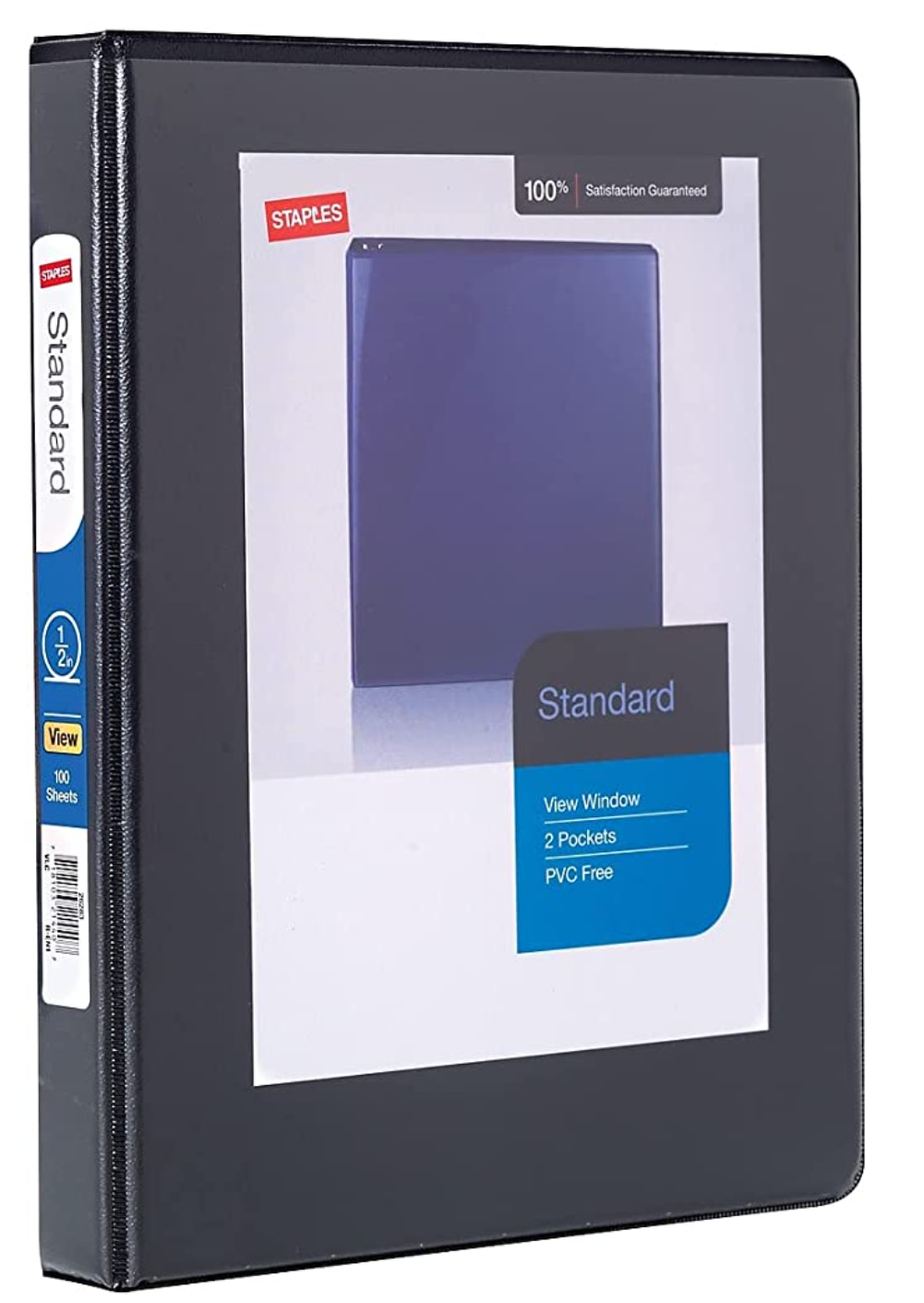
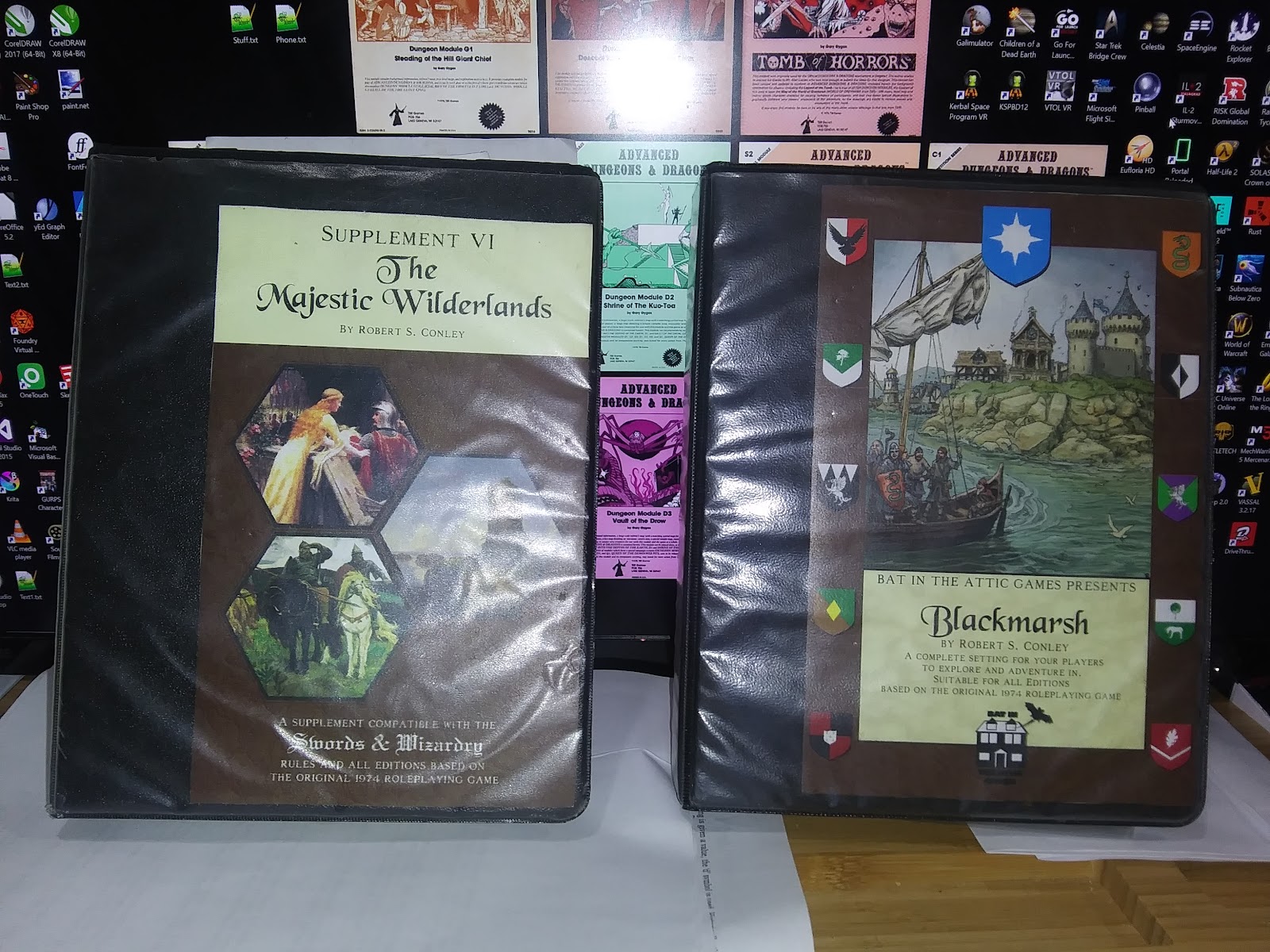
A couple of years back I found a mini binder at my local Staples. There was also various inserts including pouches and dividers you could buy as well. I realize this was the solution to a organizational problem I was having with running my campaigns. 

Often core rulebooks and supplements are too verbose to use as references during play. You have to read through a bunch of explanatory text before getting to the heart of the mechanics or details like the modifiers you need. 

So since the early 80s I been making cheat sheets for the RPG I used. Especially for GURPS. 


Binders were letter sized, often too big to be handy. So I shifted to loose sheets. But loose sheets get scattered.

So when I saw this


 I knew I could get the benefits of my old binders but in a convenient form almost as good as loose sheets and without the issue of things getting scattered. So I bought the above as well as some inserts. Then I started to make what I needed for my campaigns. The two that had the most work were for my Majestic Wilderlands using my Majestic Fantasy Rules (based on Swords and Wizardry) and for DnD 5th edition. Also included setting material from the Majestic Wilderlands and Blackmarsh.


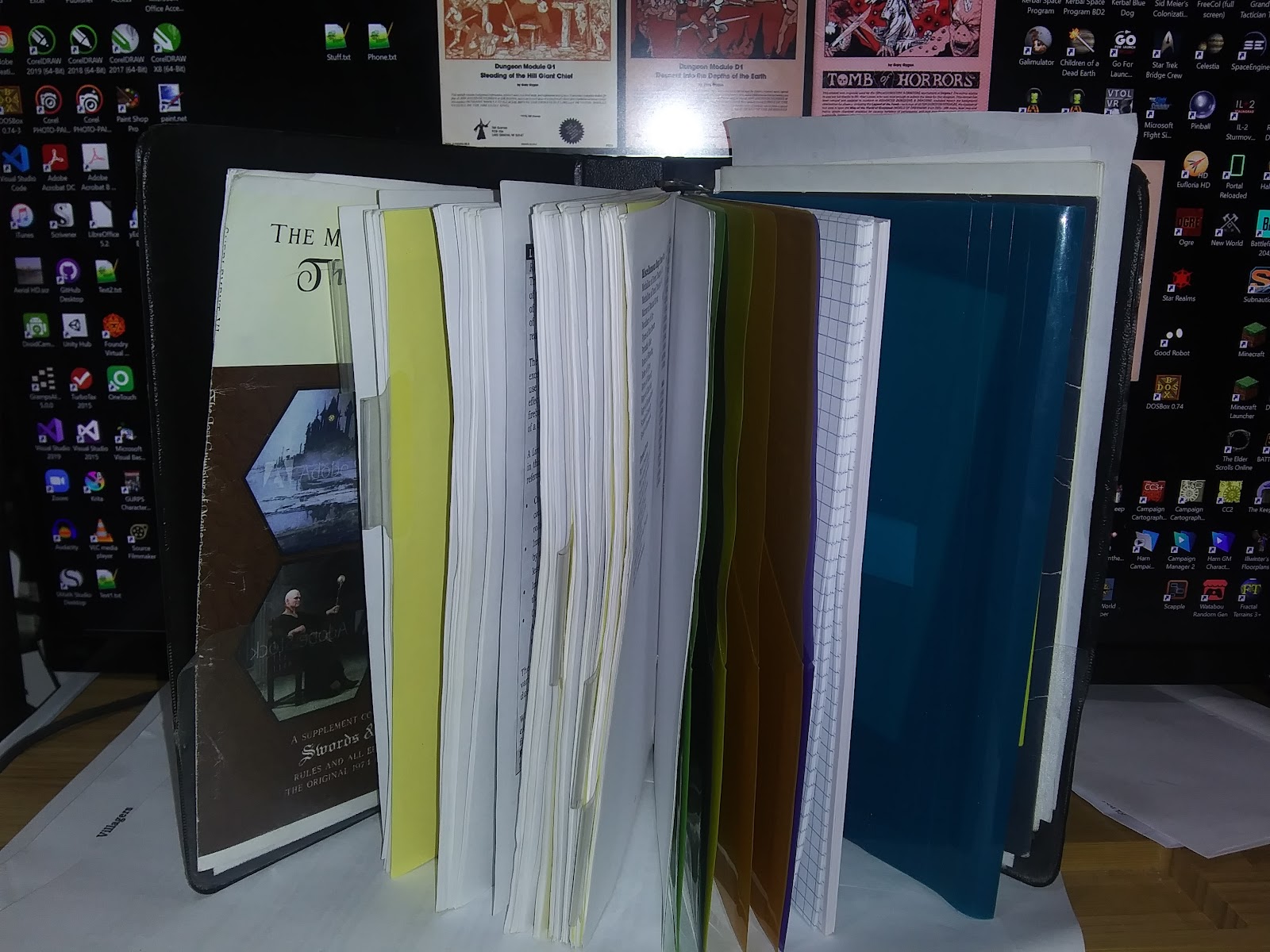
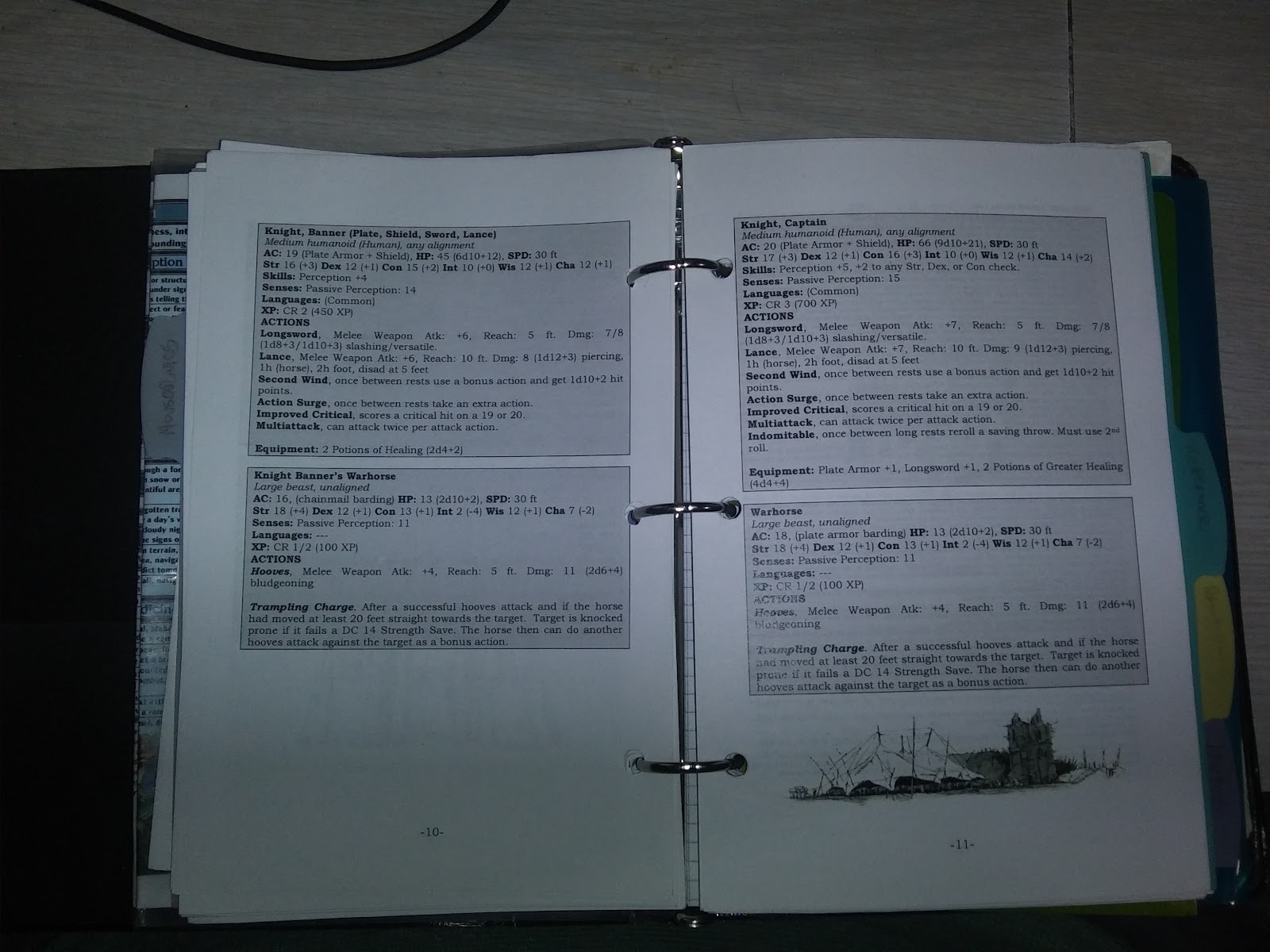
Is is one of the binderx open showing the different pages, dividers, and pages.


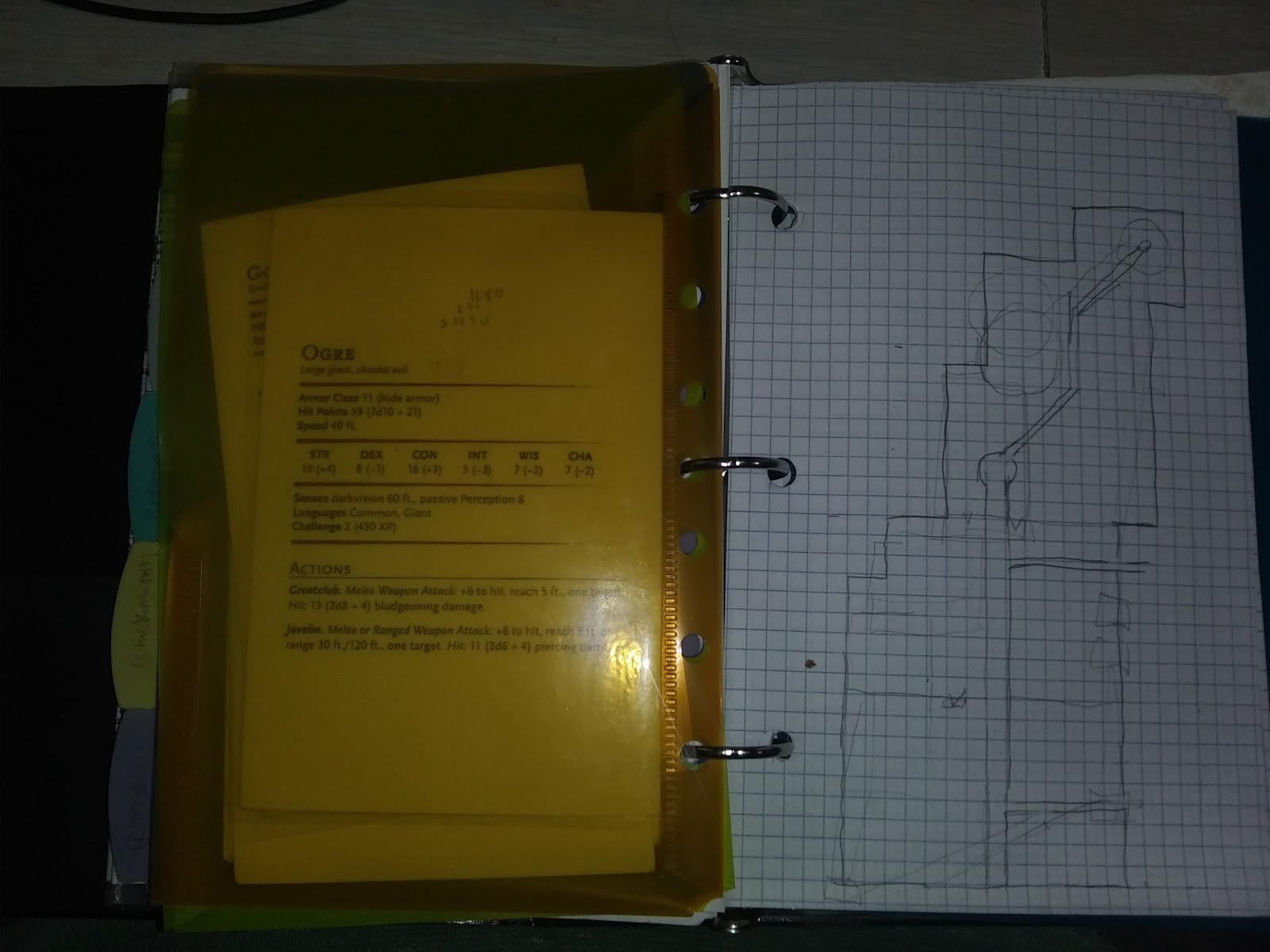
The binder cover has interior pockets. I printed stuff on digest sized pages and used dividers to organize them. This was followed by a couple of pocket inserts. Then after I added some punched digest sized graph paper and digest sized punched paper with ruled lines. Then finally a pouch with pens, pencils, and index cards.

Here is what I put into each.

The Majestic Wilderlands


  • Pouch with Pens, Pencil and Index Cards

Rob's Notes: I am planning to replace my Majestic Fantasy Basic Rules in the binder with a even more terse reference. Followed by a character class reference so I can quickly answer player questions.

Blackmarsh/DnD 5e

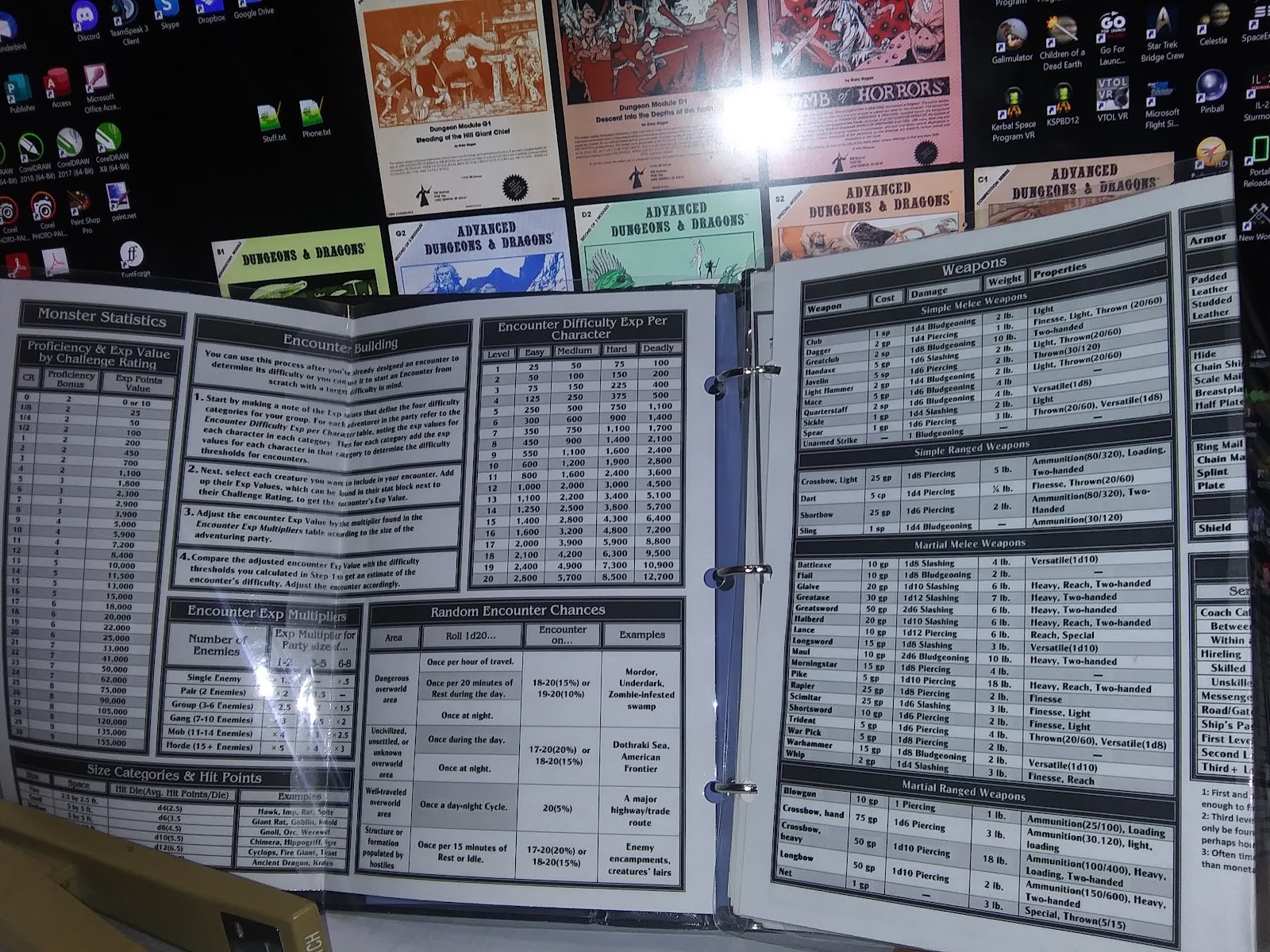
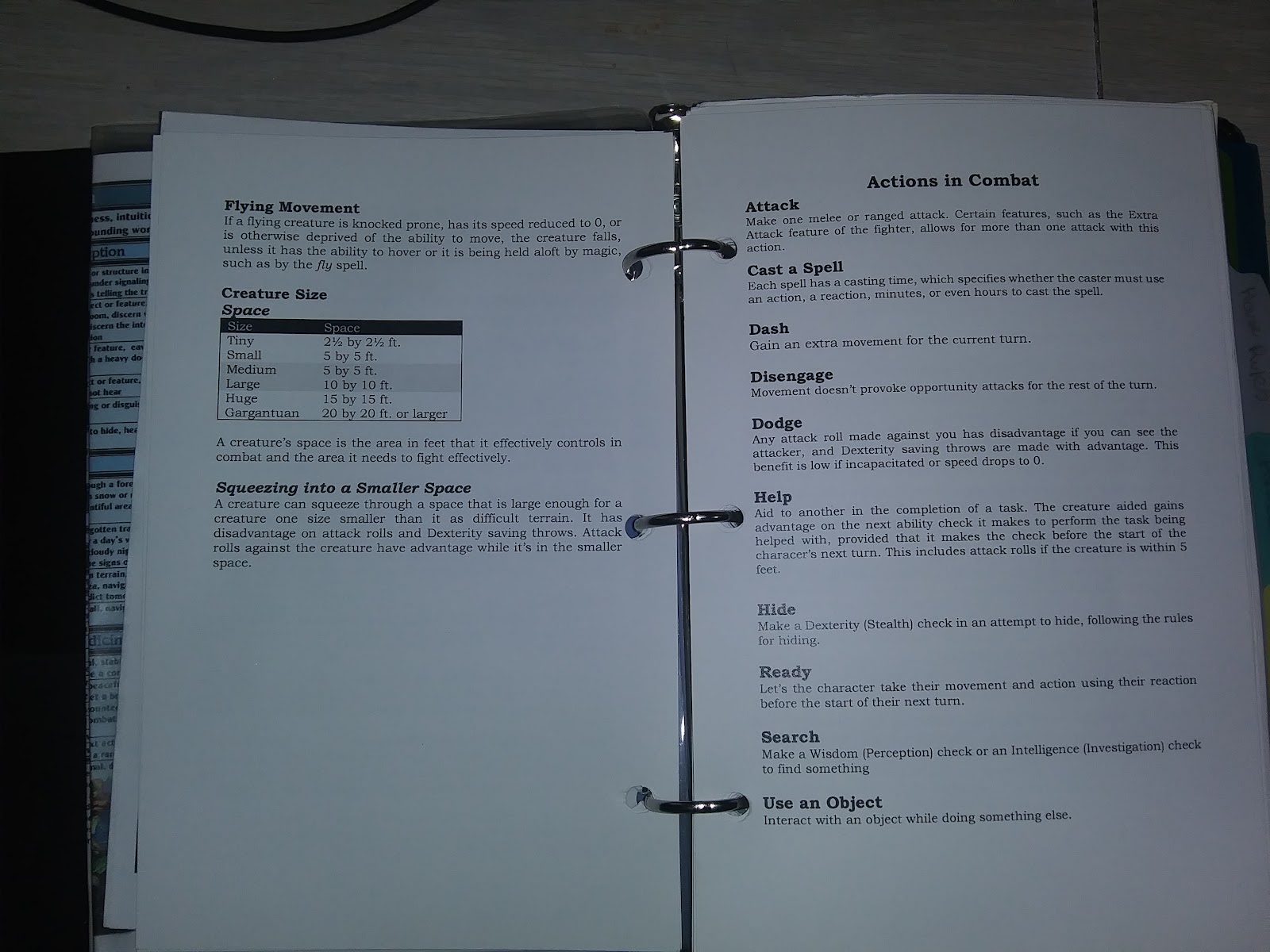
This binder is also used when I run my Majestic Wilderlands using the 5th edition rules.

  • My favorite letter sized 5e reference charts, shrunk a tad, laminated and turned into fold outs.
  • A blank 5e character sheet
  • A terse combat summary


  • A letter sized foldout map of Blackmarsh
  • Pocket inserts with 5e monster stats printed on index cards.
  • Graph Paper
  • A pouch insert with pens, pencils, and blank index cards.
  • I also have 5e reference booklets that I used before this in the inside pockets of the binder.
Handy Amazon Links