Showing posts with label managing sandbox campaigns. Show all posts

Tuesday, July 14, 2026

The Living World Sandbox Campaign

So for a couple of years, I've been slowly putting together an explanation of how I run tabletop roleplaying campaigns, and I finally got a good intro and summary that tie everything together and give me a foundation for organizing the details of what I do.


The Living World Sandbox

A Sandbox Campaign is a way to run a tabletop roleplaying campaign in which the players, rather than the referee, determine the campaign's focus. The referee creates the world, its characters, locales, and geography. During play, the referee role-plays the creatures and non-player characters and adjudicates the players' attempts as their characters. The players are free to pursue whatever catches their interest or go wherever they believe will further their goals.

A Living World Sandbox extends the Sandbox Campaign by bringing the setting to life. The goal is to let the players feel as though they have stepped through a wardrobe into a living, breathing world while pursuing the adventures that interest them.

A Living World Sandbox is not a game system. It is a way to organize and run a campaign. The referee presents a setting whose inhabitants have their own motivations, resources, relationships, and plans. The players decide what their characters attempt, and the referee uses the rules and the setting's established circumstances to determine what happens next.

The referee does not prepare a predetermined story for the players to follow. Instead, the referee prepares the circumstances, places, and people that make up the setting. The campaign develops from the interaction between what the players attempt and how the setting's inhabitants respond.

Because of this, a Living World Sandbox can be run using many fantasy roleplaying systems, including the original 1974 rules, AD&D First Edition, GURPS, Fantasy Hero, Dungeons & Dragons Fifth Edition, or others.

Some systems are easier to use than others. Generally, the more a system focuses on describing what characters can do rather than defining a story path or narrative structure, the easier it is to use for a Living World Sandbox. In my experience, most traditional roleplaying games lend themselves readily to this style of campaign.

How the Campaign Unfolds

The referee describes the characters' current circumstances. The players respond by describing or roleplaying what they attempt as their characters. The referee decides what happens, using the rules when the outcome is uncertain, and then describes how the setting's circumstances change or role-plays how its inhabitants react.

This process repeats throughout the session and throughout the campaign

After the session, the referee considers what the players changed, who knows about it, and what the affected characters (or creatures) will do next. Those consequences become part of the circumstances presented during the next session.

The result is a continuing cycle of choices, consequences, and new circumstances propelling the campaign forward.

Elements of the Campaign

A Living World Sandbox has four important elements:

  • Locales where events and adventures can occur.
  • Characters with whom the players can interact.
  • Plans made by characters and factions.
  • Natural or supernatural events that occur independently of those plans.
These elements do not need to be detailed in advance of play. The referee only needs enough material to begin the campaign and respond to the players' initial choices.

These elements do not need to be detailed in advance of play. The referee only needs enough material to begin the campaign and respond to the players' initial choices.

Locales

The iconic adventure locale is the dungeon, a maze of rooms that may be empty or contain monsters, deadly traps, strange features, or glittering treasure. Dungeon mazes can be stacked upon one another to form multiple levels, with the danger of the monsters and the value of the treasure increasing as the characters venture deeper.

In the world outside of the dungeon, locales are just as varied. There are natural locales like creature lairs and hazardous terrain (deserts, icefields, and jungles). Some locales are built, like villages and towns, camps and castles. Some locales are old and no longer used, creating ruins that may be inhabited by monsters and their treasure.

At the beginning of a campaign, create or detail about half a dozen locales. These may be original creations or places taken from an existing setting.

About half should be places where the characters can seek adventure, such as dungeons, monster-haunted forests, abandoned mines, or ruined monasteries. The remainder should be inhabited locales that the party can use as bases or visit for aid and information. Examples include a large village, a castle belonging to a local lord, a roadside inn, a market town, or a druid circle hidden deep within the forest.

These locales establish the immediate geography of the campaign. They give the players places to explore, people to meet, and resources to use.

Characters

The characters encountered during the campaign are the key element that allows the players to make their mark upon the setting. Some may become allies. Others will remain neutral unless circumstances change. A few will oppose the player characters from the beginning.

Prepare about a dozen notable characters. As a starting point, three might be potential allies, six might be neutral, and three might be potential enemies. These are only the characters' initial attitudes. Do not be surprised when the players, through good or poor decisions and roleplaying, completely rearrange the list.

Examples include:
  • A village reeve.
  • A castle lord.
  • A master druid.
  • The chief of an Orc tribe.
  • A merchant who controls the local smuggling ring.
  • A priest of an evil god who commands a band of outlaws.
  • A disgruntled old farmer who knows everybody within a day's travel.
  • An ambitious yeoman seeking adventure.
  • A retired Magic-User who sells potions from a cottage at the end of the lane.
Create a few relationships among these characters, but keep their number low at first. The old farmer and the castle lord may have been rivals for the love of the same woman when they were young and remained enemies ever since. The young yeoman may yearn for adventure so he can gain the fighting skill needed to avenge his family against the Orc chief.

Just as the passages and chambers of a dungeon provide natural avenues of exploration, the relationships among the characters provide social paths for the players to follow. At the end of these paths may be allies, enemies, information, resources, and complications that lead to further adventures.

Plans

The inhabitants of the setting have lives of their own. They possess hopes, fears, ambitions, and plans for the future.

The players decide the plans of their own characters. The referee decides the plans of the non-player characters and factions. Together, these plans become forces that shape the campaign.

Detailing the plans of three to five important characters or factions adds enough complexity to fuel numerous adventures.

For example, an evil priest has taken up residence in the forest. His god has commanded him to exact vengeance upon the region. Two generations ago, followers of the goddess of justice purged the dark god's worshippers and drove them from the area. The priest has now attracted a collection of outlaws and desperate peasants and organized them into a gang of bandits.

Most of the wealth and supplies stolen by the bandits are given to the priest. He uses these resources to search the forest for the lost axe of Chernak, a legendary Orc chief who led his tribe into the forest long ago. The priest hopes to use the axe to gain the allegiance of the present-day Orcs. Together, the priest, the axe, and the Orcs will become his god's instrument of vengeance against the followers of the goddess of justice.

Some plans are modest. A farmer may want to purchase another field. A merchant may want to eliminate a rival. A young knight may want to earn enough renown to receive a fief.

Other plans may threaten an entire region.

Regardless of their scope, these plans represent what could happen, not what will happen. They are not plots that must be completed. The actions of the players may advance a plan, delay it, change it, or make it impossible.

When that happens, the referee considers the character's motivations, knowledge, resources, and current circumstances and decides what they will attempt next.

Events

Events are natural or supernatural occurrences that happen for reasons largely independent of the choices made by the setting's characters (PC or NPCs). Some events may be anticipated or prevented through timely action, but a character's plan does not normally cause them.

Natural events can include droughts, floods, fires, disease, severe storms, harsh winters, or earthquakes that devastate the countryside.

Supernatural events might include the opening of a passage into the realm of Faerie, a surge in the local flow of magic that makes spells dangerously effective, the awakening of a slumbering taigh, or a conjunction that allows the dead to walk abroad.

Events should occur because they follow from the setting's conditions, not simply because the referee wants to create excitement. Their number should be sufficient to make the campaign feel like a living world, but not so great that the players constantly feel beleaguered.

Too many natural disasters will cause the campaign to become focused on people struggling against nature. Too many supernatural disruptions will make extraordinary events feel ordinary.

Use events sparingly enough that they remain significant.

Running the Living World Sandbox

Once the groundwork has been laid, it is time to begin the campaign.

Three primary techniques help create the feeling that the players have stepped into the setting as their characters:
  • The Initial Context establishes where the characters are and what they know at the beginning of the campaign.
  • World in Motion manages how the setting changes as the campaign progresses.
  • The Bag of Stuff provides material when the players do something unexpected, and the referee has no time for detailed preparation.

The Initial Context

The players' choices as their characters propel the Living World Sandbox forward. To make meaningful choices, however, the players must understand their circumstances and their characters' place within them. Otherwise, their choices are little better than random dice rolls.
This is particularly important at the beginning of a campaign, when there are no previous sessions or events for the players to use as reference points.

The Initial Context establishes the characters' circumstances at the beginning of the campaign and provides players with enough information to make informed choices from the outset.

The Initial Context does not have to be elaborate. It only has to be sufficient.

What is sufficient varies from player to player. I have had players create detailed histories and backgrounds. Others found a single sentence sufficient.

"Max likes to hang out at bars in Eastgate and gets involved in trouble."

That player decided to create a Human Thug for a campaign set in the City-State of Eastgate.

Most players find a paragraph or two of personal background sufficient, along with a handout describing the region, town, or city where the campaign begins.

When the players are uncertain about the available options, prepare three to five rumors, pieces of lore, problems, or contacts for them to investigate. Anything their characters would certainly know should be included in a short handout or explained by the referee.

Keep the handout as brief as possible while still covering what the players need to know.

Ideally, the Initial Context should answer the following questions:
  • Where is the character starting?
  • Who does the character know?
  • What are the character's immediate goals?
  • What social complications exist for the character at the beginning?
The answers do not have to point toward a specific adventure. Their purpose is to give the player enough context to begin making decisions as the character.

The Pre-game

The basic idea of the pre-game is to sit down one-on-one with each player before the first session and flesh out the character's background. This usually consists of discussion mixed with a little light roleplaying.

The referee might ask how the character knows a local merchant, why the character left home, what obligation they owe to a temple, or why a local lord considers them troublesome.

This technique reduces the amount of written material needed for handouts. Discussion and roleplaying often work better and are more enjoyable than reading a document, particularly for players or groups who want detailed backgrounds at the beginning of the campaign.

If this feels too formal, or if the time is not available, that is fine. The important point is that the Initial Context is sufficient for the group's time and interest.

Setting the World in Motion

After each session, review the plans of the important characters and factions affected by what occurred.

Begin with what the players did as their characters. Then consider:
  • Who knows what happened?
  • What do they believe happened?
  • How does it affect their plans?
  • What resources do they have available?
  • What will they attempt next?
  • What signs of their response will the players be able to observe?
The distinction between what happened and what the inhabitants believe happened is important. Characters act upon what they know, what they have been told, and what they can reasonably discover. They do not automatically possess the referee's knowledge of events.

You do not have to manage the entire world at once, or even an entire region.

The players' choices usually affect their immediate social circle first. This includes the characters with whom they directly interacted, followed by those connected to them. Beyond that, your notes only need to be updated when you have the time or when events make those distant characters relevant.

For most purposes, characters more than two degrees removed from the player characters are beyond the campaign's social event horizon for a session or two.

As the player characters gain experience, wealth, allies, and authority, their actions will begin to affect a wider area. A fight in a tavern may concern only the owner, the local watch, and the participants. Killing a baron, destroying a temple, or founding a mercenary company may concern an entire realm.

After each session, review the relevant plans in light of what the players did or failed to do. Sometimes an NPC's existing plan will become impossible. When that happens, consider the character's personality and motivations and determine what they now want from the future.

This process helps the referee avoid forcing the players along a predetermined path. The non-player characters may pursue their own goals, but they need to respond to changing circumstances just as the player characters do.

When you suspect that your preferences are influencing the outcome too strongly, use a good set of random tables you like. Random results can help you create unexpected reactions, complications, decisions, or new plans that you would not have considered.

Balance random results with judgment.

Overreliance on judgment may cause the campaign to reflect the referee's biases. Too much reliance on random tables can make events feel disconnected from the personalities, motives, and circumstances already established.

The purpose of the random result is to address uncertainty, not to replace the setting's logic.

The Bag of Stuff

When acting as their characters, players do the unexpected all the time.

They may decide to visit a shrine you noted but did not detail. They may abandon the dungeon you prepared and explore the forest instead. They may take an interest in a nameless guard, travel down a road you never expected them to use, or attempt to speak with a monster you assumed they would fight.

When this happens, the referee must improvise.

The Bag of Stuff is a collection of locales, characters, plans, situations, and other material that can be pulled out and used to run part of the campaign without preparation.

The material does not need to be elaborate. It only needs to give you enough information to adapt the material, begin describing the situation, and roleplay with the players.

Once something from the Bag of Stuff enters play, take notes. It is now part of the setting. If the players return to it, you can develop it further between sessions.

Locales

Prepare or gather six to twelve generic locations that commonly appear in the campaign.

Examples include:
  • A shop.
  • A crossroads.
  • A forest clearing.
  • A section of swamp.
  • A peasant's hut.
  • A roadside shrine.
  • A ruined tower.
  • A small cave.
  • A merchant camp.
  • A manor house.
These locations do not need extensive descriptions. A sketch map, a short list of features, and a note about who may be present are usually sufficient.

When you use one, alter a few details to make it fit the circumstances. A generic forest clearing may contain an abandoned cart in one session and a weathered stone idol in another.

Take notes during play if the locale is likely to be revisited. Later, when you have time, develop it into something more distinctive.

Characters

A major section of these rules describes common non-player character types in the same general format used for monsters. These entries are useful when preparing an adventure or locale, and when you need to draw something from your Bag of Stuff.

When the players unexpectedly interact with someone, choose an appropriate NPC entry and change a few details.

Give the character a name, a mannerism, an immediate concern, and a reason for being present. That is usually enough to begin roleplaying the encounter.

If the character becomes important, make a note of what happened and develop them further after the session.

Plans

Prepare a short list of personality types, immediate concerns, and broad goals. Add to the list whenever you have a useful idea.

Examples include:
  • Wants recognition from a superior.
  • Needs money to pay a debt.
  • Is concealing a past crime.
  • Wants revenge against a rival.
  • Is afraid of losing social standing.
  • Wants to protect a family member.
  • Is searching for forbidden knowledge.
  • Wants to leave but lacks the courage.
  • Is loyal to an institution but distrusts its leader.

These ideas provide a starting point for players interacting with someone you did not expect to become important.

As with locales and characters, use only enough detail to serve as a memory aid. The character's fuller personality and plans can develop through play.

Afterword on the Living World Sandbox

What started me on the path of running campaigns as Living World Sandboxes was a willingness to let the players trash my setting.

In the early 1980s, I gained a reputation as the referee who allowed the players to kill the king, build wizard towers, and become magnates controlling the underworld of a city-state. The referee who let his players trash his setting.

Much of this came from my background in early wargaming. My friends and I would set up scenarios and battle them out to see what happened. When I was introduced to Dungeons & Dragons, that same fascination carried over into my campaigns.

I built the world, detailed the characters, let the players decide where to begin, and then ran the campaign to see what happened. I had no particular destination or conclusion in mind.

My creativity was engaged not by writing stories, but by considering what could happen and then accepting the constraints of roleplaying the non-player characters under the same circumstances and rules as the players.

The results were often unexpected, surprising, and memorable for the entire group.

Across the decade, that remained the heart of the Living World Sandbox. The referee creates the setting and brings its inhabitants to life. The players step into the setting as their characters and decide what interests them and what adventures to pursue.

And they will trash your setting as a result.

Tuesday, January 27, 2026

Practice First: An Approach to Campaign and RPG Design

As I wrap up Into the Majestic Fantasy Realms, the Northern Marches, I am thinking ahead to my next major project, the full version of the Majestic Fantasy RPG.

While I still need to write the final manuscript, the rules themselves are written and have been playtested extensively. I started out with Swords & Wizardry by Matt Finch back in 2008 and adapted it to my Majestic Wilderlands setting. This involved adding a light skill system so players could have their characters be better at things other than combat and spellcasting, adding viz and other tweaks to the magic system to reflect how magic worked in my setting, tweaking the cleric class to reflect the diversity of religions, and so on.

The design process I used was iteration. Starting with Swords & Wizardry, informed by ongoing research into the origins of D&D, I added, tweaked, and modified the system until it took its current form. The final proof was always how it played at the table, measured against how I described the Majestic Wilderlands and what people actually did as their characters in past campaigns using other systems like GURPS or AD&D 1e.

However, the point of the campaign was never just to play these rules. How I used these rules mattered. I have discussed sandbox campaigns many times, along with my own specific variant, which I call a Living World Sandbox. My living world sandbox approach started out as me finding it fun to let my players trash my setting back in the late 70s and early 80s. Over time, it developed as I tried to make trashing the setting both fun and an interesting challenge.

In time, I realized that what I was doing to make this happen was bringing the setting to life in a way that left the players feeling as if they had opened a door, stepped into my world, and pursued some interesting adventures of their choice. The setting endured, reacted, and changed as a result of what they did.

Again, my design process here involved iterating across many different groups and using many different systems. I also applied my Living World Sandbox techniques to other settings in other genres, including Middle-earth, the Third Imperium, the four-color world of superheroes, and so on. In each case, I weighed what happened at the table against whether it left the players feeling as if they were in the campaign's setting and had the freedom to pursue the adventures that interested them.

While doing this, I experienced other RPGs like Fate and Blades in the Dark that played very differently from my own campaigns and those of my friends. As I learned more about RPG history and encountered various ideas and theories about RPG design, I noticed that all RPGs shared certain practices, regardless of how they were implemented or the rules they used.

  • At some point, the campaign's circumstances were described, including the characters involved.
  • The characters' actions were described.
  • Those actions were adjudicated.
  • The outcomes of those actions were determined, and the campaign's setting was altered as a result.
  • The session and the campaign involved repeating the above over and over again, in various orders and at various levels of detail.

What makes individual RPGs distinct from one another is how these shared practices are implemented, including the order in which they occur, not just what the rules say. The rules are only part of the equation. To understand how a campaign or system actually operates, you have to look at how the rules are used, how they are practiced, and what the group does at the table. This includes the order in which situations are described, actions are declared, and outcomes are resolved, as well as how adjudication is handled and who is responsible for making those decisions.

As I discuss RPGs, campaigns, and design going forward. I will start with practice and work outward from there.

Wrapping up this post, I want to give a shout-out to my friend Greg, known as the Chubby Funster, who also made a good video on this topic. In the video, he tackles the same issue from the angle of individual referees' "spheres of practice".


Saturday, September 20, 2025

Game Balance: RPGs Aren’t Games. And That’s the Point


In my last post, I argued that “rulings, not rules” wasn’t a gap to be patched but a foundation for how tabletop roleplaying works. The early hobby assumed referees would make calls, and in doing so, developed a craft of rulings. That craft became the foundation for the rulesets that shaped the hobby in the mid and late ’70s.

In this post, I want to build on that idea by asking a deeper question: what are tabletop roleplaying games, really? Why do I approach them differently from most game design frameworks? And how is my approach just one path among many for running campaigns and writing systems?

Throughout the decades I've been playing and refereeing, I've read many of the seminal books and essays on game design. Crawford, Costikyan, and other academic works like Playing at the World and Rules of Play are all outstanding, and they offer detailed and useful analyses of games, including tabletop roleplaying.

Where I depart from those frameworks is in how I classify tabletop roleplaying. I don't view tabletop roleplaying as a game. It is a means for people to pretend to be characters having adventures in other places and times. The "game" elements tabletop roleplaying uses are not the end in themselves, but a crucial aid; they make the experience more engaging than Let's Pretend, and more accessible and entertaining for the average person to enjoy within the time they have for a hobby.

In Salen & Zimmerman's Rules of Play, the issue of game balance is discussed. In Chapter 20, in the opening paragraph of "The Level Playing Field of Conflict," they write:

Competition and cooperation, goals and struggle, victory and loss: how does it all add up? What are the general conditions of a game conflict? One core principle of conflict in games is that it is fair. Game conflict is impartial conflict: it is premised on the idea that all players have an equal chance at winning, that the game system is intrinsically equitable, that the game's contest takes place on a level playing field, which does not favor one side over the other. Anthropologist Roger Caillois points this out in speaking about competitive forms of play: "A whole group of games would seem to be competitive, that is to say, like a combat in which equality of chances is artificially created, in order that the adversaries should confront each other under ideal conditions, susceptible of giving precise and incontestable value to the winner's triumph."

This is excellent advice, and I agree that this is one of the central pillars of designing a good game.

However, I don't view what I do with tabletop roleplaying as designing games. Rather, I view what I do as designing something to be experienced, experienced by people pretending to be characters looking for adventures. Game design considerations are not ignored. For tabletop roleplaying to be enjoyable and feasible as a leisure activity, a good game needs to be part of the package. However, the game elements are subordinated to the larger goal of creating an experience. Anything that gets in the way of that goal is jettisoned.

Next, we need to consider the experience I focus on. There are many ways this can be handled, but every tabletop roleplaying designer has their own creative focus. My particular focus is on crafting products that enable referees to create campaigns that leave players feeling as though they have visited a setting as their characters, while having interesting adventures. 

For example, in a Middle-earth campaign, my goal is satisfied if the players feel they have visited Tolkien's world. However, my goal isn't to leave them feeling like they experienced a Tolkien novel. I'm not interested in recreating particular narrative structures. However, I am deeply interested in bringing worlds to life in a way that feels real to the players.

Given this focus, what does it mean for the tabletop roleplaying material I publish or share? It means that often what I design isn't "fair" to the players. It is not impartial conflict. The players will not always have an equal chance at winning, the system isn't equitable, and the playing field isn't level. Certain aspects of the setting,or sides within it,are favored over others.

Instead, my material is consistent with how the setting is described. It is consistent with its own internal logic, not with the idea of equity and fairness that the concept of game balance addresses.

Now, others, when designing their campaigns for players to experience, or when publishing and sharing material, may not handle things in the same way. I've encountered many who feel that game balance is crucial to the creation of a good tabletop roleplaying campaign and its supporting material. That works as a creative goal; however, it is just one entry among many in the arena of ideas that form our hobby and industry.

And I have no quarrel with designers who go that route and focus on making the game behind their rules or campaigns balanced. Where the rules are judged to be fair, impartial, and create a level playing field. As long as they are upfront about their creative goals and acknowledge that other approaches work just as well for different creative goals and have their own fans. While I have my criticisms of RPGs like D&D 4e, one thing I don't criticize is its quality as a game on its own merits. It is an outstanding example of an RPG that focuses on game balance, and I recommend it to any group that views balance as crucial to their enjoyment of tabletop roleplaying.

Rulings, not rules,” was about equipping referees with craft, not just tools. This follow-up is about why I use that craft: to build campaigns where the setting’s logic takes precedence over balance. Where some designers seek a level playing field, I seek the living world. That’s the design philosophy behind my work, and the experience I want players to step into.

Previous: Rulings, Not Rules: A Foundation, Not an Oversight

Saturday, July 26, 2025

Rulings, Not Rules: A Foundation, Not an Oversight

There's been a lot of discussion over the years about how Original Dungeons & Dragons handled (or didn't handle) the common situations you'd expect in a tabletop role-playing campaign. Things like jumping a chasm, climbing a wall, or fast-talking a city guard. The critique often boils down to: OD&D wasn't complete, it left too much out.

What people forget is that Gygax wasn't writing OD&D for newcomers to gaming. He was writing for the early '70s wargaming community, people already creating their own scenarios, modifying rules, and running campaigns. His audience wasn't looking for a complete, airtight system with exhaustive coverage. They wanted a framework they could expand on, the kind of framework that would let them run the campaigns they'd heard about, like Blackmoor or Greyhawk.

That mindset shaped the game. Gygax and Arneson distilled what worked in their campaigns into OD&D, trusting referees to fill in the rest. What they didn't anticipate was how quickly the hobby would grow beyond that core group, or how differently newer players would approach rules and systems.


"Rulings, Not Rules" Is a Design Philosophy
When people talk about "rulings, not rules," they sometimes frame it like it's a patch, something you do because the game didn't cover enough. I don't see it that way. I see it as a deliberate design choice.

A campaign that starts with just a dungeon and a village isn't "incomplete." It's a starting point. The assumption was that the referee and players would build outward together. The game wasn't meant to hand you a world fully realized and mechanized; it was meant to give you a structure for making your own.

OD&D Worked Because of the Gaps
By modern standards, OD&D has "gaps." But those gaps weren't always accidental. They existed because Gygax knew his readers already had the habits and mindset to fill them. Wargaming referees knew how to adjudicate oddball situations, because that's what they'd been doing for years on their sand tables.

What looks like an omission today was often just a silent assumption: "Of course the referee will handle that."

That's why OD&D led to so many variant campaigns. There was no ur-text, no canon, it was a culture of iteration. Try something, tweak it, keep what works. That was the DNA of the early hobby.

The Problem When the Hobby Grew
This is where things broke down. OD&D didn't teach the process of making rulings. Once the game spread beyond wargamers, that missing guidance became a real issue.

Take the example of jumping a chasm. A wargaming referee in 1974 might've looked up Olympic jump distances, considered the character's stats, the gear they were carrying, the terrain, and improvised a ruling from that. That was normal.

But for a brand-new player or referee in 1977? That same situation could turn into a frustrating dead end. There wasn't a shared framework for how to think through it, so rulings felt arbitrary, or worse, like pulling numbers out of thin air.

Coaching and Guidance
The early hobby would have been better served by teaching how to make rulings, not just listing rules. Coaching newcomers through the process of handling novel situations and coming up with rulings, both in general, and using the designer's own mechanics, would have gone a long way.

It's not difficult to do, and it doesn't undermine the open-ended style that made early D&D so creative. In my Basic Rules for the Majestic Fantasy RPG, I wrote a chapter, "When to Make a Ruling," to address this very issue using the mechanics of the Majestic Fantasy RPG. I plan to expand on this and more when I finish the full version.


Rulings Are Not a Stopgap, They're the Point
Hobbyists aren't wrong for wanting more structure. Games like GURPS, Fate, Burning Wheel, or Mythras provide extensive out-of-the-box support, and that's valuable.

But here's the truth: even those systems eventually run into edge cases, a weird situation, a new setting, or something the rules don't cover. When that happens, you need the same tool OD&D assumed from day one: the ability to make a ruling.

And that's why "rulings, not rules" isn't just a slogan or an excuse for missing content. It's the foundation of how tabletop roleplaying was intended to work.

What we need going forward is more coaching and less telling from designers. Hand a referee a Difficulty Class, and they have what they need for that one situation. Teach them how to craft rulings along with Difficulty Classes, and they’ll have a skill they can apply to every campaign they run from that day forward.

Because rules give you tools, but rulings give you craft, and that craft is what makes tabletop roleplaying campaigns truly come alive.

Monday, October 30, 2023

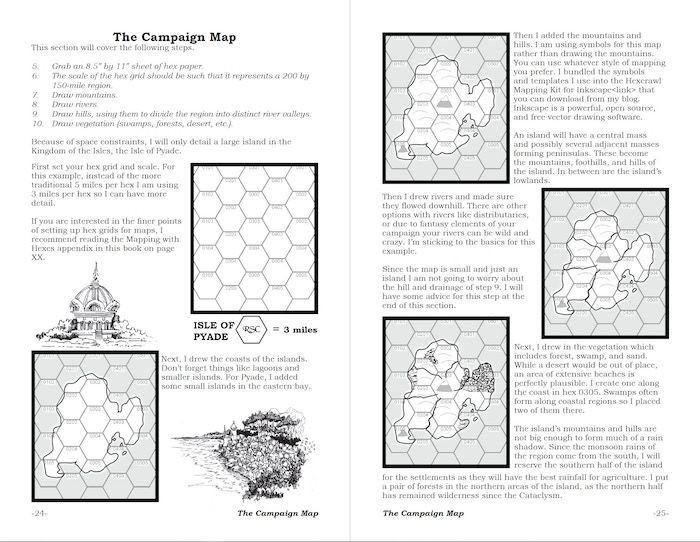
First beta layout posted for How to Make a Fantasy Sandbox backers.

How to Make a Fantasy Sandbox Beta Layout

I am pleased to share the first beta layout of How to Make the Fantasy Sandbox Kickstarter for my backers.

Some of the art are placeholder pieces. I have been buying stock art over the years but there are gaps, particularly in pieces that depict various characters. Thanks to your generosity I can not only cover those gaps but also expand the amount of custom pieces I can order. 

I want to give a shout-out to Fat Goblin Games, and The Forge Studios where I bought much of my art from.  They both have Patreons and I recommend them if you are looking for art for your project. 

The various maps and other example illustrations are created by myself and represent the final version. There may be further tweaks because the original we designed to be part of a blog post. 

The PDF is bookmarked but I haven't linked all the URLs yet.

Further Steps

Up on deck is the beta layout for the Isle of Pyade. 

The print proofs for the new digest version of Blackmarsh have been shipped.  Like with my Majestic Fantasy RPG Kickstarter, I will be releasing the print codes immediately after I check over the proof.  Each backer will get a code for the hardback version and the softcover version.

Interviews and Livestreams

I have had a couple of interviews and livestreams talking about How to Make a Fantasy Sandbox.

Random Party Generator

The regular livestream that I am part of.


Games with Dave

A live stream where Dave and I talk about the Kickstarter and fantasy hexcrawls.


Fumble Table

Damien and I discussed Fantasy Sandboxes and my background in fantasy roleplaying.


Also, check out his review of Blackmarsh


Wrapping it Up

Again I appreciate everybody's support and feel free to ask questions and leave comments on the draft and the project. 

How to Make a Fantasy Sandbox Kickstarter

Thursday, February 10, 2022

Your own custom RPG rulebook, mini binders

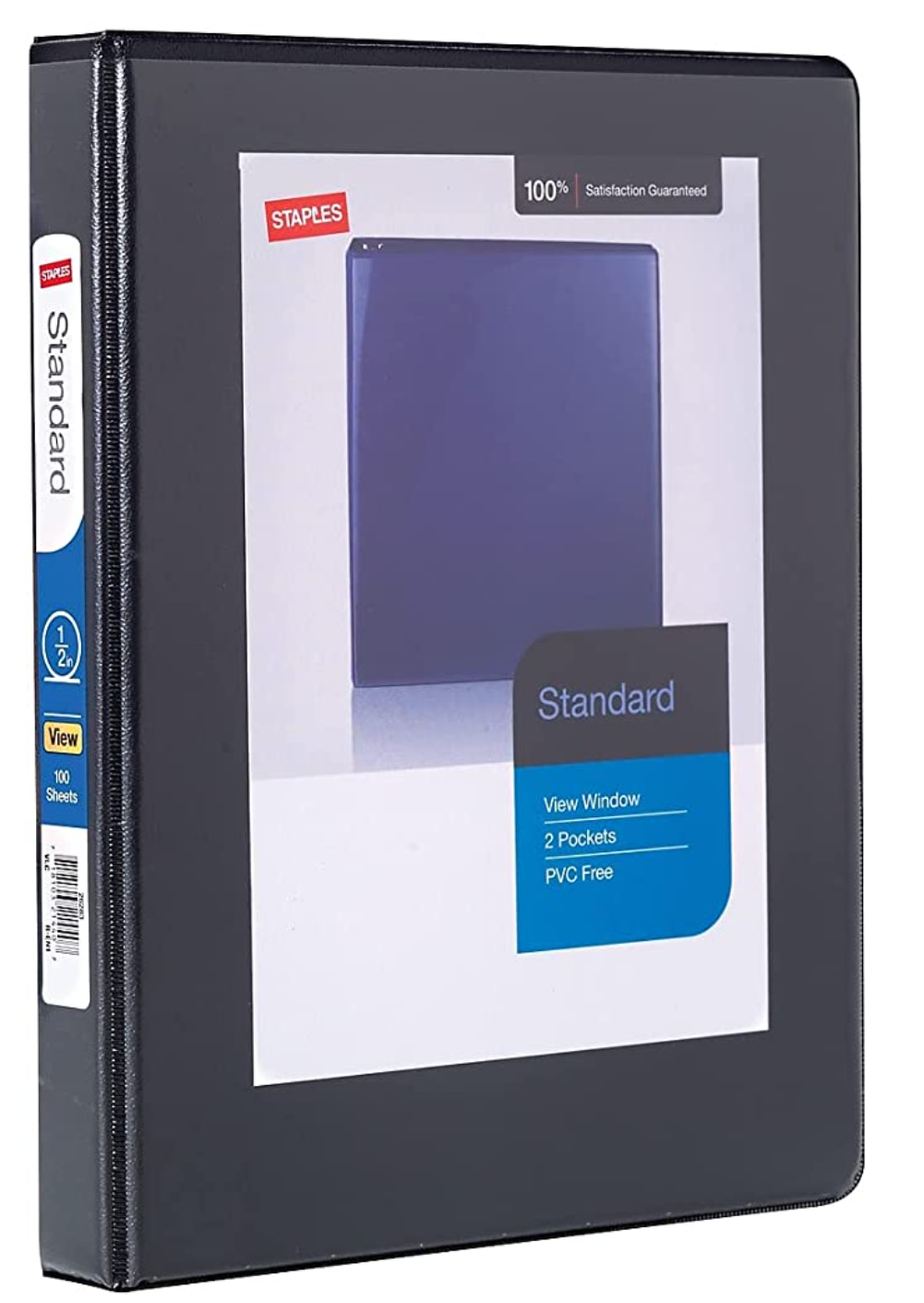
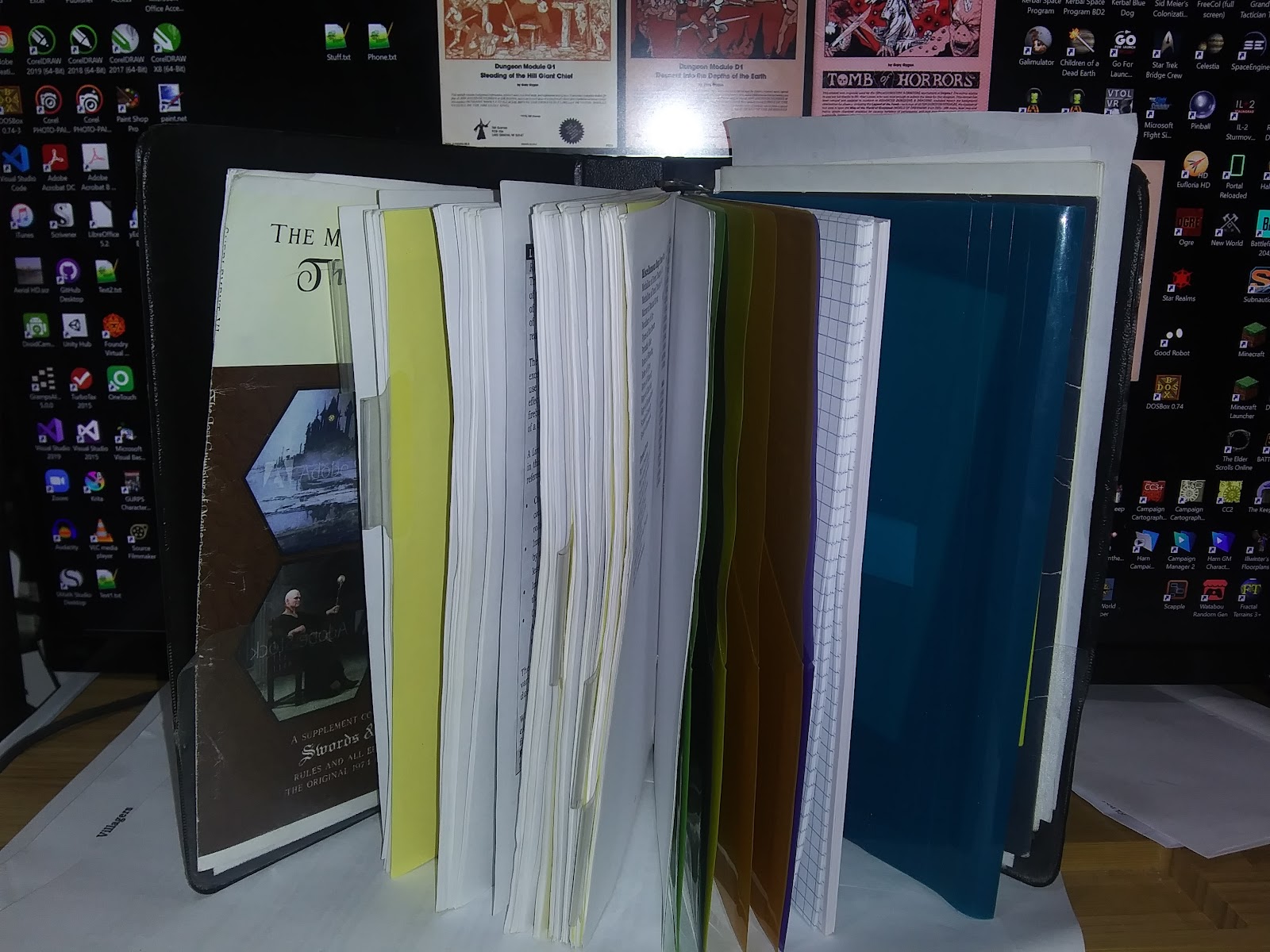
A couple of years back I found a mini binder at my local Staples. There was also various inserts including pouches and dividers you could buy as well. I realize this was the solution to a organizational problem I was having with running my campaigns. 

Often core rulebooks and supplements are too verbose to use as references during play. You have to read through a bunch of explanatory text before getting to the heart of the mechanics or details like the modifiers you need. 

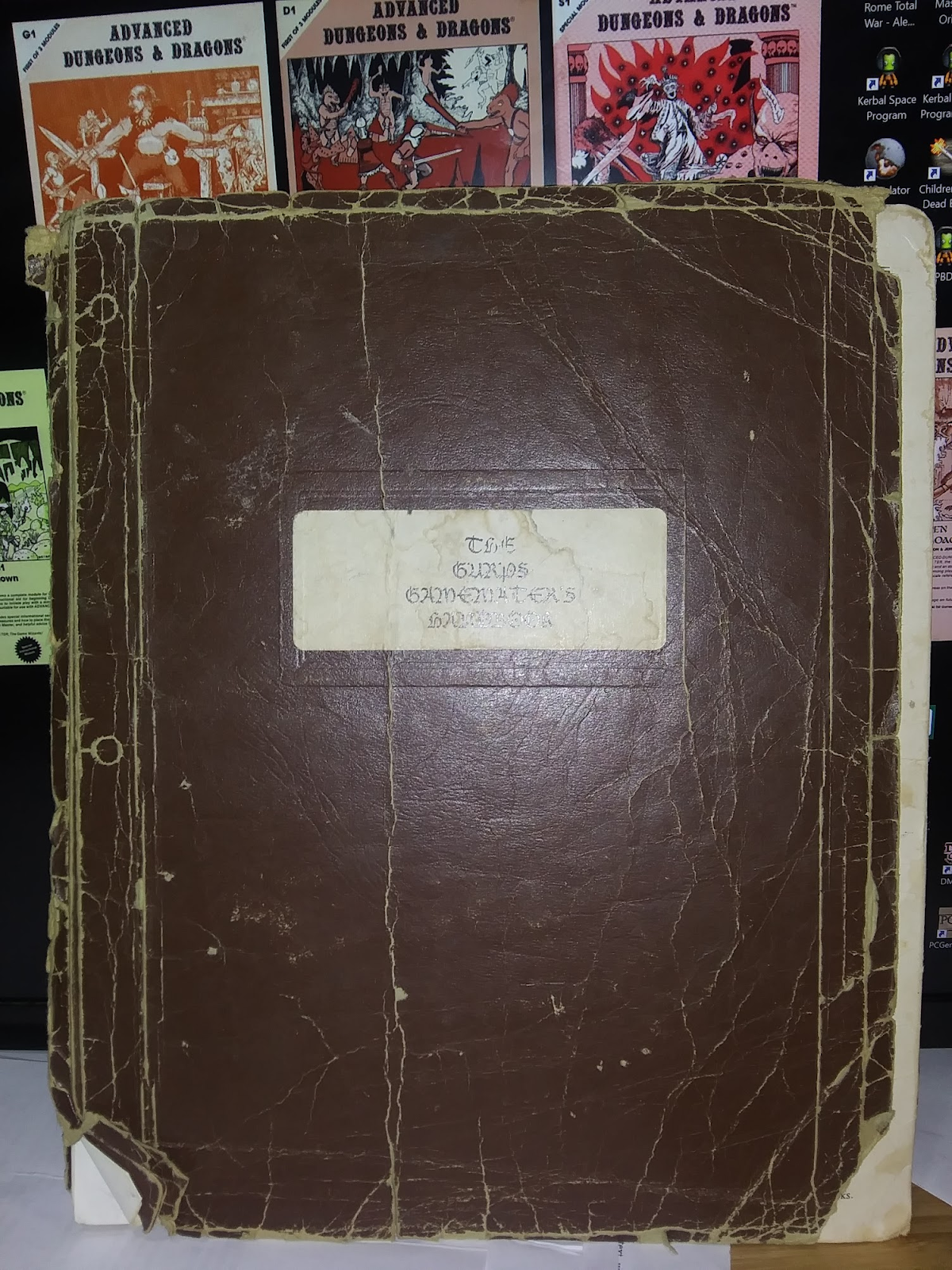
So since the early 80s I been making cheat sheets for the RPG I used. Especially for GURPS. 


Binders were letter sized, often too big to be handy. So I shifted to loose sheets. But loose sheets get scattered.

So when I saw this


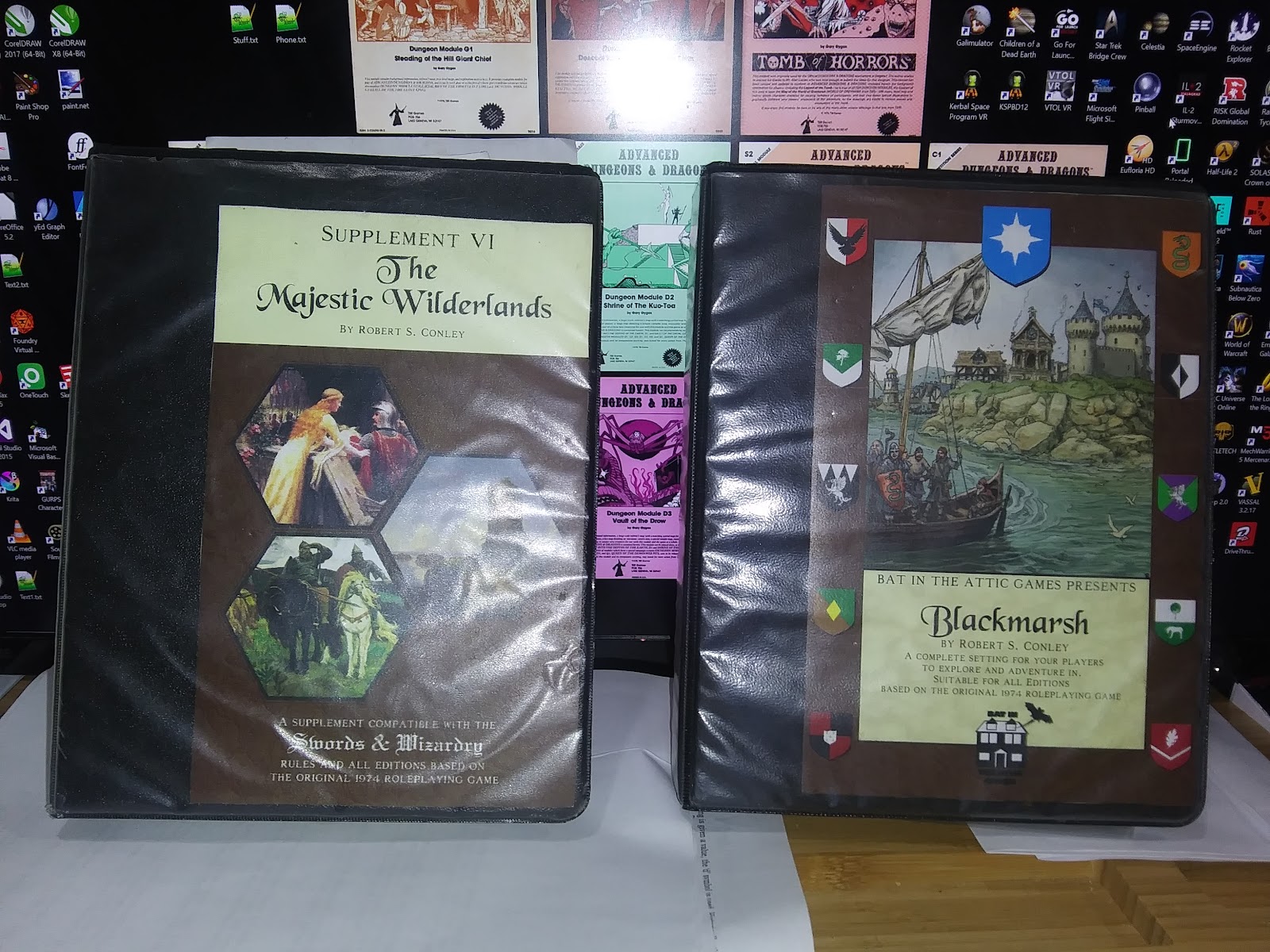
 I knew I could get the benefits of my old binders but in a convenient form almost as good as loose sheets and without the issue of things getting scattered. So I bought the above as well as some inserts. Then I started to make what I needed for my campaigns. The two that had the most work were for my Majestic Wilderlands using my Majestic Fantasy Rules (based on Swords and Wizardry) and for DnD 5th edition. Also included setting material from the Majestic Wilderlands and Blackmarsh.


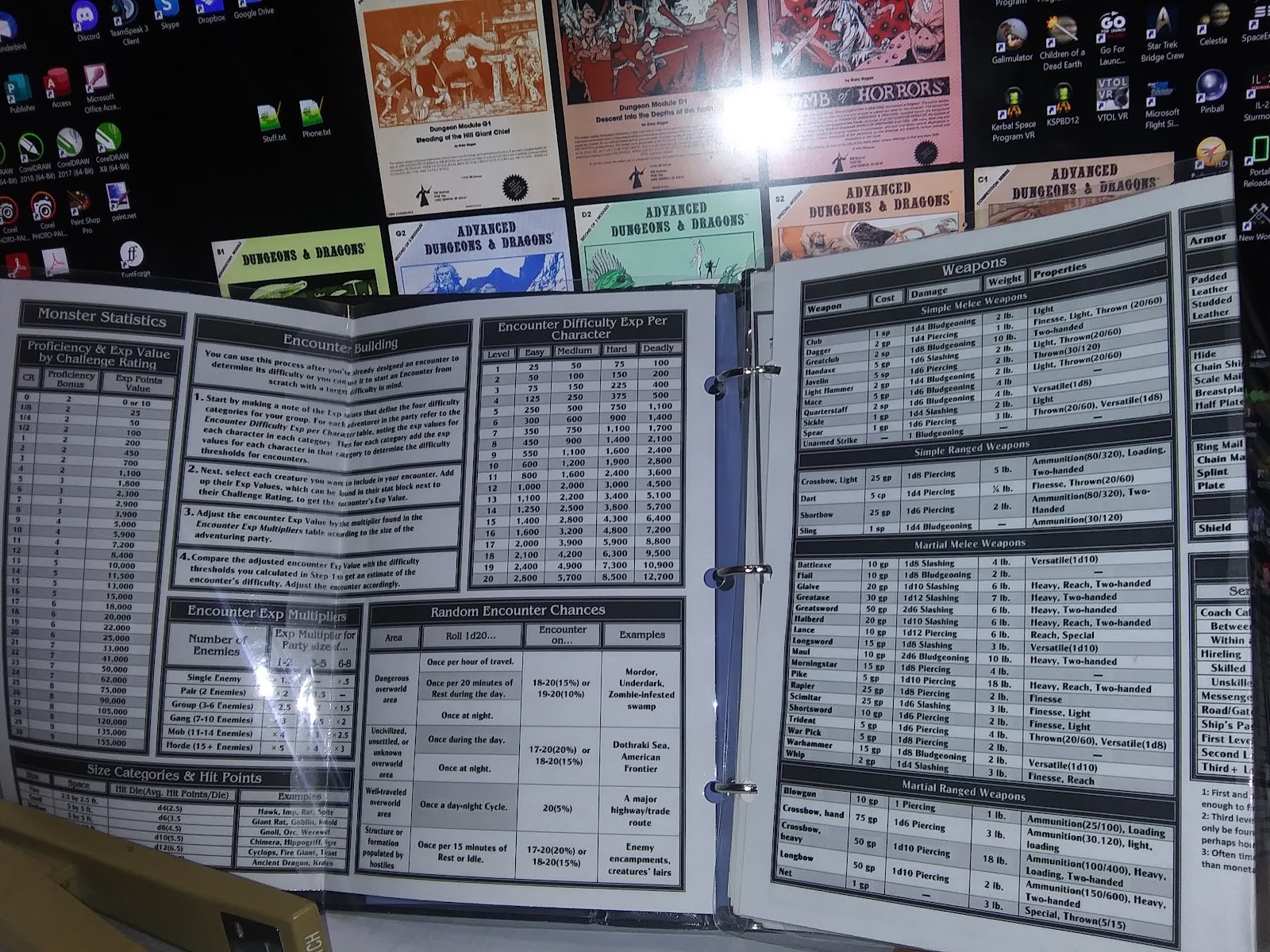
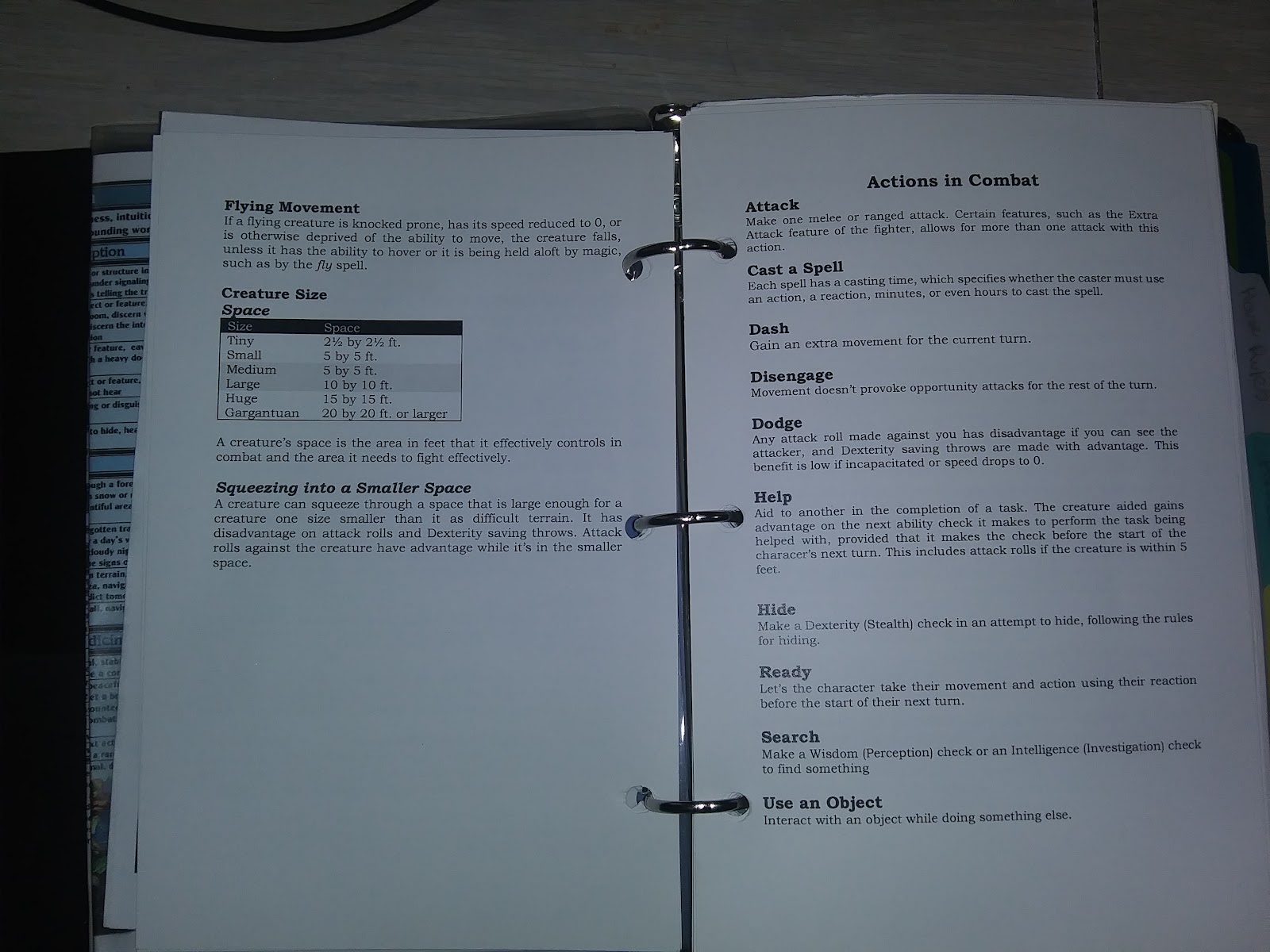
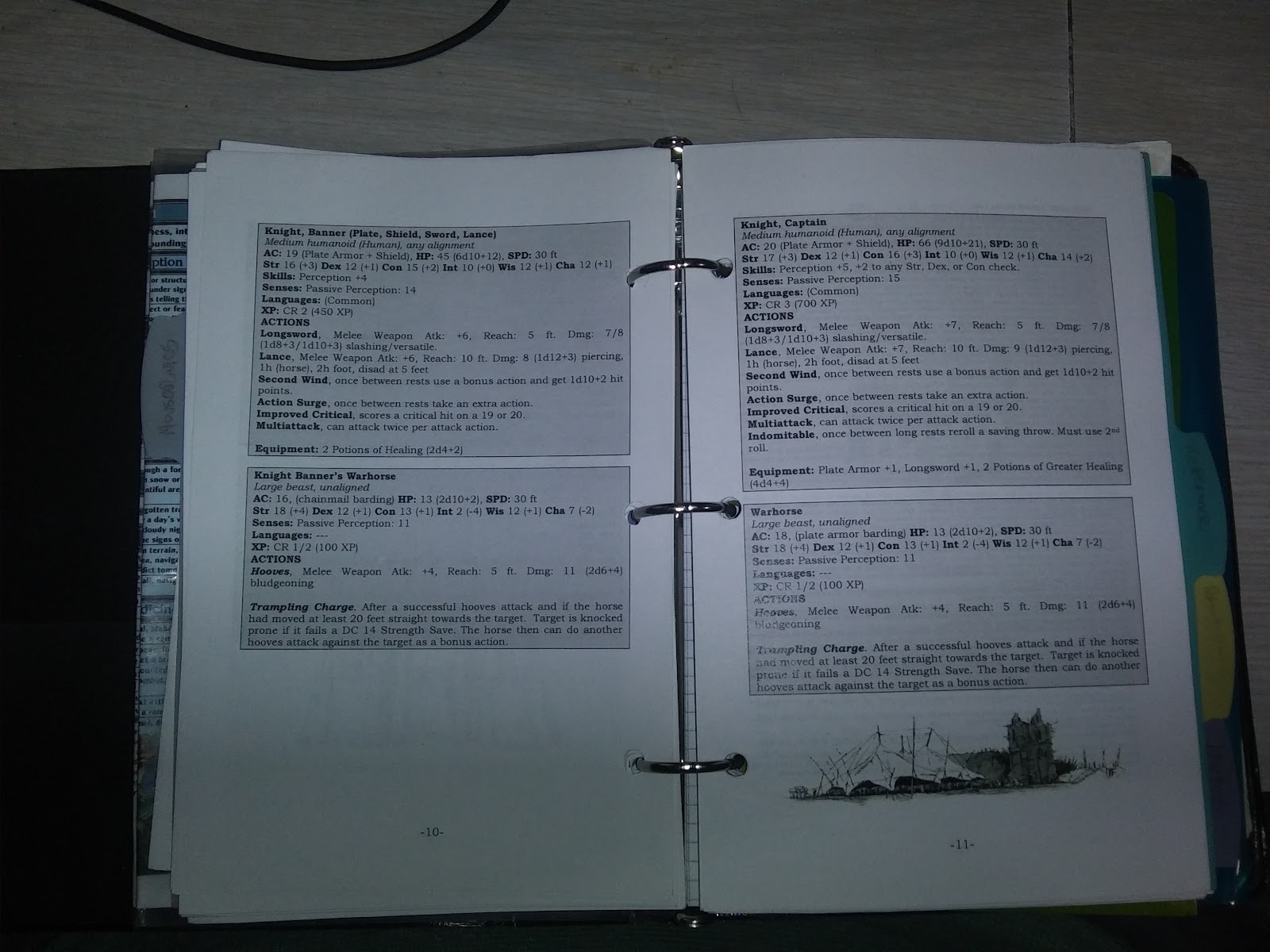
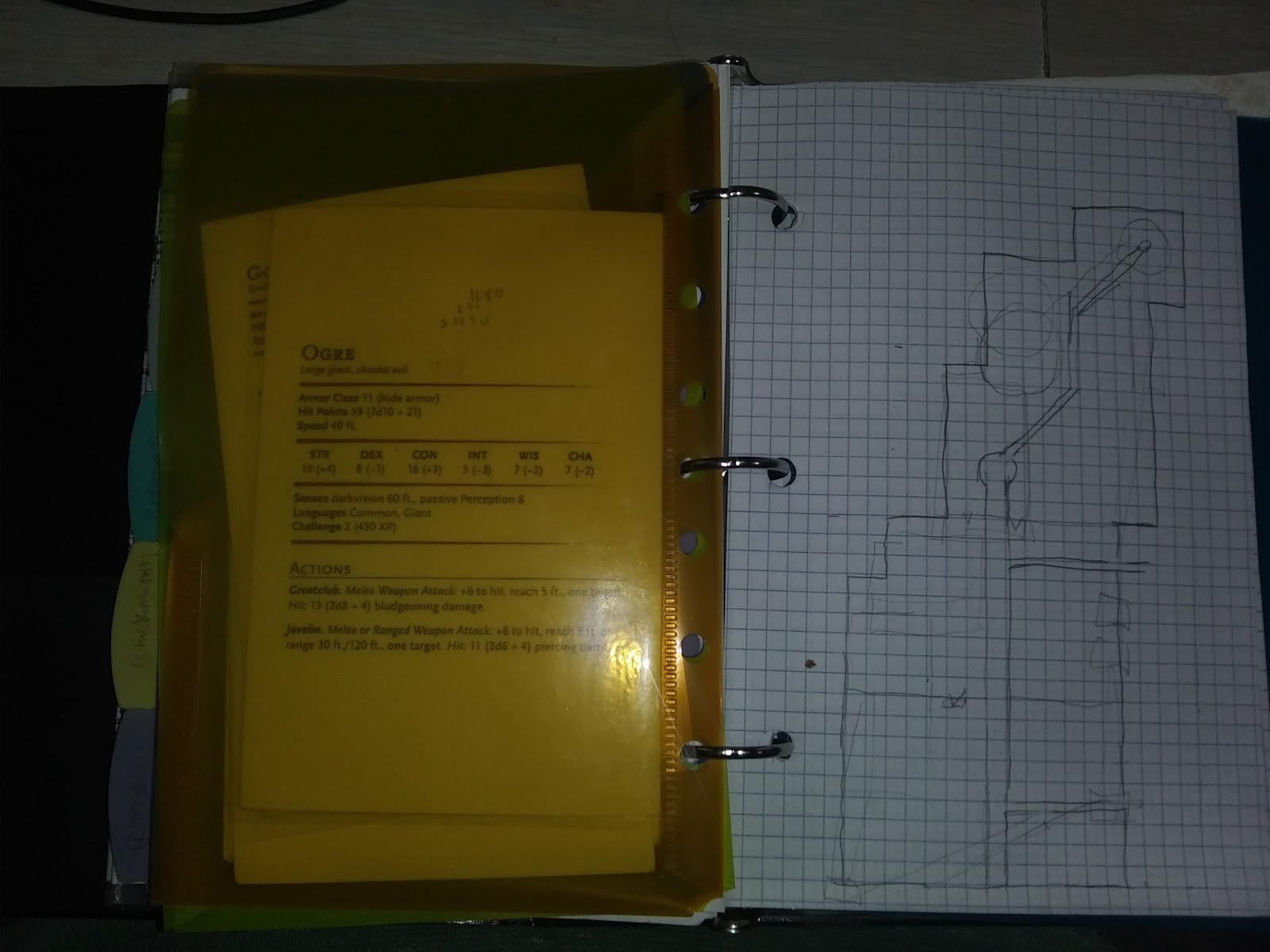
Is is one of the binderx open showing the different pages, dividers, and pages.


The binder cover has interior pockets. I printed stuff on digest sized pages and used dividers to organize them. This was followed by a couple of pocket inserts. Then after I added some punched digest sized graph paper and digest sized punched paper with ruled lines. Then finally a pouch with pens, pencils, and index cards.

Here is what I put into each.

The Majestic Wilderlands


  • Pouch with Pens, Pencil and Index Cards

Rob's Notes: I am planning to replace my Majestic Fantasy Basic Rules in the binder with a even more terse reference. Followed by a character class reference so I can quickly answer player questions.

Blackmarsh/DnD 5e

This binder is also used when I run my Majestic Wilderlands using the 5th edition rules.

  • My favorite letter sized 5e reference charts, shrunk a tad, laminated and turned into fold outs.
  • A blank 5e character sheet
  • A terse combat summary


  • A letter sized foldout map of Blackmarsh
  • Pocket inserts with 5e monster stats printed on index cards.
  • Graph Paper
  • A pouch insert with pens, pencils, and blank index cards.
  • I also have 5e reference booklets that I used before this in the inside pockets of the binder.
Handy Amazon Links

Wednesday, April 28, 2021

World in Motion: Breathing Life into your City State

 In my Majestic Fantasy Basic Rules, I touched briefly on the idea of that the setting has a life of it own. Most of I wrote was about prep, before and during the campaign. I didn't touch on things one can do at the table to breath life into the setting. This following is one thing that hopefully you find useful that makes players feel like they are part of a living breathing world with a life outside of what they do.

The specific issue I will be dealing with is life within a fantasy urban setting. The example I will be using will be based on Judges Guild City State of the Invincible Overlord.

One effective technique I use  is to develop a patter to describe what going on particularly in urban areas. I don't attempt to describe everything unless asked. I limit it to things that "caught" the attention of the PCs. The time you go downtown or to a crowded area look at what you notice as you go about your business. Then take a long look around at everything else. You will find that you have a natural filter that so that only certain things come to your attention. Because of this I feel comfortable in highlighting only a few details as the player traverse the city. If the players specifically want to observe in detail then I will paint the full picture around them.

To explain how I do this I made a graphics to illustrate what it is I do using the City State of the Invincible Overlord. The map I use is on the right and is fully keyed. The map the players see is on the right. Either laid out on the table, or up on the screen if using a VTT. There will be a marker on the player map to mark their current position.

The initial situation is that the party is current eating breakfast at the Seahawk Tavern. They decide to pay a visit to the Sorcerer's Supply House. I look at my map and figure out it would take four minutes to get there. Each square is a 120'. The party can move two squares a minute.

The urban encounter table I use has you rolling every minute. I will making six rolls: one to see if anything happens in the tavern while leaving, one to see if there anything going on outside of the tavern. Then four more to see what happens along the way. The reason for the first roll is that for the purpose of encounter the Tavern is it own thing. The reason for the second roll is that players don't know what they will find once they leave the tavern. So I roll to see if anything is going on when they exit. The rest are normal periodic encounter rolls.

I rolled the following.

  1. No Encounter
  2. Foreigner Urchins/Children To/from market/church/work Seeking/In a duel/fight/etc.
  3. No Encounter
  4. No Encounter
  5. No Encounter
  6. Thieves Guild: Pursecutting/Stalking a mark/etc.

This how it would play out.

click to view at full size

The players can deal with or ignore each of these situation as they see fit. It not uncommon for one or two players to decide they want to check out or deal with something while the rest of the party moves on. In which case I handle the split using a round robin technique. I will spend 5 to 15 minutes with a group and then turn my attention to the next group. Going back and forth as needed.

The Dots on the right hand map roughly marks where I would pause the party (or character token) and describe something.

It take some practice but highly effective in giving the players the sense they are part of a larger world. 

One problem I had until recently is the number of encounter rolls I needed to make. After running two campaigns using Adventures in Middle Earth, I really liked their journey rules. The most applicable part is where you roll for the number of events based on the length of the journey using a logarithmic scale. This means you will have journey 10 times a long before you get the twice the encounters. 

I am working on how this will work for a city adventure. The general gist so far is.

  • One the same street: 1d3-1 encounters
  • Within the same quarter: 1d4 encounters.
  • Across the city: 1d6 encounters. 

Afterwards I sprinkle the encounters along the player's route where they would make sense. Sometime it more or less evenly spaced. Other times they can be bunched up around a single block of buildings.

Hope folks find this useful.

Monday, April 5, 2021

Small Islands of Wonder, Magic and Society Part III

 Part II

After the end of the last post, the world of magic is dominated by clerics, religion, and divine magic. With the exception of the Elves and their allied culture where a tradition of arcane wizardry was developed along divine magic. 

As world rediscovered bronze and later iron technology. Arcane magic remained in the background. Cultures and religion proved to be a barrier but not an impenetrable wall. Independent discoveries and trade with the elves slowly spread arcane knowledge, spells, and rituals. Like in Earth's history the endless summer of small regional cultures doing their own things was to be shattered by the rise of the empires.

The Rise of the Viridians

Despite being divinely constructed and guarded by the Great Dragons, the entrance to Abyss that chromatic crystals guarded was a location in the world that could discovered and explored. Chance and circumstance combined with evil intent to allow a powerful wizard to steal one of the chromatic crystals, the Ebon Flame. The story of that wizard and the war against him is epic but is a tale for another time.

The theft of the crystal left a gap within the ward. and a thousand years later, the weakest of demons the Green Lords or the Viridians found the gap and they were just weak enough that they could use it to escape. Once free they sailed away and founded an empire. Soon other races including the Elves came into conflict with the Viridians and war broke out.

For magic, the Viridians had the first major independent tradition of arcane magic outside of Wizardry. Demons had no access to the divine as they considered themselves enemies of creation. So they developed arcane rituals into a high art including the development of the powerful 7th to 9th level rituals.  

The Rise and Fall of Empires

The Viridians did little to endear themselves to humans and the other races. They believe themselves to be lords of creations and sought to enslave whole cultures at every opportunity.  But their numbers dwindled and like neighboring cultures their realms experienced a rise, a fall, a dark age, and rebirth.  In both the Majestic Wilderlands and the Majestic Fantasy Realms there were three empires over the centuries. The downside of how the Viridians acted that for many cultures, arcane magic became associated with demons and evil.  It wasn't until the rise of the next great empire that arcane magic came into it's own.

That empire was the Ghinorian Empire in the Majestic Wilderlands, and the Bright Empire in the Majestic Fantasy Realms. Both considered themselves universal empire espousing ideals to appeal to all people regardless of cultures. Both had a dominant religion that preached these ideals as divinely ordained and both were highly successful in spreading to all corners of the main continent.

Like most religions in other cultures, the empire had a tradition of Arcanists subordinated to the church. One specialty found among others in various orders of scholars and monks. The success of the empire meant contact with many different cultures including the Elves and their tradition of Wizardry. And the Viridians and their tainted  tradition of arcane magic. This widespread contact lead to renaissance of learning and scholarship spearheaded by the church.

But as the centuries rolled on, the empire developed cracks and faltered. Both versions weakened by civil war, and both had their death blow delivered by barbarian invasions. In the chaotic centuries after the fall, the church shattered and it adherent left to fend on their own. The old arcanist used their knowledge of elven wizardry, the rituals of over a dozen cultures, and Viridian own tradition scrubbed of any demonic taint to create a new form of arcane magic, the Magic User. Freed by the demand and constraints of religion the early magic-users were able to prefect the new way of casting spells and teach it to others. 

Like a wizard a magic user performed mediations to memorize a spell form that could be filled with energy and released as spell. But instead of internalizing the forms, they made a crucial innovation of the spell book. The use of the spell book allowed many more forms to kept in a magic user's mind compared to a wizard. In addition it only took a short amount of time to rememorize new forms. Although the number and powers of the memorized forms depended on the skill of the magic orders.

The Magical Orders.

Art by Richard Luschek
The centuries after the empire's fall saw the rise of various magic orders. The Order of Thoth arose from some of the early magic-users banding together for protection. The Order of Sarrath was an alternative tradition of ritual casters that became an important part of the Ochre Empire one of the largest successor realms to emerge from the collapse of the Bright Empire. The various viking cultures developed an order of ritual casters using runes. Alongside these new order Wizards from the elves and their allies and Viridian artificers who used the old form of ritual magic to create magic items.

All of the orders are still finding their way. The present day of my campaigns in both the Majestic Wilderlands and the Majestic Fantasy Realms is set during the time where these orders are coming into their own. The turmoil's of their early history is past and each have established a place in their respective cultures.  

The wider world is also coming into its own as the various realms have move past the dark age after the fall of the empire. Commerce and finance has step alongside land as a source of wealth and power. And nobody know what the next few centuries will bring either for the realms or magic. 

The Mechanics

Magic Users

The same as any classic edition. Additionally magic users can cast 10 minute rituals from their spellbooks. The maximum level they can cast as a ritual is equal to 1/2 of the high spell level they can cast (rounded down). If a magic-user can cast 4th level spells they can also cast 2nd level spells as ritual. In this area magic-users regressed compared to the older ritual caster due to the focusing on memorizing spells. 

Order of Thoth

The same as magic users above. In addition they learn the Shield of Magic which confers 20% magic resistance per level until it maxes out at 100% at 5th level when they become a master in the order. I recommend limiting this to non-damaging spells that require a save like charm person. Not to spells like fireball or stinking cloud that create something else that does the damage. The Shield of Magic was developed to protect mages from being controlled as a slave by another mage. 

Order of Sarrath

This is a order of the ritual only spell casters known as Theurgists. As an official arm of an empire dedicated to worship of the dragon god of war and order (think lawful evil) these spellcasters learn to cast joint rituals. They can combine their caster levels for an increased spells effect. For example 5 5th level Theurgists can cast a 25D fireball.

Rob's Note: I have to admit, I thought this would work out better than it did. At the time I thought there were a fair amount of spells in the classic editions like fireball where they were more effective when cast by higher level magic users. This turned out the exception not the rule for the classic editions. 

But would out work out fine if 5e is being used. In 5e most spells are more potent when cast through a higher level spell slot.

Runecasters

This is another order of ritual only spell casters originated among the dwarves and human viking cultures who used runes. Instead of scrolls runecaster can scribe runes that function the same. Used the spell is cast and the rune disappears. The difference is that runes are more compact so Runecaster can make runewands or runestaffs with many runes on them. And they are more lasting than paper being carving into a durable material like wood or stone. Runes for a spell take up around three inches of length for a staff or wand. A three inch by three inch square on a flat surface.

Charms

Charms are like scrolls except they remain after being used. They cost double (money and time) what a scroll costs and half to recharge (money and time). They also can be activated by non-spellcasters as one-use magic item. For runecasters they are an advanced form of runes.

Wrapping it up.

My hope with this short series of essays on magic and society provide some useful insight and inspirations for your own campaign. The history of magic I outlined is not the only way it could have played out. With different premises and history turning in a different all kinds of interesting possibilities emerge. 

One thing to keep in mind if you believe that a magic utopia is inevitable. Once way to sidestep that issue to set the campaign prior to the time in which the utopia will happen. Everything has a beginning and Rome wasn't build in a day. 

Finally this material is also preview of the upcoming Lost Grimoire of Magic. The next book in my Majestic Fantasy RPG series with will debut late this summer after the Wild North is released.

Sunday, March 21, 2021

Small Islands of Wonder, Society and Magic Part II

Part I

In my previous post I discussed the status of magic at the beginning of history within my setting, the Majestic Fantasy Realms. Here I will discuss the aftermath of the Dawn War and how it gave rise to the first great era of magic. 

Prior to the Dawn War all magic was arcane and ritual based. The gods were known as the Lords of Creation and functioned as guides, teachers and coaches rather than as a source of divine mystery. Their roles were to prepare the two races, humans and elves, for the roles they were to play in the newly created world. 

As recounted in the last post, the demons were imprisoned in the Abyss with the chromatic crystals and as a result magic in a concentrated form was cycled throughout the world. Providing a source of energy to cast spells within seconds instead of minutes.

Faith, Signs and Portents.

The Lords of Creations decided that their close presence to the mortal races was one of the primary causes for the rise of the Demons. After the Abyss was sealed, they withdrew from the world and only interacted with those who followed their philosophies. Communicating through signs and portents, they sought to teach through faith instead of direct instruction. In doing this they changed from being the Lords of Creation into gods with religion and faiths.

Their clerics became the first true spellcasters in the world. Those who developed or had the strong faith found they had power as well. They were given divine insight to use the new sources of magical power coursing throughout the world. Through meditation and prayer they could memorize specific spells. Developing the forms in their mind. Then while casting filling the forms with magical energy and finally releasing the form and energy as a spell. As the cleric became more experience their divine insight developed to allow them to cast more potent spells. 

However, power had a price, and that price was belief and faith. Belief in what they were taught and faith that it was right and real and not madness or the whisper of demons rising from the Abyss. Without faith and belief, there was no divine insight, without divine insight the ability to cast spell within seconds disappeared.

As religions developed and took hold, the Cleric became the dominate spellcaster overshadowing the old arcane ritual casters. A major contributing factor was the Shield of Faith, which made Clerics invulnerable against spells and rituals cast without a god's divine insight unless the spell manifested something in the physical world like fire, ice, stone, or lightning. In many cultures the ways of the old ritual based arcane spellcasting was lost. Except for one group, the Elves and their allies.

The Elves and Wizardry

Within a few generations only the elves preserved any memory of the time before the Dawn War. Like other cultures, the god also only spoke to the elves in signs and portents. But among the elves and their allies it did not developed into a full blown religion but into various philosophies one committed their lives too. Those who committed to one of the divine philosophies also received the divine insight to learn and cast spells within seconds. 

But because elves still remembered, they and their allies also still practiced and more important continue to develop the old arcane rituals. They learned how to cast rituals with divine insight separate from the forms they created in their mind with their daily meditations and prayers. They could cast divine rituals without a having to write them into ritual book.

And the elves and their allies developed a way to casting arcane spells within seconds called wizardry. Through a complex series of meditations, rituals, and study, Wizards could internalize spell forms to fill with energy to cast at a moment’s notice. However, it took practice and further study to be able to do their more than once a day and with more potent spells. Even then the Wizard were very limited in how many spells that could be internalize and the process of internalizing a form took years even decades. An issue that wasn’t present with divine insight. 

Wizardry did not spread far beyond the elves and cultures allied with the elves for two reasons, the laborious study involved which was fine for immortal elves but took up much of a human’s lifetime. The second and more tragic, was that many rejected interaction with the elves and their allies when elves began to contact others cultures again a thousand years after the Dawn War. The worldview of the elves and their allies was seen as godless to cultures dominated by religion. 

Hedge Mages and Arcanists

Magic in concentrated form flowed through everyday life. It would manifest in physical objects known as viz only to dissipate at dawn the next day. Creatures, some known as monsters, developed ways of harnessing magical energies to better survive. Outside of the elves, religion and the clerics were dominate but over the centuries people both within a faith and outside were continually rediscovering arcane magic and ritual spellcasting. Most times it was a curiosity and limited to a few weak rituals. In some cultures an underground tradition of Hedge Mages developed who lived on the fringes of society and passed down hard won rituals from master to apprentice over generation. Mostly making a living by brewing potions and elixirs for the few who found them. When the culture’s religion found out about them the reaction was nearly always negative and many died after being called heretics and apostates. 

Some religions allowed orders of arcanists to develop and catalog arcane rituals under the strict supervision of the religious hierarchy. Arcanists were rarely a separate order but instead a specialty among scribes, librarians, and record-keeper. 

The Dawn of the Magic User

As the centuries rolled on and history unfolded, chance and circumstance allowed cracks to form in the dominance of magic by clerics. In the next post I will conclude this series by talking about the events that lead to the rise of the magic-user.

The Mechanics
For Swords and Wizardry the cleric is as written. I have a few additional wrinkles like the Shield of Faith which acts as a form of limited magic resistance in the Majestic Fantasy RPG. 

Viz is the same as spelled out in the Basic Rules for the Majestic Wilderlands RPG. One viz allows the cast to cast a 1st level spells without losing it from memory or using a spell slot (if a wizard, see below). It also reduces the cost of creating a magic item. But a spellcaster can only keep so much viz intact without it dissipating at dawn. Generally equal to half their level rounded down plus their intelligence or wisdom bonus.

The Wizards works similarly to the D20 Sorcerer where the spellcasters do not have to memorize spells but instead learn spells known and cast them any way they want until their spell slots are used up for the day.

For Swords and Wizardry I went with the following table instead the one with the D20. They can cast arcane rituals with a spell level equal to 1/2 the high level spell they can case (rounded down). So Wizard can begin to cast first level arcane rituals at 3rd level when they learn how to learn and cast 2nd level spells. 

Spells Per Day

Spell Known

Wednesday, March 17, 2021

Small Islands of Wonder, Magic and Society Part 1

On one of the posts I made on social media, Ian Borchardt created a great phrase for how I view magic's effect on the cultures of the Majestic Fantasy Realms.

One of the big problems is that magic in a lot of campaigns tends to be non-scalable, being focused in individuals. Thus I suspect that as a result the effects of magic would tend to cluster tightly, rather than spread through the society. Small islands of wonder in what is otherwise a less developed world (since there would be less incentive for overall development).

Over a decade ago I wrote a post speaking in general about some of issue surrounding magic and society.

Magic and Society (Feb 2010) 

I wrapped the post up with this.

There are a lot of dials here you can play with and the results is that many types of settings can result even when they share the same assumptions I am making. By doing this type of exercise you find yourself considering the different possibilities. This is can ultimately to a more interesting and fun game for you and your players.

Since then I done more work detailing my setting both as the Majestic Wilderlands and as the Majestic Fantasy Realms.  Hopefully a brief overview will serve as an example of some of the thing I touch on that post.

One the things I developed is the technology of magic. How was it discovered and how did it developed into its present form as outlined by the system. Currently the Vancian system found in ODnD's 3 LBBs. 

Originally in the Majestic Fantasy Realms level of magic was low, spells could only be cast through laborious 10 minute rituals. The range of spells was similar those found in the 3 LBBs of ODnD. Magic could be found in physical form as viz and that would allow a spell to be cast within seconds. Related spells could be cast quickly if made into a scroll or a magic item.

After the Dawn War, the Demons were imprisoned in the Abyss. Each of the surviving gods created a crystal. Nine of them were used to seal the entrance of the Abyss, and the tenth was the master Chromatic Cystal.

In order to power them, the gods had the crystals channel the ambient magic into their crystalline structure and then release it back out into the world. Creating a self sustaining loop the keep the demon imprisoned. A side effect this that were now flows of magic throughout the world. Concentrated enough to allow magical energy to be gathered quickly and released as a spell within seconds. 

The nine crystals "tainted" the flow emerging from them creating nine distinct forms of magic. Each form reflected the personality and powers of the god that created the crystal. These nine forms plus the original ambient magic became known as the Ten Arts of Magic.

Like our world's zodiac, they became associated with specific images and colors. The Claw (Black), The Eagle (Red), The Flame (Orange), The Forge (colorless, original ambient magic), The Hearth (Green), The Lantern (Purple), The Skull (White), The Storm (Indigo), The Tree (Blue), The Web (Yellow).

The Mechanics

So what does it means in terms of Swords and Wizardry? I created the following additions*

  • The maximum spell level the spellcaster could cast as ritual is determined by their level. 
  • Rituals take ten minutes to cast and require the presence of the spellbook.
  • Ritual spell caster can't memorize spells. 
  • The ritual spell caster had to have scribed the spell into their spell book. For pre-literate societies arcane spellcasters used natural media like cave walls, bark, stone, and sometimes dried tablets of clay to scribe mystical pattern that enabled to learn the spells. 
  • Magic items can be used in seconds within the time of a single combat round. Thus any spell used in combat had to be scribed as a scroll (or similar object), a wand, or a magic item.
  • One additional wrinkle I will touch on later is that if the ritual spell caster has viz, magic in physical form, then a spell can be casted within seconds. The number of viz needed is equal to the level of the spell. Viz is ephemeral and the spell caster can only maintain a number of viz equal to half of their level (rounded up) plus their intelligence bonus. Excess viz dissipates at the next sunrise, unless they have a special magic item called a Arcane Coffer.  
  • Spells are kept the as they are written in the book**. 
  • Each spells is associated with an art of magic. 
  • If cast with viz associated with a specific art or a spellcaster with a focus in that art. The spell has an increased effect***. 
*Rob's Notes: Ritual only spellcaster are deliberately designed to be weaker than normal vancian style magic-users. The only thing they are better at is that they are able to caster higher level spells at high level as ritual. A normal Magic-User can only learn to cast up to 4th level spells as rituals when they learn to memorize 8th level spells. 

**Rob's Notes: In the Majestic Fantasy RPG, I have rewritten some spells for clarity. Functionally they work the same as how they are presented in Swords and Wizardry.

***Rob's Notes: I was reluctant to this. Originally my idea was to have viz or a focus in an art equate to a +1 level caster bonus. A 8th spell caster with a focus in the Art of the Flame would cast fireball with 9d6 instead of 8d6. But it turns out there not many spells like Fireball in Swords and Wizardry, so I went through each spell and gave a small bonus effect if casted with a focus in an art or viz of that type. Usually increase in duration, range, etc.

Part 2

Monday, March 15, 2021

Farewell to Magic, A brief essay on the economics of a fantasy setting.

 In my previous post, I talked about how resolved the issue of how to price real estate for when my players want to buy not build. Along with sharing it here, I posted links on facebook and other chat groups I frequent. 

One poster posted an interesting comment about the lack of profit motive my post implied. One part stood out as a reminder of how I view the Majestic Fantasy Realms.

Without any profit there is no growth and they would stay in the Middle Ages forever.

Over the decades, even before the internet, sometime I got into debates over how a fantasy setting would work, especially with my friends who knew how I ran the Majestic Wilderlands. One thread of the conversation was the impact of magic. Some who I talked to believe that magic would guarantee prosperity, create what we would now call a post scarcity society.  

My counterpoint, that the Industrial Revolution wasn't just about about technology but also ideas of how people can organize themselves or conduct business with each other. Without those idea, all what would happen with magic is the lives of an elite few would get better while the rest of the populace would have marginally better lives like the introduction of the horse collar allow formally difficult to cultivate lands to be brought under the plow to grow food. I usually pegged the average effect of magic at 20% better.

But it was just a guess based on instinct on what I read about history.

Then a few years back, I read a book that I felt gave my opinion a little more weight. 

It called a Farewell to Alms: A brief economic history of the world. 

The thesis as far as my post goes, is that prior to the industrial revolution. Improvements in technology or society only resulted in a temporary increase in prosperity. With more food and better living condition, the birth rate rose. Within in a handful of generations, the population grew to the point where living conditions were no better than before, except now there are more people. 

One main reason is that the pace of technological and society productivity prior to the industrial age could not keep pace with the birth rate except in brief burst. Like the introduction of the horse collar allowed areas with thick heavy soils to be cultivated easily greatly expanding where crops could be grown.

In this regard magic is no different than technology. The spread of using magic throughout a culture would bring about a temporary prosperity, which will bring about an increase in birth rate, which over time would bring everything back to the way it was except now there are more people.

That is until conditions are such that ideas, technology, (and magic since we are talking fantasy) come together to form an industrial magical revolution. Where productivity increases outstrip birth rate for decades and centuries.

As I been saying for years to friends, the Majestic Fantasy Realms is set in the time period before all that happens. But it nice that my guess has better foundation in fact. 

It is a good book and I recommend it highly. It also goes into why the first industrial revolution happen which may provide inspiration for a different kind of fantasy campaign set during that time. If that interest you I recommend getting Susanna Clark's Jonathan Strange and Mr. Norell. A story of English magic set during the Napoleonic Wars.