Showing posts with label DnD 5e. Show all posts

Thursday, September 8, 2022

1D&D: The 5E Skill System Is not broken, but it may not work out for you.


 On the Alexandrian, Justin Alexander writes a 2,500-word review that tears apart the DnD 5e skill system. This appears to have been prompted by the fact that the One DnD playtest added a rule that 1 is a failure on ALL d20 rolls and a 20 is a auto success (and grants a point of inspiration) on ALL d20 rolls. In the current rules natural 1's and 20's only matter on the to-hit roll. Although myself and others I know apply it to ability checks, saves, and skill checks. 

The review is quite detailed in goes into some of the math behind the DnD 5e skill system. 

And it misses the entire point of the skill system. 

First off for those interested, here is a link from back in the day explaining what bounded accuracy is about and includes a link to the original article from Wizards explaining it.

Are peoples' competencies really as flat in D&D 5e as its math suggests?

What it boils down to is what is the author's view of the fantasy genre? (since DnD 5e is meant to handle various fantasy settings). In DnD case the specific question, is what is a 1st level character is like? What is a 6th level character like? A 12th level character? And so on up to the maximum level the author wants to write about. In 5e's case that is 20th level.

It is not apparent from Justin's review what he views what characters should be doing in non-combat situations at various levels. He references low-level 3.X a lot but doesn't say why. I am left with the impression that he feels somehow the 5e target numbers should match those of low-level 3.5?

For me the 5e authors take is apparent. You start out so-so: 55% success for easy (DC 10), 30% for moderate (DC 15), and 5% for Hard (DC 20). With a +4 attribute bonus and a +2 proficiency, you can get those up to 85% success for easy, 60% for moderate, and 35% for hard. This is at 1st level. 

To me, this means the authors feel when it comes to non-combat tasks that 5e 1st level characters have some measure of competence. If your view of the capabilities of first-level characters is not the same then the above isn't going to work for your campaigns.

At 20th level for most characters, the odds shift. Now characters often have a +5 attribute bonus, and a +6 proficiency bonus.   You going to automatically succeed at DC 10 (Easy) task. 85% success for DC 15 (Moderate) tasks, and 60% success for DC 20 (Hard) tasks.

If these odds don't reflect what you think 20th-level characters are capable of then 5e isn't going to work out. 

Bards and Rogues along with two feats in the later books give expertise. Rogues also have Reliable Talent at 11th level. Expertise doubles the proficiency bonus for some skills. This shifts the odds of success in skill and ability checks considerably. 

At 1st level, we are talking about a +10% improvement with any skills that have expertise. At 20th level Rogue and Bards with expertise will automatically succeed on DC 10 (Easy), and DC 15 (Moderate) tasks, and have a 90% chance of success on DC 20 (Hard) tasks. 

With Rogues, when they get Reliable Talent at 11th level, the player can declare that they roll a 10 with a skill check. This means they will succeed with everything up to a Hard task? 

Justin fail to mention that there are two more task levels DC 25 (Very Hard), and DC 30 (Almost Impossible). A 20th-level Rogue with reliable talent will always succeed at DC 25 task (10 + 17 = 27).

Is this bad? Is this poor math on the designer's part? No, it fits with their view of what Rogues (and Bards) are capable of at 1st, 11th, and 20th level. This is why I put a reference to something that I and others have written back in 2014. To show why 5e authors wrote up the classes and mechanics the way they did.

As for the change in the One DnD playtest, it is more about making the system reflect how hobbyists like you and me actually play 5e rather than trying to fix a non-existent math issue.

If that is not how you view the capabilities of a Rogue or a Bard then 5e isn't going to work for you. 

And certainly not for Justin Alexander.


Thursday, August 18, 2022

One D&D, The Announcement

So One D&D?

Today Wizards announced some details about what happening to DnD. 


The one thing they hammer on in the initial press release is that Wizard does not what you to think of it as the next edition. In the press release, they are stressing that One DnD is 100% compatible with 5e. Using Curse of Strahd as an example of something that can work equally well with the current 5e rules now and the One DnD core rules later.

I believe them. If the authors make that their goal it is totally doable given my experience dragging the Majestic Wilderlands through multiple systems. And we have actual examples of how this would work with Adventures in Middle Earth versus DnD 5e Core rulebooks. 

But there is a catch. 

A catch?
The feel of a campaign is determined by the referee's personal style, along with how the systaffand stuff work together. Using AiME as an example again, it uses the 5e system but with radically different stuff (classes, monster, abilities, etc.) that turns it into a Middle Earth RPG. 

An AiME campaign doesn't feel like a core book 5e campaign. Even if you were to use the same adventures for both. Which happened to me when I ran an adaptation of Scourge of the Demon Wolf for AiME at Con on the Cob a few years ago.

One DnD likely is 100% compatible by continuing to use the 5e system. It may have a completely different feel because of the stuff the authors choose to use for the RPG. If it is different enough my guess is that most hobbyists will consider it a new edition despite the marketing.

Another observation the closest analogy we have is the transition from 3.0 to 3.5. And that didn't go over well for 3.0 products and put the final nailing into bursting the d20 boom. But the Wizards as a company deliberately decided to design 3.5 so it is not quite compatible with 3.0.

Here the design team wants the system to remain 100% compatible limiting changes to the stuff (classes, skills, spells, etc.).

Wrapping it up

We will see how they do as they are having a somewhat open playtest on DnD Beyond.


I will have further comments later on DnD Digital and the initial playtest on Character Origins.

Next: Thoughts on the One DnD: Character Options.


Thursday, February 10, 2022

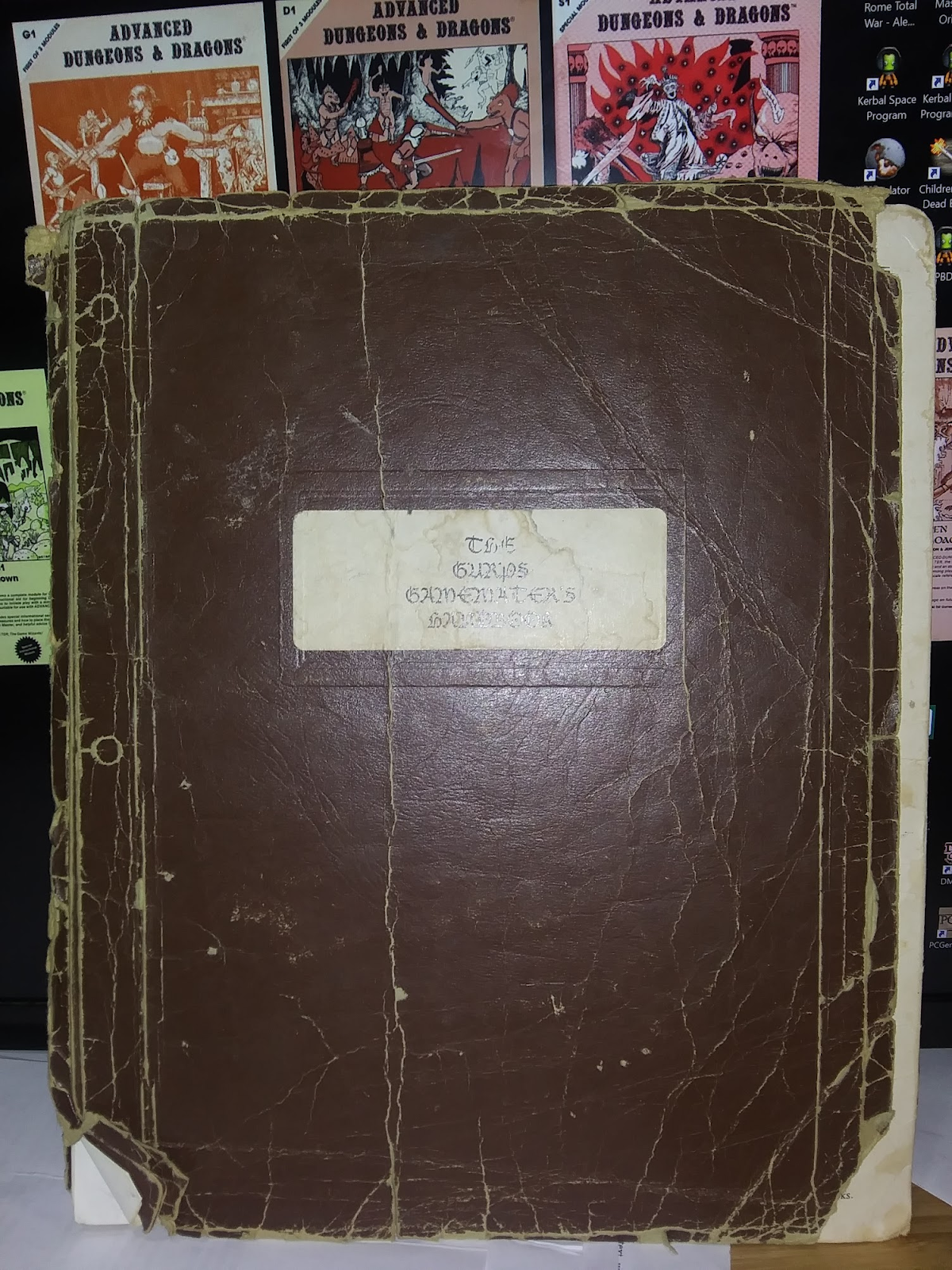
Your own custom RPG rulebook, mini binders

A couple of years back I found a mini binder at my local Staples. There was also various inserts including pouches and dividers you could buy as well. I realize this was the solution to a organizational problem I was having with running my campaigns. 

Often core rulebooks and supplements are too verbose to use as references during play. You have to read through a bunch of explanatory text before getting to the heart of the mechanics or details like the modifiers you need. 

So since the early 80s I been making cheat sheets for the RPG I used. Especially for GURPS. 


Binders were letter sized, often too big to be handy. So I shifted to loose sheets. But loose sheets get scattered.

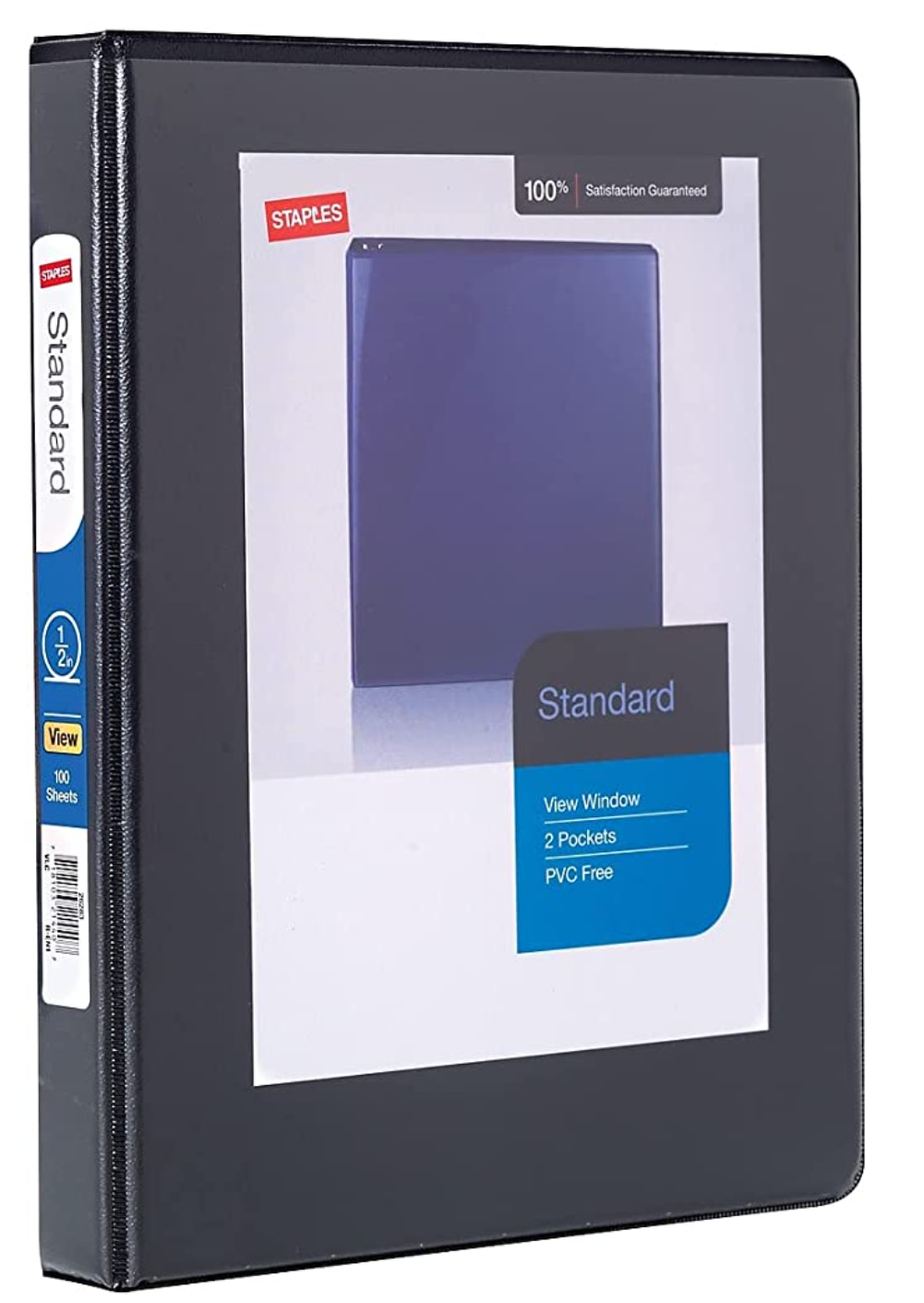
So when I saw this


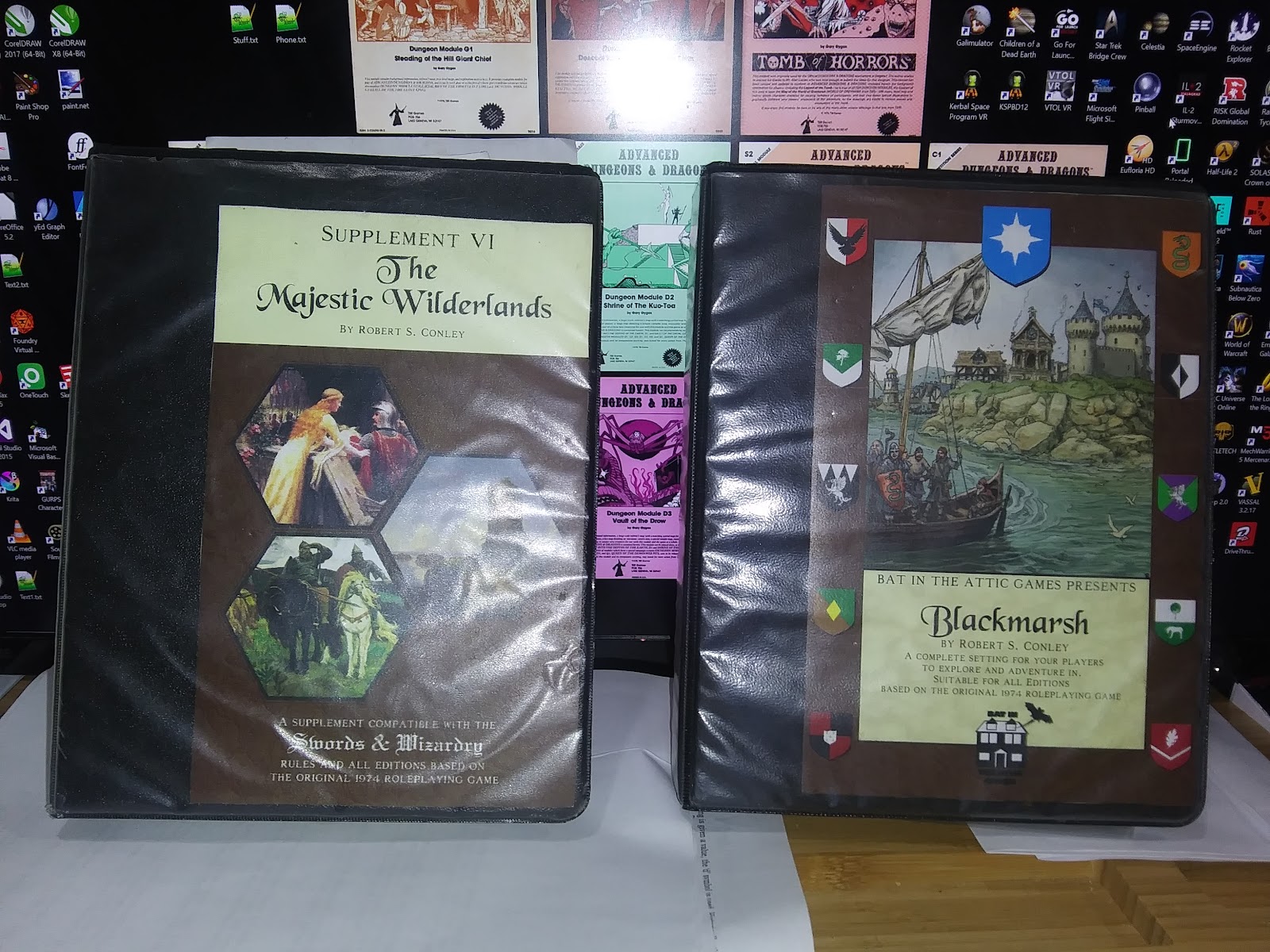
 I knew I could get the benefits of my old binders but in a convenient form almost as good as loose sheets and without the issue of things getting scattered. So I bought the above as well as some inserts. Then I started to make what I needed for my campaigns. The two that had the most work were for my Majestic Wilderlands using my Majestic Fantasy Rules (based on Swords and Wizardry) and for DnD 5th edition. Also included setting material from the Majestic Wilderlands and Blackmarsh.


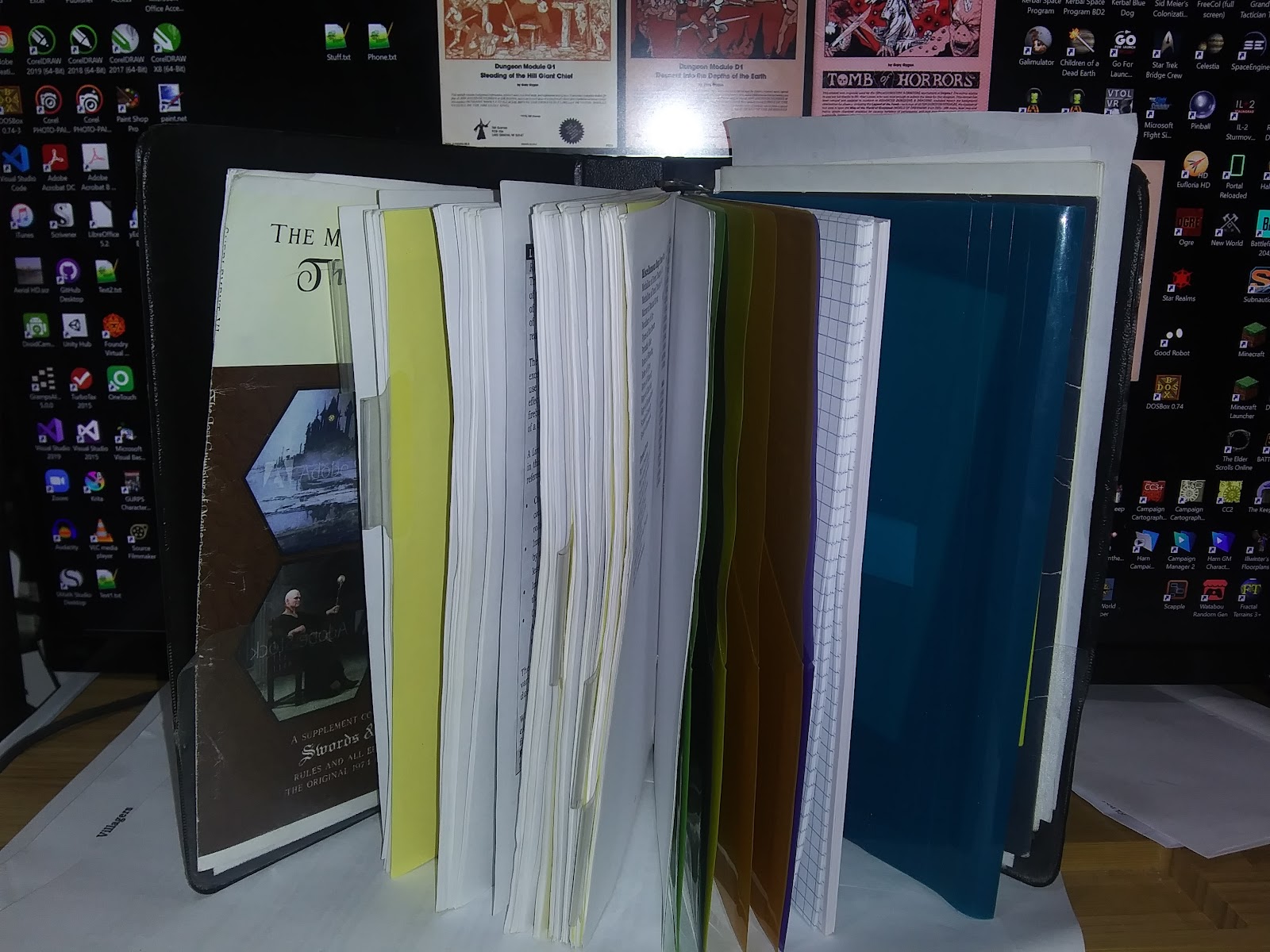
Is is one of the binderx open showing the different pages, dividers, and pages.


The binder cover has interior pockets. I printed stuff on digest sized pages and used dividers to organize them. This was followed by a couple of pocket inserts. Then after I added some punched digest sized graph paper and digest sized punched paper with ruled lines. Then finally a pouch with pens, pencils, and index cards.

Here is what I put into each.

The Majestic Wilderlands


  • Pouch with Pens, Pencil and Index Cards

Rob's Notes: I am planning to replace my Majestic Fantasy Basic Rules in the binder with a even more terse reference. Followed by a character class reference so I can quickly answer player questions.

Blackmarsh/DnD 5e

This binder is also used when I run my Majestic Wilderlands using the 5th edition rules.

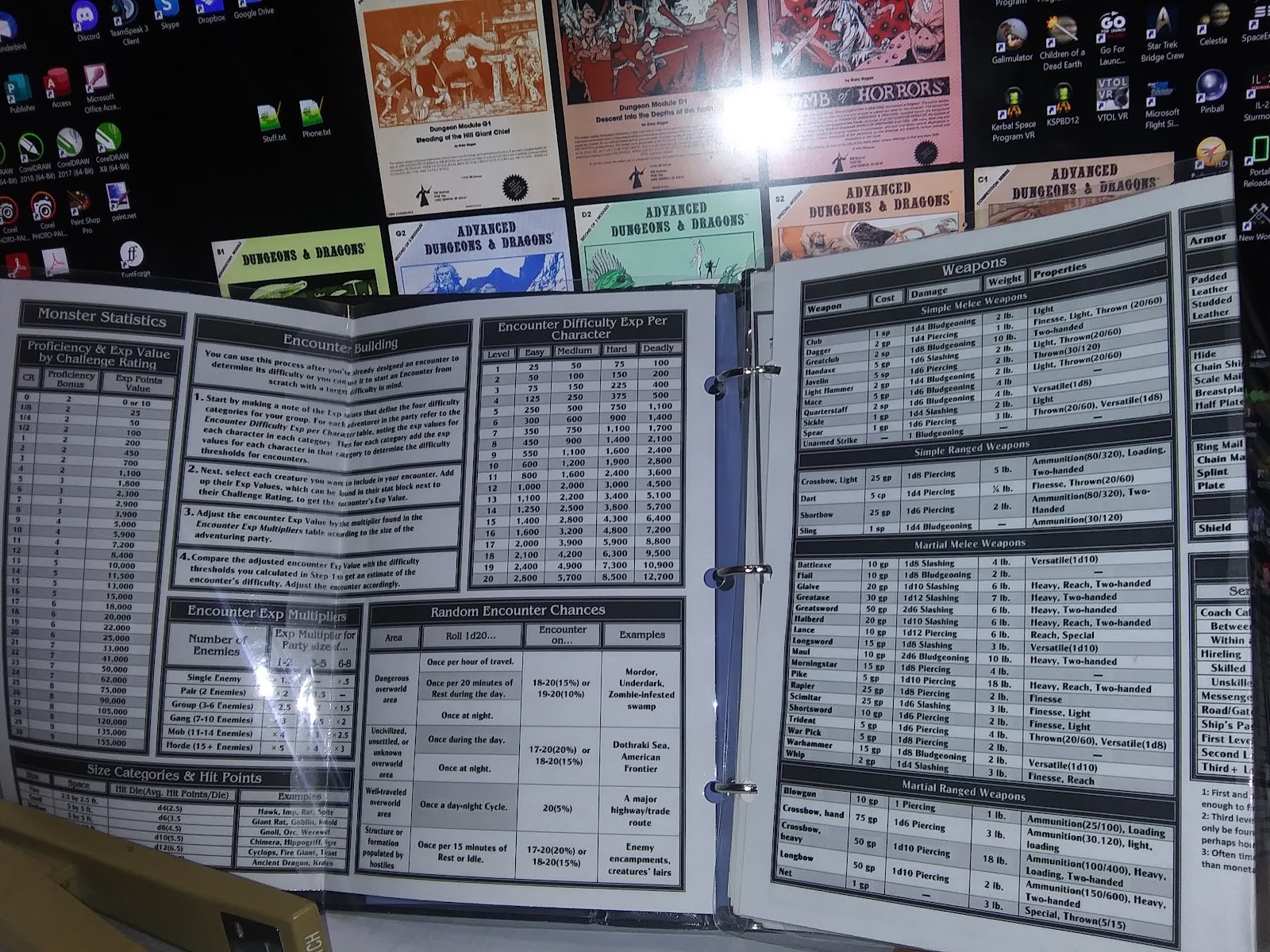
  • My favorite letter sized 5e reference charts, shrunk a tad, laminated and turned into fold outs.
  • A blank 5e character sheet
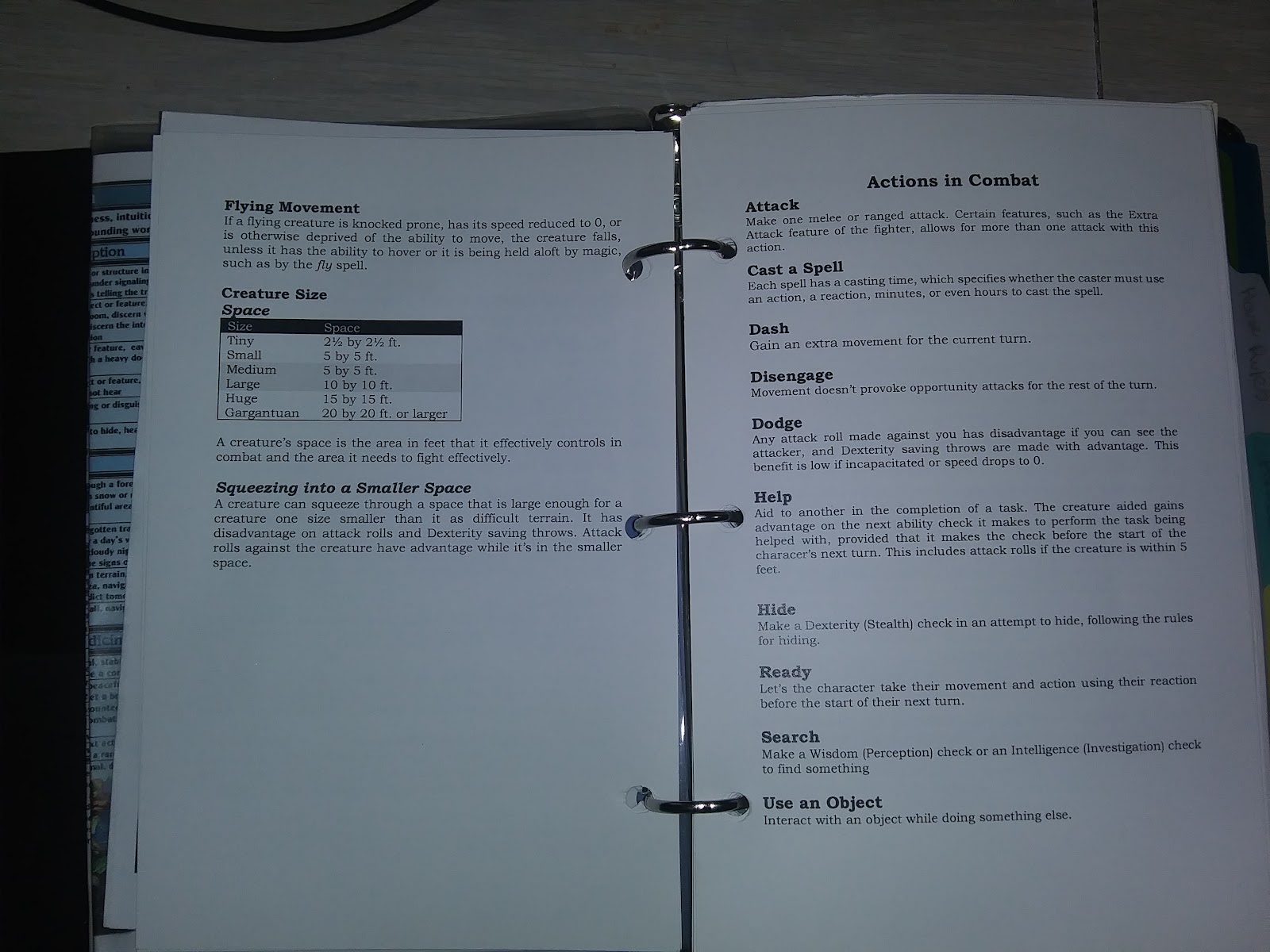
  • A terse combat summary


  • A letter sized foldout map of Blackmarsh
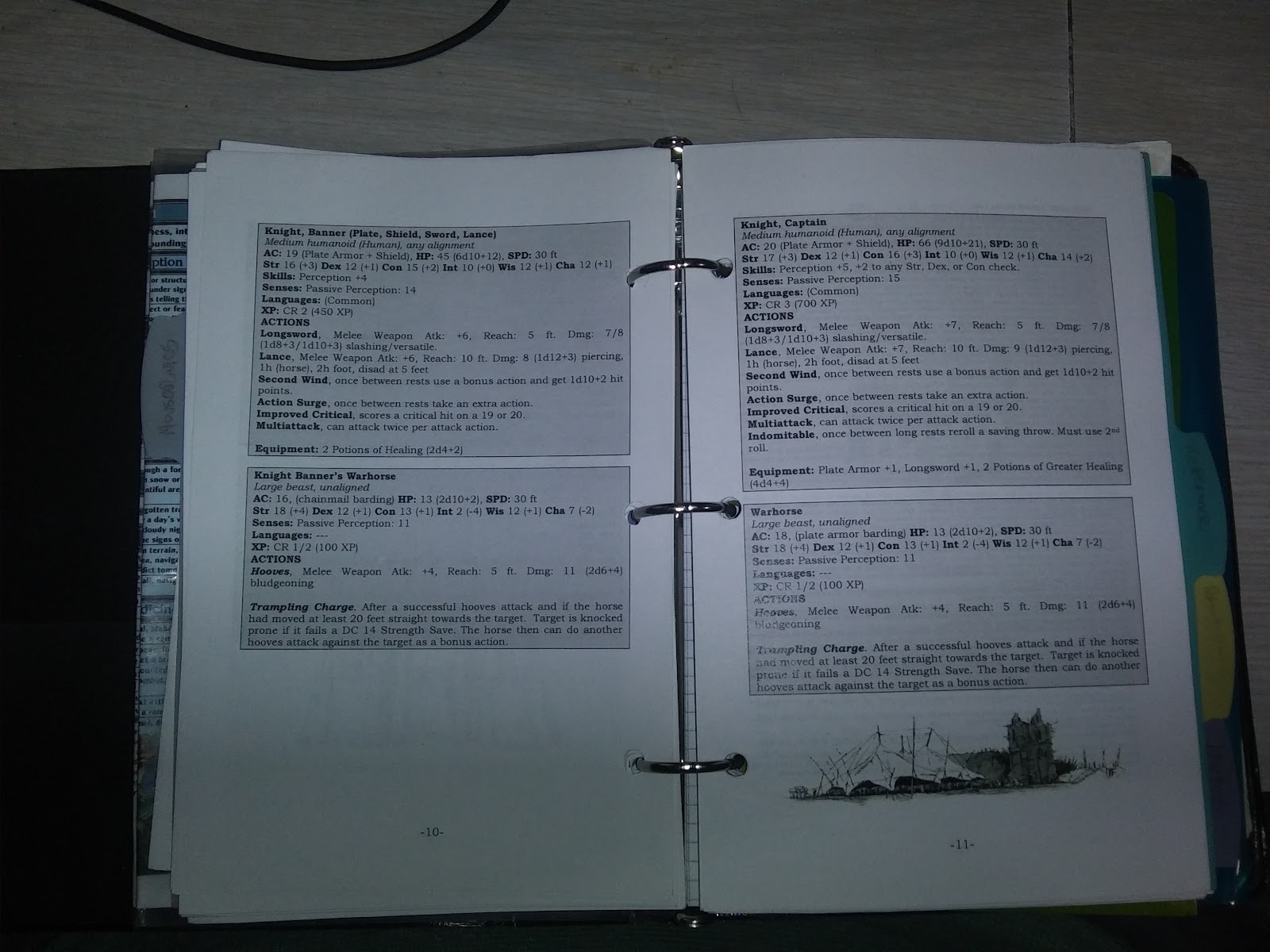
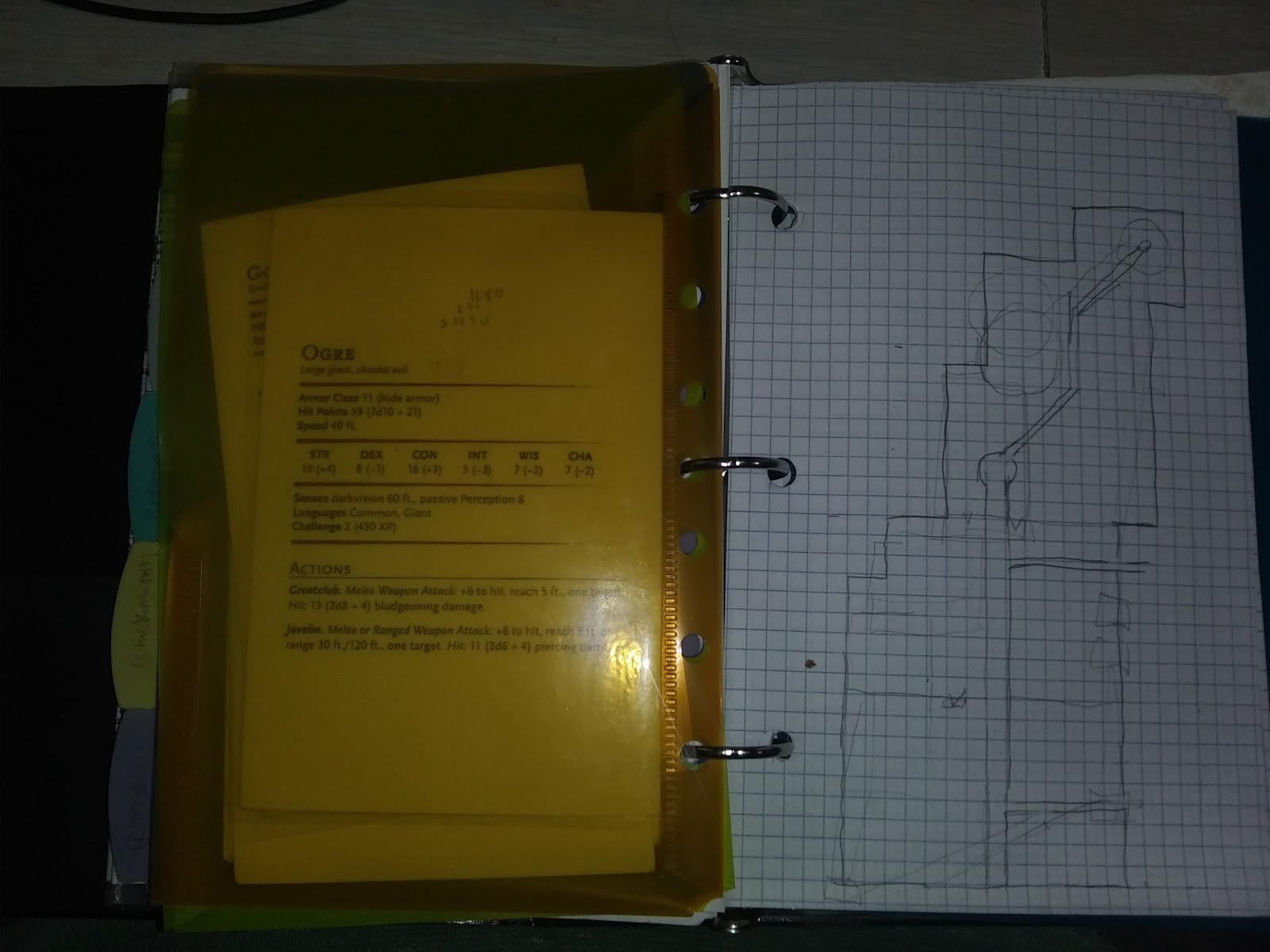
  • Pocket inserts with 5e monster stats printed on index cards.
  • Graph Paper
  • A pouch insert with pens, pencils, and blank index cards.
  • I also have 5e reference booklets that I used before this in the inside pockets of the binder.
Handy Amazon Links

Tuesday, July 16, 2019

D&D 5e Essential Kit.


What it is?
A boxed set available only at Target for starting out with DnD 5th edition. Includes rules, aides, and an adventure.

The Details
The rules are far more complete than the DnD Starter Kit. They describe five character classes Bard, Cleric, Fighter, Rogue, and Wizard up to 6th level. An addition are rules for sidekicks which clearly not only play the role of traditional hireling but also as additional adventuring companions for smaller groups. The rules go into how to level sidekicks. There are three categories of sidekicks; Experts, Spellcasters, and Warriors.

The aides include a doubled sided poster maps of the Sword Coast around Neverwinter on one side and the village of Phandelver on the other. A set of cards that are mostly magic items but also include initiative tracking, condition tracking, sidekicks, and quests. There is a referee screen, and six character sheets.

The adventure, Dragon of Icespire Peak, takes place in and around Phandelver much like the Lost Mine adventure in the starter kit. In general it is a set one session quests combined with tables to determine where the adventure's antagonist, Cryovain, a young white dragon, is at when the party travels.

The quest structure comes off a bit like a video game however it also a structured sandbox. It start off with two quests available on the "job" board in Phandelver and then goes from there. The quest, the town descriptions, and the random tables governing the dragon all point the party to a confrontation with the Cyrovain and the conclusion of the overall adventure.

Honestly for something that trying to get a novice going, this adventure is well down for a potential sandbox adventure. If the referee doesn't get it right away the quest structure will keep things going in a way that fun and feels like progress is being made. For referees that want to branch out there is enough in adventure and the boxed set to do so.

I will say that most of the adventure location are fairly fleshed out. Many are  complete small dungeons or adventures.

Yeah but I am not a novice
While a bit pricey as an expansion, this in conjunction with the Lost Mines adventure found in the Starter set makes for a very nice campaign. With two primary antagonist and a wealth of locations to explore nobody is going to feel railroaded or hemmed with the combination.

And the digital
DnD Beyond is the official digital platform for D&D fifth edition. There is a lot not to like about the business model as it could "go away" at any time because all their content is hosted on their server. Thus when they go away, the content will go away.

But the app and website make looking up stuff convenient on your computer, tablet, or smartphone. Very convenient as I been finding out.  Enough so that there may some merit of doing something similar with the various retro-clones of the OSR.

The DnD Essential Kit comes with two codes. The first allows you to buy the 5e PHB on DnD Beyond at half price, the second gives you the Dragon of Icespire Peak for free.

In playing around with this, I learned that you can add the DnD 5e basic rules to your app or account for free. With the Dragon of Icespire Peak adventure you get a substantial peak of how the functionality of DnD Beyond works.

Like looking up specific spells, abilities, or classes, I can quickly zero in on a location within the adventure. With the website I can also pull up images of not only the keyed map but also a player version that I can save and use with Roll20, Fantasy Ground, or print out for the table.

For example the map for a mine adventure

DM Map                                             Player Map

Overall I was pleased at the functionality and convenience but it definitely optional. My recommendation is to try the Basic Rules and above adventure if you get the Esstentials Kit and see if it is for you. I opted to get the PHB for half off as I know I would use it. I just got a smartphone and it proving far handier than I thought it would be. This just adds to the functionality of the device.

Wrapping it up.
I consider the Lost Mine of Phandelver one of the best DnD adventures ever made.  The Dragon of Icespire Peak isn't quite up to the level of the Lost Mine however it function very well as an expansion to that adventure.

The Essential Kits does way better on the rules presenting levels 1 to 6 of five different classes in conjunction with the various packaged aides. I would recommend this for anybody starting up with tabletop roleplaying.


Friday, April 27, 2018

Dragon Heresy Kickstarter

My friend, Douglas Cole of Gaming Ballistic is in the final 48 hours of his kickstarter  for his Dragon Heresy Introductory Set.

Dragon Heresy is a Dnd 5e variant that is a gritter take on the fifth edition mechanics. In addition the setting he created for his RPG has an interesting take on Norse mythology and culture.

Currently I am running an Adventures in Middle Earth campaign. The experience had lead me to conclude that Mearls and his crew did an excellent job of designing an RPG that can be adapted, with tweaks, to radically different settings and sub-genres. Dragon Heresy is another excellent example of using that flexibility.

Head on over to the kickstarter and listen to Doug's pitch and see if it something that interests you.

Tuesday, January 23, 2018

Making a campaign human centric with the least amount of violence to RAW

+Joshua Macy has a complaint that not uncommon, all the players in his campaign made non-human characters. Let's face it, non humans are cool kids of fantasy roleplaying. Most races have interesting backstories, memorable characters, and of course the racial abilities. Sometimes all three like with the Drow.

Starting with DnD 3.0, later edition attempted to rectify this by giving Human their own racial abilities. Typically extra flexibility by granting a feat or two, increased ability of the player's choice, or more skills. But still it seems lacking and rather bland.

The primary way I fixed it was to grant a 15% XP bonus for humans that works the same as the XP bonus due to having a high prime requisite. Read below the fold for my reasons why.

Monday, January 22, 2018

Why Middle Earth is working for me, the Cubicle 7 supplements

There are two main things that "sold" me on Adventure in Middle Earth by Cubicle 7. The fact that magic is presented as subtle in the core books, and the quality of their supplements.

First most of the AiME contents is repackaged from their The One Ring (TOR) equivalent. What differs are the short sections of either AiME rules or new stuff like NPCs, Creatures, and items. The rest is duplicated from the original TOR version. Luckily the TOR stuff is excellent. But I have to put it out there so you are not surprised in case you decide to buy the TOR supplement AND the AiME supplement. The Moria Boxed Set will be the first Middle Earth product that new to both TOR and AiME. For the rest TOR is generally ahead on the release schedule but AiME is catching up.


Rhovanion Region Guide
TOR and AiME have a class of supplements that can be characterized as a region guide. Both games have a referee hex map that divide broad areas of Middle Earth into regions. One reason for this is that the hex map works hand and hand with the journey rules. Another is that it offers a useful way of  organizing the geography for supplement like this one.

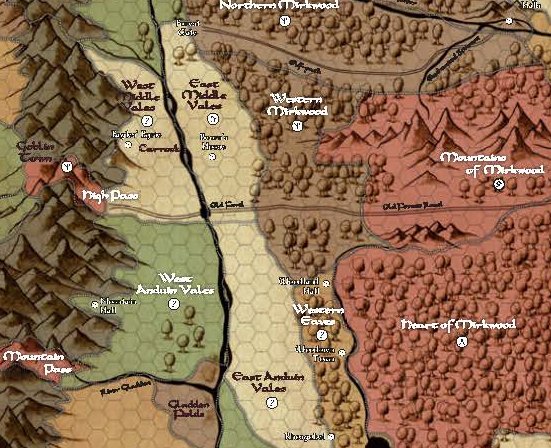
This is a section of the referee's map for the Wilderlands in Rhovanion.


The reddish area are the place that are most  dangerous to travel in as the party found out last week when they were attacked by a swarm of black squirrels in the middle of the Heart of Mirkwood.

The Rhovanion Region Guide has three major section. The first covers the regions along the river Anduin, the second covers the regions of Mirkwood. Dale, Lake-town, and Erebor are not covered although the TOR supplement for these areas have been released. The last section are new adversaries found in these region. It includes NPCs like Gorgol, son of Bolg, and the more general like Hunter Spiders. Seventeen new foes are added plus numerous NPCs in the various region writeups.

Out of all the supplements this is perhaps the most useful.

Each region is given a general description. Has a section called combat scenery which is advice on where typical encounters take place. A description of the wildlife, and inhabitants. This is followed by a list of notable inhabitants. For example the East Middle Vales describes; Beorn the Shape-shifter (from the books), Turin the Tinker, Gelvira Pot-stirrer, Ennalda the Spear-maiden. The last three are original characters created by the author. Turin is a useful contact about the what going on. Gelvira runs a inn at the Old Ford which can be used as a home base by the PCs. Ennalda is a spear-thane of Beorn and is likely the person the PCs will interact most with if they associate with the Beornings.

Then the section goes on to describe notable places within the region. Which for the East Middle Vales is The Carrock (from the books), The Old Ford, The Isle of Strangling Tree, Beorn's House (from the books), The Grey Heath, and The Cleft of Storms. All of these provide interesting places to explore or have roleplaying possibilities.

Man it looks packed
It is and it isn't. While there are a lot of things described it isn't like my mini-region in Scourge of the Wolf where I provide a capsule description of a dozen settlement within a 25 mile radius. Each hex in the above map is 10 miles not quite the howling emptiness of Greyhawk's 30 mile hexes but large enough that even with what I described for the East Middle Vales you have to spend a day or so travelling to each site. And if you go outside of that, you are talking journey of a week or longer.

When you look at the below map for the East Middle Vales keep in mind that you are travelling two hexes (20 miles) per day by foot. That the only two "settlement" are The House of Beorn and the Old Ford with perhaps the Carrock when the Beornings meet there. Where are the Beornings? Read the description from the book.
While most Beornings live in isolated farmsteads, there are a few… well, towns would be an exaggeration. Call them villages, or steadings, clustered around trading posts or river crossings; one of the largest has sprung up in the vicinity of the Old Ford. 


I will talk about the other supplements in the next post.

Tuesday, January 16, 2018

Why Middle Earth has been working for me

Since the beginning of summer I been running a Middle Earth Campaign using Cubicle 7's Adventures in Middle Earth. My friend Tim's blog post reminded me that I haven't blogged on the campaign in a while.

One of the initial reason I was attracted to Dungeons and Dragon in the late 70s was due to my love of not only Lord of the Rings but the history that was revealed in the Return of the King appendices.

DnD offered me a way to take that love and actually turn into something more concrete than scribbles on a paper. Because Tolkien's history described realms rising and falling, naturally I was open for the players to do the same. Leading to me to be the referee that let players "trash" his campaigns.

The disappointment of Iron Crown MERP
As the hobby and industry expanded I looked for material to help me with this. I found it easier to use things that were grounded in the medieval side of fantasy. Then layered the level of magic I liked on top of it, Harn and Ars Magica I found particularly useful.

During this time Iron Crown published their Middle Earth Roleplaying System or MERPS. I really wanted to like this RPG and their supplements but they paled compared to the quality of Harn, Ars Magica, and Pendragon material I had. Everything except for Pete Fenlon's maps which were great.

The main problem with the game and supplement is that they didn't feel very Middle Earth to me. Yeah they had the names, characters, and locales but they lacked that spark that Tolkien infused the books with.


Over the years I collected two dozen MERPS books which remained unused until I gave them to a friend who really like the game and Middle Earth in the early 2000s.

During that time Decipher released the The Lord of the Rings Roleplaying Game. Then Cubicle 7 released The One Ring RPG. I looked at both and felt they were more interested in having the referee tell Middle Earth stories to his players rather than helping the referee bring Middle Earth to life as a place for the players to experience.

I know a subtle point but to me the distinction is important. When I referee I am not into telling my stories. My goal is to bring a setting to life so that the players felt they actually visited another place and did interesting things that were fun.

Adventures in Middle Earth
Then came along Adventures in Middle Earth also by Cubicle 7. I wrote a review of the first book in this post. Because it was rested on the foundation of DnD 5e, I knew that there was a limit to the amount narrative mechanics it could have. After reading it, I was intrigued because of how they reworked the classes, eliminated DnD style spell,  and turned feats into virtues More than just a Middle Earth RPG, it was a very much a low fantasy RPG using the mechanics of DnD. And completely avoids the issues I had with MERPS which to me always felt like DnDish fantasy, routed through Rolemaster, dressed in a thin Middle Earth outfit.

So I wanted to run it to see how it played, and so started a campaign. I started buying the supplements. It is in the supplements that Cubicle 7 kills it. It doesn't matter if it is the AiME version or the ToR version they make killer supplements for ANY Middle Earth campaign. And the stats are presented with light enough touch that they are easily adapted to your RPG of choice.

And their initial focus on setting the RPG in Wilderlands is brilliant. In the Return of the King appendices we know shit went down in the Wilderlands, both Dale and Erebor were attacked by the forces of Sauron. We get a paragraph of details and that it.

This means that a Middle Earth campaign can be set during the time period of the Lord of the Rings where the players are truly the heroes that matter. The members of Fellowship of the Ring may have ultimately ended Sauron and the war but dozens of other locales has their own struggles and victories. To be specific the various ToR and AiME products are all set between the Battle of Five Armies and the beginning of the Lord of the Rings novels.

The actual supplements are some the best adventures and campaign guides I seen outside of Harn, Pendragon, and Ars Magica. They range from regional supplements, books of adventures, to a pendragon style grand campaign spanning decades. And when they expanded to other reasons like Rivendell, Rohan, and Bree, the authors done a great job of opening enough of a crack that what the players do matter but still make the events of the novels plausible. For example Rohan regional supplements (Horse Lord of Rohan) and the associated adventure book (Oaths of the Riddermark) all focus on helping Thengel, the father of Theoden, the King of Rohan from the novels.

Next up is a Moria boxed set which I can't wait to see. It been a while since I bought into a RPG line wholesale and Cublicle 7 has earned my dollar.

The Campaign
I will blog more about what I am doing in my AiME campaign but I want to point out one thing. The biggest difference I am noticing is the pacing of in-game time. At first the alternating cycle of fellowship phase and adventure phase seemed seem too much like a straight jacket akin to the metagaming mechanics that other games use to in a vain attempt to create a "narrative" in the campaign.

But then I found it makes for a great way of abstracting the downtime between adventures. I am always a fan of what most hobbyists call down time activities. For example in my Majestic Wilderlands Thursday campaign  one player is always using the magic item creation rules, while another is busy lining up trade deals.

What make AiME fellowship rules nice that they are not all meat and potatoes activities (trade, crafting, training, etc). About half of them are what I call pure roleplaying focused on interacting with NPCs. Here is a partial list.

  • Gain a Cultural Virtue
  • Gain an Open Virtue
  • Gain New Trait
  • Heal Corruption
  • Influence Patron
  • Meet Patron
  • Receive Title
  • Open Sanctuary
  • Recovery
  • Research Lore
  • Secure a Supply of Herbs
  • Tend to Holding
  • Training

Added to this are version regional undertaking. For example a couple of sessions back the PCs made friends with a group of Woodsmen living next to the Old Ford across the Anduin. That settlement has a special undertaking called Guard the Old Ford. Which offer the possibility of earning a bit of rare coin from the tolls levied on travelers.

Wrapping it Up
Again I am having a great time and now that I have several months under my belt I will be posting on some of the interesting things I learning running a Middle Earth campaign.

Thursday, October 26, 2017

Observations on what is Dungeons and Dragons

 After working with this stuff for a decade I observed that there are common elements in the RPGs that are consider compatible with one or more editions of DnD. I found it useful while working on my Majestic Fantasy Rules to keep these in mind as I develop various subsystem.  There is no right or wrong way of doing this but it is helpful to have a starting point. 

My view of what constitutes a minimum set of mechanic for a DnD related RPG are:
  • Six attributes: Strength, Dexterity, Constitution, Intelligence, Wisdom, and Charisma generated on a 3 to 18 scale with 10 being human normal average.
  • Saving throws to avoid bad things.
  • Armor Class as a target or an index to a chart to see if damage is scored.
  • A d20 to-hit roll
  • Difference races/cultures that offer a package of attributes bonuses and abilities.
  • Experience is represented by higher levels. 
  • Classes that are a package of abilities arranged by levels.
  • A character's health is represented by Hit Point when brought to zero incapacitates or kills the character.
  • Creatures can have hit dice instead of levels.
  • Creatures at a minimum have hit dice, hit points, movement, armor class, and a list of special abilities including attacks.

Beyond this anything is fair game. As long the above list is implemented it will be highly likely that the game will be seen as DnD compatible.

The Numbers
The interplay of the numbers used for the to-hit roll, armor class, hit points, and damage is a large part of what gives a specific edition their flavor.

You need to keep this in mind because the numbers work out differently for ODnD, ODnD+Greyhawk, ADnD, ADnD+Unearthed Arcana, Holmes Basic DnD, B/X DnD, BECMI DnD, ADnD 2e, ADnD 2e + Skill n Powers, DnD 3.0, DnD 3.5, PathfinderDnD 4e, and DnD 5e.  The good news it is not rocket science. Just need to figure out what edition you want it to be like and go from there.

Simplifying things even further the above can be grouped into broad categories:

  • Classic DnD (ODnD to ADnD 2e)
  • DnD 3.X (DnD 3.0 to Pathfinder)
  • DnD 4e
  • DnD 5e

The Stuff
If you noticed I didn't mention anything about specific classes, spells, magic items, lists of monsters, etc. To me these are setting details, either specific settings like my Majestic Wilderlands, Tekumel, Blackmoor, or Forgotten Realms. Or the generic fantasy that the core books of most editions of DnD assume.

With stuff like Dark Sun, Spelljammer, Eberron, Lamentations of the Flame Princess, Arrows of Indra, Spears at Dawn, and other worthy works, I think it been established a RPG can be considered DnD even if it depicts a radically different setting or different vision of the fantasy genre.

For most of these games this was accomplished by having a different set of class, items, monsters, and even different systems of magic.

Conclusion
The point of this post is to offer a useful starting point from which to develop your own take on the world's most popular roleplaying game.


Friday, October 13, 2017

Is your D&D 5e Character Rare?

Five Thirty Eight niche is using statistics to analyze sports and politics. But occasionally they turn their attention other topics. This time was the different type of DnD 5e character made with DnD Beyond, the online tool officially licensed by Wizards of the Coast. Recently Curse, the company beyond DnD Beyond supplied Gus Wezerek of FiveThirtyEight with a breakdown of the combination of class and race people were making on the service.

Looks like there quite a few folks using the tool numbering in the tens of thousands. Below is the data presented in chart form. It look like the winner is the good old Human Fighter followed by the Elven Ranger.


Tuesday, October 10, 2017

How much is having Initiative worth?

So here is an interesting combat question how much initiative is worth to the side having it in various editions of Dungeons and Dragons?

When I was mucking around with Fudge, I wrote a program that simulated two guys whacking the other with swords. I did this to see how the number worked out over thousands of fight. I coded up GURPS Basic Combat and classic DnD Combat to use as comparison.

One of the things I did was randomized starting initiative at the beginning of combat. Then alternated sides from that point on. So I was playing around with it today and I noticed something interesting. When two combatant have equal stats with random starting imitative the odds look like this for 10,000 fights.

Alex Wins 5060
Brian Wins 4940
Average Rds 4.1268


So when I gave Alex starting Initiative all the time. The result was this

Alex Wins 5575
Brian Wins 4425
Average Rds 4.08065
Then switched to Brian

Alex Wins 4512
Brian Wins 5488
Average Rds 4.0986


The implication is that having initiative all the time increases your odds of winning combat by 4.5%. This is especially relevant to DnD 5th edition where the default is to roll initiative once.

Note: Both Alex and Brian had AC 12, +1 to Hit, 1d8 damage, and had 10 hit points.


Sunday, November 13, 2016

Dungeon Grappling Kickstarter

Douglas Cole of Gaming Ballistic has started a Dungeon Grappling Kickstarter. He was a great player in my DnD 5e Majestic Wilderlands campaigns, and the author of several GURPS Supplements including Technical Grappling for GURPS.

The basic idea is that there a better way of dealing with grappling. Doug developed a set of mechanics that takes the same basic mechanics of rolling to hit and inflicting damage and turns the result into something meaningful when it comes to grappling. He did this for GURPS and now he doing this for classic DnD, Pathfinder, and DnD 5e with the kickstarter.

Doug's project already funded however further support will allow him to pay for a ebook layout and full color art. I hope you will support him.

Wednesday, September 14, 2016

Adventures in Middle Earth, a review

I bought Adventures in Middle Earth, the D&D 5th edition sourcebook for Tolkien's Middle Earth produced by Cubicle 7. Cublicle early published The One Ring RPG after securing the Middle Earth license. I have PDFs of the first two books of The One Ring. It OK but not really my style as it has to much narrative/metagaming mechanics in it and abstract in other eras like combat. It seem to me more focused on creating stories set in Middle Earth than experiencing what it is like to do things in Middle Earth. Which is what I want out of an RPG I referee.

So I was eager to get a crack at a D&D 5th edition sourcebook because if they make a honest effort at being a sourcebook there only so much storytelling metagame they can try to jam in. And the good news overall, they do a good job. It is a solid 5th edition sourcebook.

So lets get that out of the way. Adventure of Middle Earth isn't a clone it is a source book. You will need the D&D 5e core book, the 5e SRD, or the 5e basic rules on hand to run this. The Loremaster supplement looks like it will extend the Dungeon Master side rather act as a replacement.

The Wilderlands

The default setting of The One Ring and Adventures in Middle Earth is set in the Wilderlands (the area in which Tolkien's Hobbit took place) after the death of Smaug and before the events of the Lord of the Ring. Now that Smaug is dead, people are resettling and reclaiming old homes and building new ones. But evil still lurks and Sauron's hand still reaches out from the darkness of Mordor.

But Cubicle includes enough of the rest of Middle Earth that you could pretty much set your campaign anytime after the downfall of Numenor in the 2nd Age. Perhaps even back to the end of the first age if you know your Tolkien lore and proficient in D&D 5e. The only major thing that is omitted are the high elves like Elrond and those who live at Rivendell.

The first section is devoted to fleshing out the Wilderlands and its inhabitant. It is a travelogue full of high level details. You will have to work at fleshing a specific area in order to start a campaign. If your know your Tolkien already it serve as a useful summary of what they are planning to cover.

Cultures
Adventures in Middle Earth is not focused on race but rather cultures. Races are wrapped up in this sections so you can play a Dwarf of the Lonely Mountain, or an Elf of Mirkwood. Men of Bree are treated a little different than Men of the Lake which are not the same as the Dunedain. The full list is Bardings,Beornings, Dúnedain, Dwarves of the Lonely Mountain, Elves of Mirkwood, Hobbits of the Shire, Men of Bree, Men of the Lake, Men of Minas Tirith, Riders of Rohan, Woodmen of Wilderland. Like I said before the only major omission are the Elves of Rivendell.

I am all for the culture based presentation as when I run my own Majestic Wilderlands, I focus on the adventure that rises out of the clash of culture, religion, and politics. However I am little disappointed in the write up of the elves. My own version is largely taken from Tolkien's writings. Here they are pretty D&D 5e elves with a few changes to make them into Middle Earth woodland elves. I think they were afraid to present an "unbalanced culture" even though that would better reflect Tolkien's source material.

But this a minor nitpick in otherwise good job in this section.

Classes
I have to say that classes and how they all mesh together is pretty sweet. In my view this is the definitive low fantasy presentation of D&D. There is still magic but it is very low key. Here an example of a 17th level Scholar ability
Words Unspoken
At 17th level, you may convey your thoughts without speaking aloud. When dealing with high-level Scholars, Elves, Dúnedain or other folk of power, you may hold a full conversation, speaking mind to mind. Others have a sense or intuition of your words, but cannot reply, and may misinterpret your thoughts as their own. You cannot read the minds of others with this ability. Once per long rest, you may send brief snatches of your thought over great distances, conveying a single word or short message in dreams.
Here the list of classes and their specialties Scholar (Master Healer, Master Scholar), Slayer(The Rider, Foe-Hammer), Treasure Hunter(Agent, Burglar),  Wanderer(Hunter of Beasts, Hunter of Shadows), Warden(Counsellor, Herald, Bounder), Warrior(Knight, Weaponmaster).

The downside, none really. I didn't spot any obvious mistake and they all convey the flavor of Middle Earth. I can them seeing working with the traditional 5e classes in another setting. Even they are "weaker" than standard 5e classes when it comes to combat, they will probably do quite well in terms of the life of campaign setting. Probably better than most of the standard classes as they feel more organic.

Virtues
Now this is a clever use of feats. On one hand Virtues are nothing more than 5e feats with the additional provision that some are limited to specific cultures. Just like feats you acquire them in lieu of an increase in ability scores. (4th, 8th, 12th, 16th, and 19th level).

They work for Adventures in Middle Earth as they all been rewritten to fit in the Middle Earth setting. For example this for Dunedain
Endurance of the Dúnedain
"Hardy is the race of Elendil!"
The Dúnedain have long endured war against Mordor and the forces of the Great Enemy. They are slow to weary and endure burdens stoically. In battle they are fearsome foes, often able to fight on against overwhelming odds and in spite of grievous wounds.
When a blow reduces you to 0 hit points, but does not kill you outright, you may spend Inspiration to automatically stabilise, remain conscious and continue to take actions.
I read one interesting suggestion by a fan that all characters of a given culture should automatically get their cultural virtues. That might something you want to try.

Backgrounds
All specific to Middle Earth and pretty much have the same effect as they are in the D&D 5e core books. Of course this specific character mechanic was meant by Mearls and crew to be customized for ones campaign.

The backgrounds are Loyal Servant, Doomed to Die, Driven from Home, Emissary of your People, Fallen Scion, The Harrowed, Hunted by the Shadow, Lure of the Road, The Magician, Oathsworn, Reluctant Adventurer, Seeker of the Lost, and World Weary.

Equipment
The D&D 5e equipment list modified and rewritten to fit Middle Earth. The most interesting thing are culture heirlooms which function as roleplaying macguffins and minor magic items. You get them either by taking the Cultural Heirloom virtue, maybe as treasure, and perhaps as a result of a successful audience
Númenórean ArrowsFor many long centuries, the “Men of the Sea” sent cohorts of archers to deluge their enemies under a rain of steel. Their long, black-feathered arrows can still be discovered inside burial mounds, among the tall grass of Eriador or where long-forgotten battles were fought across Gondor.
You start each Adventuring phase (see pg. 198) with a number of Númenórean Arrows equal to half your proficiency bonus (round up). When you attack using a great bow, you may declare that you are using one of them. If you succeed on your attack roll, the arrow does additional damage equal to your Wisdom bonus; moreover, your target’s next attack is made with disadvantage.
At the end of the battle you can recover your used arrows if circumstances allow it, unless you rolled a 1, in which case, that arrow is lost or broken beyond recovery.
I want to note that I like the section on Middle Earth herbs. It fits well with the low fantasy feel of the product.

Journeys
Now here is an interesting section where they give you some mechanics for making journeys interesting. If you read the book, you know the character travel a lot. This is their way of fitting that into a Middle Earth campaign. It is consist of three main things. First, the conditions at the start of the journey, a way of generating what your encounter on the journey. And then your condition at the end of the journey.

It is the latter that will probably get ignore by traditional 5e gamers because it requires you to roleplay how your character feels. Many if not most players react poorly to mechanics that dictate how they must roleplaying. It one thing to read a cultural or race description to use as a starting point, it is another to have a specific mechanics that says
3. Arrival in Poor Spirits
They are beset by foul moods and short tempers that they must work hard to throw off. They are considered disadvantaged on all rolls pertaining to social interaction, until such time as they succeed in one of these rolls. This penalty will apply if they seek an Audience at the destination. If there is a single upside to this dark mood, it is that they are so spoiling for a fight that each member of the company receives advantage to their Initiative rolls should they find themselves in combat at the destination.
It not that that this can't work in a campaign, but it will have limited appeal. While success at overcoming the various challenge during the journey has an impact on the final rolls. I will have to try it and see how it works but it may be too random. The system for generating encounters however is solid.

Keep the roleplaying aspect in mind as move forward. Aside from the occasional use of 5e' Inspiration mechanics there is little in the way of anything involving metagaming or narrative mechanics. There however a whole lot of what I would call roleplaying mechanics. Think how people play being charmed, under the effects of a confusion problem, suggestion, etc. Some groups roleplay it quite well, others don't.

Shadow
There is no alignment in Adventures in Middle Earth. There is however corruption. The basic idea is the more evil acts you commit, the more evil you experience, the more open you are to the corruption of the shadow that is Sauron. This is basically Call of Cthulu sanity mechanics adapted to Middle Earth and crafted to fit with D&D 5e. Like Coc insanity mechanic, successfully using this require player willing to roleplay. The part with the least appeal will be where even exposure to evil cause corruption. While true to Tolkien's presentation of Middle Earth, many players will not find this appealing. Particularly as it runs up against the player's tendency to thrust themselves into danger in pursuit of their goals.

Audience
Another feature of Tolkien's stories is that the adventurers will occasionally encounter the great and mighty of Middle Earth mostly in the form of audience where they either have to explain themselves, or ask for a favor. This short section gives some rules and guideline for making this work during the course of a Middle Earth campaign.

The Fellowship Phase
Ars Magica was an RPG released around 1989 that focused on players roleplaying mages living in a secret magical society within the confines of otherwise medieval Europe. Pendragon is another RPG focused on roleplaying in the setting of of the legend of King Arthur and features, among other things, playing characters across generation of a family. Both of these games devote a portion of their rules to laying out system of time keeping to reflect how character live their lives within each setting. Unlike many D&D campaign, the time adventuring is the exception not the norm. Both RPGs have rules that flesh out the other parts of the character's lives.

The Fellowship rules does this for Adventures in Middle Earth. The idea is that at the conclusion of an adventure the fellowship disbands for a time and the character return to their lives to recover, heal, or to undertake long term projects. Then the fellowship is reformed when the course of events require everybody to adventure again. An important use of the Fellowship phase to recover from corruption.

Adventures in Middle Earth pretty glosses over the details and references the upcoming Loremaster book. It also mention sanctuaries which I assume are places like Rivendell where players find safety. It also mentioned that it not totally devoid of action or important events. For example Elrond's Council in LoTR, Lothlorien, or Elrond helping Thorin and Company in the Hobbit.

Conclusion
Overall I am pretty happy with this product and eager to see the Loremaster book. I hope to run a campaign provided my players are interested in the roleplaying aspects.

Addendum - Inspiration. 
+Douglas Cole asked what they have to say on acquiring inspiration which has a brief mention in the core rules of DnD 5e. Inspiration plays a major part in various specific abilities. And they do give more specifics on how to earn inspiration. Although at its heart it remains a judgment call on the quality of roleplaying done by the player.
From the General Overview
Roleplaying your character in accordance with your background grants Inspiration. Inspiration not only allows Adventures in Middle-earth a roll with advantage, it can also be spent to trigger certain special abilities, representing an effort of will or the use of an innate power. Finally, while a character has Inspiration, they may avoid the worst effects of being Miserable.
From Backgrounds - Distinctive Quality
Distinctive qualities define a Player-hero’s personality traits and physical peculiarities, whether inborn or developed during their upbringing. Highlighting one’s most distinctive quality is generally worth the awarding of Inspiration.

Distinctive Qualities are one of the four tables for  each background and have entries like
2 Fair-spoken. You have a pleasant speaking voice that puts your listeners at ease.
3 Honourable. You are the consummate diplomat and have garnered a reputation for being respectful with your foreign peers.
While they don't say it outright I get the feeling that the Loremaster Guide will be covering the awarding of Inspiration.

Monday, May 16, 2016

D&D 5th edition 1.1 SRD released

While it was great that DnD 5th edition got a System Reference Document under the Open Game License, there were some flaws with the document. Notably the lack of the Eldritch Blast cantrip for the Warlock.  Now it looks like Wizards cleaned it up and added a few more things like rules for magic item attunement and use. And the document has been reorganized a bit.

You can download it from here.

Here is the full changelog

  • Various key spells used by classes, magic items, and monsters have been added to the spells section. For example, the eldritch blast cantrip is essential for many warlock abilities, and is now part of the SRD.
  • References to any archetypes (and similar choice-based class features like cleric domains) that aren’t in the SRD (like wild magic for sorcerers) have been removed from the text to avoid confusion.
  • References to “chapters” are gone, as the SRD isn't organized by chapters.
  • Bookmarks have been added for the most important and frequently-referenced topics.
  • A few text corrections have been made (such as a few references to "DM" instead of "GM," some typographical errors from importing the text from its original source, and incorporating errata from the Player's Handbook, Dungeon Master's Guide, and Monster Manual).
  • All appendices have been moved to the end of the document. For example, the Conditions appendix from the Player's Handbook used to appear in the middle of the SRD, but now it's at the end. To avoid confusion between appendices taken from the Player's Handbook and the Monster Manual, the appendices now have a PH- or MM- prefix as appropriate.
  • Rules for magic item attunement, activating items, and wearing and wielding items are now in the SRD.

Thursday, February 18, 2016

Releasing my first D&D 5e product for free!

A couple of weeks ago Wizard of the Coast has graciously released a system reference document for DnD 5th edition. I been busy with mapping projects but I did have something that was more or less finished. So I took the time and polished it up for release.

When I go to conventions, I like the players to roll up their characters. Because time is precious, I evolved a way to do this quickly. One thing I did was to create crib sheets that distilled the character creation rules into a minimal format. A quirk of my convention games that I have the players roll for starting level, a trick I swiped from +Jeff Rients Under Xyaltaren's Tower module. This results in mixed parties of characters ranging from 1st to 6th level. One implication of this is that if you are lucky enough to have rolled a 5th or 6th level character you can start with a magic item!

So without further ado, I present Basic Character Classes Level 1st to 6th. This should help out +Erik Tenkar get up to speed on learning DnD 5e as well.

The product is designed so that you can print it as a booklet and everything you need to create a character in there. The character class description is design as a bullet list. Once you know your level you just start at the top and work your way down recording everything up to and including your level.

By spring, I hope to release a full version covering all the SRD classes along with a version based off of my Majestic Wilderlands rules and Swords and Wizardry.

Wednesday, January 13, 2016

Brief pass at the 5e SRD

So I skimmed over the DnD 5e System Reference Document. The following leaped out at me.

  • Classes have one option each similar to what they did to the four core classes in the basic rules. 
  • I think some classes suffer a bit because of this particularly the Warlock patrons. 
  • Spells, Magic Items, and Monsters are extensive but it will take a bit of time to make a list to see what there and what is not.
  • The document layout is not amicable to just reading it. I had to break up the PDF into its component chapters to make sure I understood what was in it.
  • Because of the above, we are going to see a wealth of indexes and reformatted SRDs. I know people complain about how the OGL lets a person copy a work verbatim but the 5e SRD really needs a better format to be used even as a publishing reference.
  •  I expect some interesting mashup to come of this. There is enough of 5e in the SRD to make a complete 5e base RPG for example +James Spahn could design a 5e White Star out of this. Likes +James Raggi  could make a 5e Lamentation of Flame Princess with a focus on weird fantasy.
  • Or +Harley Stroh and Joesph Goodman making a mashup of the DCC RPG with 5e. 
  • I predict Frog God Games will quickly fill in any gaps with the monsters.
After looking around the Dungeon Masters Guild website here are some quick impression.
  • It is a closed creative circle with everybody participating sharing their stuff.
  • The main advantage is to be able to play in Forgotten Realm and make some money off your contribution. 
  • The price for the above is only a 50% royalty and everybody else in the DM's Guild can use your stuff.
  • However I suspect they are going to be pretty hard nose about any violations of the community guidelines.
  • It appears unless they buy it and make it canon, you retain full rights to any original content you create. Of course how useful that is depend on how much Wizards IP you weave into your product. For example it appears I could release a version of the Scourge of the Demon Wolf set into some corner of the Forgotten Realms and still have the Majestic Wilderlands version up for sale as a separate product. 
  • The DM's Guild already has some art assets and other aides for use. I suspect that will expand a lot in the future. 
  • While Forgotten Realms is the only setting at the moment they hinted that others may be added. I am totally down for some Greyhawk. I have a handful of stuff I created back in the day that I could polish up and release.
  • Finally Wizards is trying something innovative since the release of the original SRD for 3.0. I don't know if it work beyond fans of the Forgotten Realms and other Wizards IP. But it will sure will be interesting to follow.
  • Maybe Wizards is getting a clue that on the digital front and working with people who know what the hell they are doing.  Now if could get something going with Roll20 that would be great.
I will post more info as I find them.

Tuesday, January 12, 2016

D&D 5e has released a system reference document.

D&D 5e just released a system reference document under the Open Game license!

There is also a marketing program called the Dungeon Masters Guild that open up additional benefits most importantly allowing people to set material in the Forgotten Realms.

I will look over things tonight and have a in-depth post about where the limits are.

Yeah there just may be a 5e Majestic Wilderlands.

Wednesday, June 24, 2015

Awarding XP in Classic D&D and in 5th edition.

Tenkar has been talking about XP awards and I figured now is a good time to lay out how I handle XP. Early on I grew to dislike XP for gold, and somewhat later XP for treasure, never had a problem with XP for overcoming monsters.

However not awarding XP for Gold or Magic Item left a huge whole in what the players earned per session. I was and still am big on "roleplaying" i.e. acting as if you are there as your character. So in place of Gold and Magic Item XP, I had a roleplaying award.

The formula was 100 xp times the character level time a factor. If I wanted a slow campaign, I used 50 xp as the base, a faster campaign, 200 xp as the base.

At first the factor was based on my judgment on how well the played "acted" as his character. That didn't work so well. I dislike having to play pageant judge week after week and players invariably protested low awards. More importantly some players were successful in my campaign acting as themselves with a particular character abilities.

I decided that good roleplaying wasn't about being a good actor, but about acting and reacting as if you were really there in the setting. This accommodated players who developed distinct personalities for their characters, with players who played a version of themselves.

So what about the factor? I started to pay attention to what were the personal and party goals. When one of them was accomplished, I gave a bonus award that session. The base award was a factor of 1. I would use a factor of 4 for some really big noteworthy accomplishment. The rest were inbetween.

The virtue of this system that it largely stripped my campaign of preconceived notions of what it ought be about. The goals were not my goals, but what the party set for themselves. Of course I manipulated that by the various clues, hooks, and situations, I created but I always left the final choice of goals in the hands of the players. In addition I rarely try to do anything formally about what the goals are. Instead I tried to play careful attention to what they wanted to do and use that as the basis for my awards.

5th Edition DnD has an explicit options for the above in the DMG. It called milestones and it uses the Encounter XP charts as a foundation for the amount of the award. In the Monday Night campaign I use the milestone awards combined with the xp value of any creature killed as the foundation of what I hand out.

In my view the benefit of using milestone awards is immense plays directly to the strengths of tabletop roleplaying over other types of roleplaying and games. With a human referee, players have the freedom to explore anything they can explore with their characters. With milestones, they don't have to feel like they have to kill and loot to get ahead. Instead they pursue whatever they find interesting.

To be honest for most that still ends up involving killing and looting. But hey now they don't feel they have to do it. Which is a good thing right?

Thursday, April 30, 2015

Gods of Dakar for 5th edition

I find it useful to focus on the religions rather than the deities themselves. I consider religion to be the culture that surrounds the worship of a deity or deities. Because it is a culture it is useful for defining the motivations and personalities of NPCs that the players come into contact with as their characters.

And given the various demands on our day it helps to have some worked out examples to use as a starting point.

Gods of Dakar

Daysha, Fate, Destiny, Female
Hydeth, Physical and Mental Mastery, Male
Sho Dae, Twilight, Shadows, and Stealth, Female
Astrel, Lakes, Rivers, and Wells, Female

Daysha
The Dakarian religion teaches that no man may escape his fate. Many Dakarian are fatalistic about life. Many travelers will attest that most common phrase among Dakarians is, "It is the will of Daysha". This fatalism often causes the Dakar to take more risks and to be more militant than the other cultures in the World of Eastgate.

Daysha, the spider goddess of destiny and fate, personifies fate for the Dakar. The Demon Wars left the Dakarian people struggling some of the world’s most inhospitable deserts. This struggle caused many Dakarians to embrace Daysha.

Many Dakarians do not actively pursue worship or service with Daysha. They view her as a cruel and uncaring goddess. To outsiders this makes the Dakar appear not as religious. However anyone born in Dakarian culture is always concerned with his fate and will work to ensure his fortune. To one born in Dakar, no one escapes the will of Daysha.

The scholarly arts flourish in Dakarian society due to Daysha’s influence. The scholars are in great demand by those who desire to change or evade what fate has set before them.

Daysha does have clerics and 80% of these are female. Society in Dakarian lands is traditionally male dominated. Women are regulated to a lower social class than their male counterparts and are given fewer rights legally and socially. Daysha would accept any into her service and many women joined. Service to Daysha became even more popular among women when it was discovered that Daysha treated all who served her equally. Men feared Daysha for her power over their fates and followed the dictates of her clergy even if they were women.

5th Edition Notes:
The temples of Daysha are dominated by Clerics with the Knowledge Domain.

Hydeth
Daysha is not the only power worshipped in Dakarian society, others arose when people seek to regain control over their fates. Hydeth is a god who teaches that if one controls his body and mind with absolute discipline, and then one will have control over their fate.

The followers of Hydeth are called the Followers of the Way. The Followers of the Way made their appearance about 200 years ago in Dakarian Society. They developed methods and techniques that lead to the development of the unarmed martial arts. The Followers of the Way have established monasteries to study the martial arts and control of the mind and body.

Along with the development of the martial arts, many of the Followers of the Way developed the mind to the point of that they are able to affect the world and others with the power of their mind alone. Many come to study the esoteric science of Psionics.

5th Edition Notes:
The shrine of Hydeth are dominated by Monk following the Way of the Open Hand, along with one or two Clerics with the Knowledge Domain.

Sho Dae
Sho Dae revealed herself over one thousand years ago. The followers of Sho Dae believe that while all men are predestined by fate the only way to deal with the situation is to laugh and take as much of life as one can. Sho Dae is the patron of thieves throughout Dakar. Followers of Sho Dae tend to be the adventurers, and rogues of Dakarian society.

5th Edition Notes:
The shrines to Sho Dae are dominated by Clerics with the Trickery Domain, there is also usually a group of Arcane Trickster associated with the shrine.

Astrel
Astrel is the most powerful of a group of demi-gods associated with places and elemental forces in Dakar. When the First City fell to the Demons, these demi-gods fled into the wilderness of Dakar and prepared safe havens for the survivors.

Astrel is the patron of Lakes, Rivers, and Wells. Her clerics protect oasis, wells, local lakes, and rivers from those who wish to despoil or pollute them. Astrel continued to be worshiped because much of southern Dakar is desert where there is very little water. Astrel’s priests have established shrines throughout the region to protect oasis and other water sources. Because of this, Dakarian caravan masters and the nomads give thanks to Astrel when they travel.

5th Edition Notes:
The camps devoted to Astrel are dominated by Clerics with the nature domain, along with Paladins who have sworn the Oath of the Ancient to protect water sources. There is a faction, who lives in the deep desert, dominated by Druids of the Circle of the Moon, and Rangers who are Beast Masters.This faction is far more fanatical about protecting water sources viewing any regular use by tribes or caravans as a source of pollution.

The Nomads of Dakar
Among nomads of Dakar, their shamans worship the old demi-gods of the elements and places and have formed pacts with them. The shaman acts as a intermediary between the tribe and the one of the local gods. The shaman will lead the tribe in the ceremonies and sacrifices that maintain the good-will of the demi-god.

5th Edition Notes:
The temples of Dannus are dominated by Warlocks with a pact similar to the Pact of the Archfey. In place of the Archfey, the warlock deals with a demi-god. The referee should modify the spell list to reflect the focus and personality of the demi-god.

NOTE:
Before I secured a license from Judges Guild to publish the Majestic Wilderlands I was working on a version of the setting that used a new map and all the Judges Guild specifics striped out. I took some of what I wrote for the Greyhawk Gods and adapted to this setting.

Sunday, April 26, 2015

Some 5th edition NPCs for a Feudal Setting

The NPCs templates found in the back of the 5e Basic Dungeon Master’s Guide and the 5e Monster Manual are a great resource for a campaign. However they don’t cover the range of military types that would be found in a feudal setting.

In the rules there are the Guard and Knight templates with little to choose from in between. The following are a basic set of templates to use in a setting inspired by Medieval Europe during the middle ages.

NPCs for a Feudal Setting