Showing posts with label OSR. Show all posts

Friday, March 13, 2026

What Is the OSR? A Different Take.

 This past January, I had the privilege of attending the Philadelphia Area Gaming Expo and participating in a discussion panel on the State of the OSR. The panel was hosted by Luke Stratton, author of Pirate Borg and host of the Ship of the Dead podcast. My fellow panelists were Kelsey Dion (Shadowdark), Tiger Wizard of Exalted Funeral, and Levi Combs of Planet X Games.

We had a lively and positive discussion about the OSR and its various aspects, which you can view here. 


One of the first questions asked was “What is the OSR?” I’d like to share the answer I gave. Once again, thanks to Luke for hosting, and to Kelsey, Tiger, and Levi for a great discussion.


I’m going to offer a slightly different take on the question. What is the OSR? It’s about the logistics.

In 2009, I wrote that the OSR wasn’t about a specific rulebook or about running a dungeon crawl. It was about going back to the roots of our hobby and seeing what avenues were left unexplored because of the personal or commercial interests of the time. In fact, the OSR is an alternate history of what game design could be.

It started with the hack that Matt Finch, Stuart Marshall, and Chris Gonnerman discovered. They found that they could take the d20 SRD and, if they omitted the newer stuff, what they had left was only a hop and a skip away from the classic edition of your choice. From that, we are now living in that alternate history.

The reason we’re living in that alternate history is that we built the infrastructure to pursue those unexplored avenues: open licenses, digital distribution, and crowdfunding.

So my answer to the question “What is the OSR?” is simple: it’s all of the above. The classic editions form a gravitational point source around which systems, play styles, and projects orbit. Some of them achieve escape velocity, but most remain either further out or closer in.

Those classic, out-of-print books form the center of the OSR, but what you do matters more. It is the logistics that drove the explosion of creativity and enabled it to move from the gaming table to global audiences.

It’s why we have Shadowdark, Pirate Borg, OSRIC, my stuff, and all the other offerings, both commercial and non-commercial, available today.

So that’s what I think the OSR is.

Thursday, October 9, 2025

What is the point of the OSR?


 Over on Reddit, Kaliburnus asks What the point of the OSR is? He concludes his post with some questions.

So, honest question, what is the point of OSR? Why do they reject modern systems? (I’m talking specifically about the total OSR people and not the ones who play both sides of the coin). What is so special about this movement and their games that is attracting so many people? Any specific system you could recommend for me to try?

My answers

Saturday, June 7, 2025

The Old School Renaissance

 Debates about what the OSR is have been going on since at least the late 2000s. Lately I seen more rounds of discussion on this topic on various forums and on youtube like this panel discussion.

What sets the OSR apart, from the beginning, is that, unlike most corners of the hobby, it hasn’t been driven by a single author, company, or creative vision. While it grew from interest in out-of-print editions of D&D, its creative output quickly became rooted in open content under open licenses. That foundation created not a canon, but a commons.

And from that commons emerged a kaleidoscope of creative visions: rulesets, zines, hacks, adventures, philosophies, and play styles. The movement thrived not because it had a unified voice, but because it didn’t. It was, and remains, a productive chaos of competing, overlapping, and deeply personal creative visions.

Digital publishing supercharged this. The barriers to creating and distributing game content collapsed. Suddenly, anyone with the time and drive could turn their vision into a PDF, a print-on-demand book, a boxed set, or a full-blown system, no approvals required.

The OSR is shaped daily by those who publish, those who share, those who play, and those who promote. You can see just one slice of this activity on DriveThruRPG, with nearly 15,000 titles tagged OSR. Itch.io adds another 5,000+ projects under the same banner, each one a different take on what an “old school renaissance” can mean.

Many have tried to define the OSR. All of them fail, because definition implies boundaries, and the OSR has none that aren’t self-imposed. At its core, the OSR is an invitation. If you have the interest, the ideas, and the willingness to build, then it’s yours.

That’s the point. The OSR is what you make of it.


Thursday, January 5, 2023

Section 9 of the Open Game License

Update: I talk about the impact of recent events on me here.

 There is been a lot of discussion over whether Wizards can revoke the OGL by de-authorizing it. This came about because of Section 9 of the open game license.

9. Updating the License: Wizards or its designated Agents may publish updated versions of this License. You may use any authorized version of this License to copy, modify and distribute any Open Game Content originally distributed under any version of this License.

I highlighted in bold the operative section. The theory goes if Wizards de-authorized the license then everybody who ever used OGL 1.0 or OGL 1.0a will be forced to go to OGL 1.1 even folks who made their stuff open content that had nothing to do with any of Wizard's offerings like the d20 SRD, or the d20 Modern SRD, for example, Cepheus, Mongoose Legends and so on.

I am not a lawyer but like any layman, especially one involved in making creative content, I learned enough so I can ask my attorney intelligent questions to make sure what I want to do has all the i's dotted and t's crossed. 

What I learned is that while the letter of the contract is important, the courts give great weight to intent. What the parties intending to do to when the license or contract was made. If you google contract law and intent you will find several excellent summaries of what intent means in common law countries like the US.

As for the OGL, this means that the old d20 FAQ becomes highly relevant.

The D20 FAQ captured on April 29th, 2001

While not a legal document it does show the intent of Wizards circa 2001 when they released the OGL.

Q: What is meant by the term "Open Gaming"?

A: An Open Game is a game that can be freely copied, modified, and distributed, and a system for ensuring that material, once distributed as an Open Game will remain permanently Open.

This is further supported by the fact that when Wizards released the highly restrictive Game System License several years later, they did not try to revoke the OGL although they did sunset the d20 Trademark License.

Next, is the fact what is meant by an authorized license? Many contend it means that the OGL can be revoked. Or some like myself, argue that it means that the version had to have been authorized by Wizards at some point. The fact that Wizards does not wish to continue offering it for its own stuff is irrelevant to its use for current and future material.

I believe my point of view is further supported by how ambiguity is handled in the US Courts. A person in 2001 and in 2022 would reasonably assume they can use the OGL and any associated open content as long as they met the terms of the license. 

This is further supported by the references in the d20 FAQ to what the term "Free" means in the context of the OGL.

Particularly this

This use of the term "free" is a recognition of the philosophy of the roots of the Open Source software movement. The Free Software Foundation and the GNU Project, founded by Richard Stallman were the first formal efforts to codify the philosophy of Open Source software. It is the preference of the Free Software Foundation and Mr. Stallman to use the term "Free Software" rather than "Open Source", to keep the focus on the idea that the important part of the philosophy is the freedom to copy, modify and distribute computer software, rather than the more utilitarian objective of simply giving users access to the source code.

And the above is supported by the fact that the d20 page referred to the Open Gaming Foundation which is still in existence and has been recently updated.

Section 9 is, in my opinion, is a badly rewritten version of Section 9 of the GNU Public License  Ver 2 (the then current version) which reads. 

9. The Free Software Foundation may publish revised and/or new versions of the General Public License from time to time. Such new versions will be similar in spirit to the present version, but may differ in detail to address new problems or concerns. Each version is given a distinguishing version number. If the Program specifies a version number of this License which applies to it and "any later version", you have the option of following the terms and conditions either of that version or of any later version published by the Free Software Foundation. If the Program does not specify a version number of this License, you may choose any version ever published by the Free Software Foundation.

Finally as for Wizards making all open content magically use OGL 1.1 by focusing on authorized licenses. I submit folks are forgetting about 

You may use any authorized version of this License to copy, modify and distribute any Open Game Content 

That is a choice, if the worst case scenario comes to pass, you can decline to use OGL 1.1 and omit the open content that is not original to your work and then release it other another license or under traditional copyright.

I can't say how things will go but I hope this helps as a more hopeful view of the possibilities than some of the other commentary that is out there.

Update

This was pointed out to me that was in the OGL FAQ as well.

Q: Can't Wizards of the Coast change the License in a way that I wouldn't like?

A: Yes, it could. However, the License already defines what will happen to content that has been previously distributed using an earlier version, in Section 9. As a result, even if Wizards made a change you disagreed with, you could continue to use an earlier, acceptable version at your option. In other words, there's no reason for Wizards to ever make a change that the community of people using the Open Gaming License would object to, because the community would just ignore the change anyway.

This gives weight to my assertion that Section 9 of OGL 1.0a is intended to operate like Section 9 of the GPL rather than a "scrap it" clause.

Also 

Concerning Bat in the Attic Games, Steady as She Goes

Friday, August 5, 2022

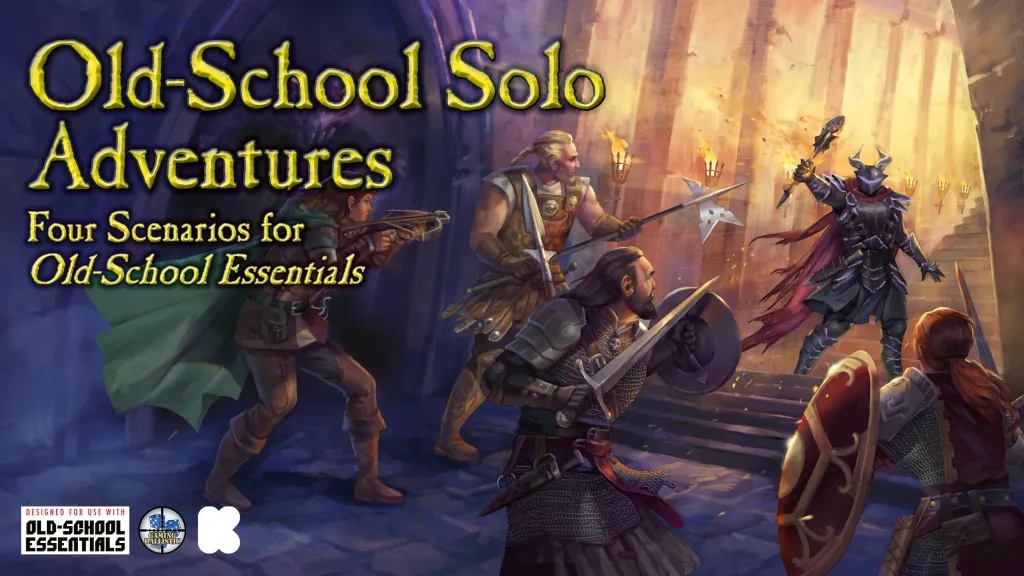
Old School Solo Adventures for Old School Essentials


 The Fantasy Trip by Steve Jackson Games has a long tradition of offering solo adventures like Death Test. When Douglas Cole of Gaming Ballistic secured a 3PP license for TFT he and his authors continued that tradition with their own series of adventures.

Now he and his team of authors did the work into making these adventures compatible with Old School Essentials. Given that OSE is a hop and skip from a dozen other classic editions and close clones these adventures can be used by a wide variety of OSR systems. 

He has started a Kickstarter to fund the printing and final work on these adventures.

Old-School Solo Adventures

I was given Til Death do Us Part to try and I found it fun and interesting to play out. Its replayability is good as there are multiple paths with multiple outcomes to explore. I think leveraging the TFT community's experience with solo adventures  is a great idea and will create a fun niche for classic edition hobbyists to play with between sessions and campaigns.


Friday, November 19, 2021

3D printed Miniatures and a JE Shields Kickstarter

 James Shields has been drawing art for the OSR and RPGs for a while. I have used several of his pieces in my projects and backed several of his kickstarters

He is always trying new things. For example a project creating stock art that allows you to mix and match different elements to create science fiction art. 

His latest kickstarter is also about something different, Uncommon Monstrosities It offers 3D model files suitable for 3D printing but with the miniatures sculpted in JE Shields' distinctive style. 

I think it is a neat idea. With 3D printing becoming more popular I figured that folks to know about this. Recently I made some figures with Heroforge and paid for a couple of stl files. A friend of the mind, Josh, had a 3D printer and made the models. The results were acceptable. 


Yeah I know the shield is bent weirdly but having the rest of the mini exactly how I wanted it was great. The shield issue resulted because you have to consider proper support when the model is printed partway. Anyway thank to Josh for printing this for me! I am in the midst of painting them and will show them off once I am done.

Best of luck to James and his Uncommon Monstrosities kickstarter  and hope it works out great!

Friday, September 3, 2021

Concerning the OSR, Everything is All Right.

Over the summer and recently I seen posts and opinions on the direction of the Old School Renaissance or OSR. Just keep in mind that due to how it came about. A result of discussion and sharing on the Internet combined with judicious use of open content like the D20 System Reference Document. Because of this, differences in content, tone, and feel are not only expected but inevitable. 

Everybody has equal access to the foundational material and the situation is such that one can do quite a bit within the time one has for a hobby. Even when it something more involved like getting a work in shape for publication. 

The result is that the OSR is confusing kaleidoscope of many voices doing their own things. Which is a good thing in my book as this ensure that your voice will be heard if you have the interest and time. Plus thanks to digital technology it only take a few hundred folks interested in particular take to keep it going.

The downside is that if you have a specific interest and it not being handled by anybody then the only recourse available is to do it yourself. Encouragement or promotion might work but the only way to ensure that something gets done is for somebody somewhere to pick up the available tools and starting making stuff.

Which why what I said back in 2009 is still true today, the OSR belongs to those who do.

Finally remember what you see, including myself, is just a slice of a much larger effort. With nearly 8,000 items on DriveThruRPG alone, I would not trust anybody's assertion that the OSR is about anything in particular other than it that probably originated in a theme or set of mechanics associated with the various classic editions of the world's most popular roleplaying game. 

But if you look at specific groups and specific individuals, like myself, then that will not be the case, and that there will be a specific focus. For me it been mostly about sandbox campaigns, hexcrawl formatted settings, letting players trash settings ,and when needed using rules based off of Swords and Wizardry. Other folks have their own focus.

One particular thing I want to mention that matured quite a bit since 2009 are virtual tabletops. Even after face to face gaming resumes it former place, the development of VTT software, like Roll20 and Fantasy Grounds continue to allow people separated by geography or circumsantces to get together and play the games they like and love.  And the best part you can switch easily between a VTT and face to face when time and circumstances permit. Both start with the same material and require pretty much the same type preparation although there are differences in how the session are handled. 

As always Fight On! and have fun with the stuff. It yours to do as you will whether it is playing, promoting, sharing, or publishing. 


Tuesday, July 6, 2021

Food for thought concerning MegaDungeons

James over on Grognardia talks about the list of upcoming Greyhawk products that can be found in Dragon #55. 


Later in the post he focuses on this tidbit

As with most extensive dungeon complexes, much is developed and kept in the head due to actual play, and some areas are so difficult as to be impossible for those not used to our DM style.

A while ago I talked about Minimal Dungeons inspired by my reading up books on the early days of the hobby and this picture of Gary Gygax refereeing where we see part of his notebook.

Minimal Dungeons

Minimal Dungeon Redux

As food for thought, perhaps a megadungeon "fit for sale" shouldn't be focus on presenting a product formatted like a tournament style dungeon. A dungeon map with every room keyed and written with a description. Rather a megadungeon should be focused on teaching the reader how the author ran the megadungeon. Accompanied by any aides the author used whether it is a complete map, geomorphs, or a sketch. 

Keep in mind that the work for a dungeon (or even one of my Blackmarsh style sandbox settings) grows by the square of the area covered. A map twice the size is not twice the work but rather four time the works if one try to format it like a tournament style dungeon.

When it comes to the Greyhawk Dungeon, we do know that Gygax was able to teach how to run it at least once with Rob Kuntz. My opinion that any thing we can do as humans can be taught or at least explained to other humans. 

Personally I was able to do a lot with the map to Tegel Manor because of the numerous notes and the room labels. The key served as a reference to specific content like monsters, and treasure. Occasionally a room would have a paragraph if it was a special encounter. What Tegel was missing was commentary and notes by Bob Bledsaw on how he ran the adventure. Plus a page or two page introduction for novices to running a megadungeon or for less experienced referees would be a good thing to have. 

Friday, June 11, 2021

OSRIC - Available on DriveThruRPG

Over the years the sites and means of sharing digital content have changed and OSRIC was among the early adopters. The First Edition Society started with using its website and then shortly used Lulu

Now the First Edition Society has released OSRIC and Monster of Myth on DriveThruRPG.


I hope this raises the visibility of the one of the two critical rulesets that ignited the Old School Renaissance as we know it today.

Saturday, January 11, 2020

Zweihander, Open Content and a reply to Daniel Fox

The Old School Renaissance or OSR, rest on the foundation of open content released under the Open Gaming License. Open content is what allowed this segment of the hobby to become then just a regurgitation of classic DnD content and tropes. 

For everyone who worked to support the classic editions 'as is' dozens more emerged to take them into new direction. New genres, or infusing a new version with a different tone or tenor than the originals. All of this was possible because the use of open content placed no restrictions on the next author imagination. The main requirement being is that anything you use or is based on open content must also be open content along with retaining proper credit.

For over a decade this has fueled an amazing array of works and products using not only classic edition of DnD but other older games as well. Including hybrid fusing older concepts with newer mechanics and ideas. The result is a dazzling array of products and works for anybody tastes within the tabletop roleplaying hobby. Five thousand+ on DriveThruRPG's site alone.

Yes there are individual and companies that don't contribute open content yet strive to take advantage of the OSR label. One of them is Daniel Fox and his Zweihander. RPG. Recently Erik over at Tenkar's Tavern pointed out the incongruity of having a OSR community content program.

Daniel had this reply

Hi Erik,
Thanks for the post. A few points of factual clarification:
* Zweihander Grim & Perilous RPG was released under Creative Commons License non-commercial. This means anyone can take, remix, reduce and create their own free content, unbound by a license.
* Commercial efforts for community content can be monetized through the Grim & Perilous Library, our Dungeon Master Guild at DriveThruRPG. They are released in PDF, and print-on-demand starting in February. Commercial efforts can only be released via DriveThruRPG.
* RPGs Powered By Zweihander (our commercial IP license) are released by Andrews McMeel Publishing. Examples include the upcoming Colonial Gothic Grim & Perilous RPG.
My design intention: the argument whether Zweihander RPG is OSR isn’t ours to make, but our fans believe it’s an OSR game. The OSR was one of the design principles when it was written, influenced by Maelstrom and other older games that hadn’t been revived at the time.Thus, why we categorize it as OSR.
OSR isn’t just D&D. It may have started there, but there are numerous examples of games classified as OSR that aren’t D20-based

The argument that Daniel make is disingenuous, the debate isn't what rule system is to be considered part of the OSR, the debate is whether open content is to be primary driver of the OSR.

The first thing to keep in mind that Zweihander is the result of Daniel's own work. While inspired by the first two Warhammer edition it is not a clone in the sense that OSRIC, Labyrinth Lord, or Swords and Wizardry are clone of various classic edition. It is a system that is design to appeal to fans of early editions of Warhammer Fantasy, and to easily be understood by those fan. This is important to understand because this mean that in regards to Zweihander IP, Daniel has complete control over how it is to be presented and used.

Unlike the situation I have with Judges Guild where I am licencee and thus limited in what I can do with it. For the recent Wilderlands releases only the Monster & Treasure section was released as open content. But where I do have complete control, I tend to release the work as open content under the OGL For example Blackmarsh, and much of the material found in Stuff in the Attic.

.  Why? Because it only fair. While I do a lot of my own work when it comes to settings like Blackmarsh, when it comes mechanics and rules, I stand on the foundation built by past authors. Those publishing in the 70s and 80s. Those publishing now in the 2010s. So it only fair that I contribute back, not halfheartly but fully in the same spirit that the material I used was given.

As for the OSR label, what it is the largely the work of hundreds of author doing their own thing. My voice may reach a larger audience but I don't have any bigger say about what the OSR mean then the individual who just shared their first adventure last week. But I am not going to stay silent when I see people not contributing or in Daniel's case justifying why they are not fully sharing.

Breaking it down.
* Zweihander Grim & Perilous RPG was released under Creative Commons License non-commercial. This means anyone can take, remix, reduce and create their own free content, unbound by a license.
This is a nice thing to do. However it is not sufficient. The reason many in the OSR prize the freedom to commercialize their work is that many project need some kind of return in order to happen. To buy art, editing, or layout services. The non-commercial restriction means you only have the freedom to do something if it on your own dime. Which is fine for somebody like me who makes a decent living from a job. But not fine for somebody who has little to no income.

Keep in mind that most OSR project are written, produced, and sold within somebody's time they have for a hobby. Usually the income these work generate won't make them rich but it will just enough to make it possible compared to what else they could be doing with that time.

Commercial efforts for community content can be monetized through the Grim & Perilous Library, our Dungeon Master Guild at DriveThruRPG. They are released in PDF, and print-on-demand starting in February. Commercial efforts can only be released via DriveThruRPG.
First of all the Grim and Perilous Library is not a DM Guild program. It is a Onebookshelf Community Content program. Each program has their own license and their own body of IP that they offer. The only thing in common is that they are managed by Onebookshelf through DriveThruRPG.

Second every program except the Genesys Foundry but including the Grim & Perilous Library has the following restriction. This excerpt is taken from the license attached to the Grim & Perilous Library.
(b) Except for short promotional excerpts used to promote your Work, you may not display, recreate, publish, distribute or sell your Work (or derivatives thereof) outside of the Program administered on OBS websites or through other platforms or channels authorized or offered by Owner.
(snip)
(b) Exclusive License to your Work. Effective as of the date you setup your Work through the Program on OBS’s website, you grant us the exclusive, irrevocable license for the full term of copyright protection available (including renewals), to develop,
license, reproduce, print, publish, distribute, translate, display, publicly perform and transmit your Work, in whole and in part, in each country in the world, in all languages and formats, and by all means now known or later developed, and the right to prepare derivative works of your Work.
 The implication of the above is twofold, the first is that you can't bring an existing work or existing open content into a worked released within the Grim & Perilous Library. Second, any work you release first within the Grim & Perilous Library, you lose the right to use it outside of the program even if you remove all of the Zweihander IP.

In effect if you wrote the Cave of the Night Warlock for Zweihander you can't release it later for DnD 5th edition even if you removed all of Daniel's Zweihander IP.

Needless to say, I very opposed to this provision and view as unnecessary for any program except those that are focused on sharing setting IP like Traveller's Third Imperium or WoTC's Forgotten Realms.

There is now an alternative, a few month back the Genesys community had an outcry about this issue. Fantasy Flight had OBS chancg the license. Removing the clauses limiting derivatives work and putting in new limit stating only FFG IP has to be remove for a work to be used outside of the program.

So it is within Daniel's power to have this changed for the Grim & Perilous Library.

My design intention: the argument whether Zweihander RPG is OSR isn’t ours to make, but our fans believe it’s an OSR game. The OSR was one of the design principles when it was written, influenced by Maelstrom and other older games that hadn’t been revived at the time.Thus, why we categorize it as OSR.
OSR isn’t just D&D. It may have started there, but there are numerous examples of games classified as OSR that aren’t D20-based
The debate isn't over whether the OSR label includes non DnD systems like Zweihander. That ship has long since sailed. The debate is whether the label OSR stands for sharing open content free from any condition other than to share. In my opinion a generous as Daniel has been with his IP, that generosity doesn't met the standard of many of us who use the OSR label who offer material free of any condition other than to share as we have.

What should be done about this?
As I stated many times before nobody controls the OSR label. It widely known because many, including myself, adopted it as a shorthand for their own work. What it is a result of our combined work over time not of any one person or smaller group.

But I do have opinions, and one of them that the OSR is at its best when sharing open content. A thing that doesn't just benefit a particular system or edition but the entire hobby. The way to ensure that the OSR continues to stand for sharing open content, is to share. Share your thoughts on open content, make content and share under a open license like the OGL, and support those who do share open content.

In doing these we will ensure that the next five thousand works are every bit as amazing as the first five thousand.

Update
So I talked to Daniel Fox over on Discord and learned something interesting about how OBS handles the Community Content Program. That is largely on the publisher to police including enforcing the above clause. Several people on in the Grim & Perilous program have published their work elsewhere. Daniel was receptive to changing the license to one more like the Genesys Foundry to better reflect what he is already doing.

Thursday, December 5, 2019

Castle Xyntillan now avaliable

This begins with a story, back in the 2000's a bunch of folks were organized by Necromancer Games to fleshed out Judges Guild's Wilderlands of High Fantasy. The project took a lot of work but finally saw the light of day.
One of the author involved was Gabor Lux (also known as Melan).

So as a follow up to the Wilderlands one of the project Necromancer Games was planning on was Tegel Manor and Gabor Lux was tapped as the author. We all knew him from his blog and other writings and was excited about seeing his take on the venerable adventure from Judges Guild.

But alas it was not to be.

Now flash forward a decade, Gabor Lux revisited his ideas for Tegal and made his is own haunted castle adventure, Castle Xyntillan.  You can take a look it yourself at his store front. It is $40 plus shipping. You can also read up what Gabor has to say about in this blog post.

Finally I did the cartography for the adventure.

You can get a sense of the detail and scale from the players maps that Gabor Lux provides Or this snippet below.

Enjoy!

Monday, September 16, 2019

Your help is needed for Jim Kramer of Usherwood Publishing

OSRIC along with the Basic Fantasy RPG ignited the OSR as we know it today. Jim Kramer is part of the OSRIC community and through his company, Usherwood Publishing, offered a print version of the OSRIC rules as well as his own works.

Jim and his family need your help. The OSRIC community explains,
You may know Jim Kramer from his Usherwood Publishing modules & supplements, or his work helping produce works like OSRIC and Knockspell. You probably didn’t know Jim had multiple brain surgeries to remove tumors, and the battle has gotten much harder. To help Jim and his family during this difficult time, a group of his friends, collaborators, and first edition enthusiasts banded together to make this fundraiser fanzine, where all royalties go directly to Jim and his family.
To this end the Saving Throw fanzine was created.  You can look over the table of contents and buy the Saving Throw fanzine from this link. Or look over his store and if something interests you buy something from there.


Thursday, May 23, 2019

OSRIC now has a wiki

OSRIC, the first retro-clone, now has a wiki available. A useful resource for people using OSRIC to run 1st edition campaigns. You can read the announcement on the Knights and Knaves forum.

OSRIC Wiki

Kudos to PresGas and his team for putting in the time to do this.

Saturday, April 13, 2019

James Smith of Dreams of Mythic Fantasy passed away


Sadly James of Dreams of Mythic Fantasy passed away a few days ago. He enriched us all with his love of our hobby. More than that he went above and beyond by collecting information about what other folks were doing and letting the rest of us know with OSR News

He will be missed

James Albert Smith Jr (1968-2019)


Thursday, January 31, 2019

What is the best OSR system for RPG novices?


One forum I frequent is the RPGPub. Recently a question was asked,

What is the best OSR system for RPG novices?

I gave some system recommendations and then I realize I been looking at the answer to this question wrong.

Given that nearly all of the various editions of  classic DnD and OSR retro clones are of comparable complexity. Especially in what you have to do get a campaign going. The answer is all of them and none of them.

Why?

Because system doesn't matter, it all depends on the referee being a good teacher and a good coach. So use whatever system that works with the way you think and operate and focus on learning to teach and coach.

I throw in coaching because in sports the athlete is expected to execute strategies and procedures that are mostly in real time. A good coach not only explains those strategies and procedures i.e. teach, but guide the athlete through them the first few time until the athlete is able to do them. Afterward the coach will help the athlete practice to improve their skills in regards to whose strategies and procedures. Much of this occurring in real time with the athlete doing whatever their particular sport requires them to do.

While not as physical, the interplay of the players describing what their characters and the referee making a ruling often by using a printed system of rules means there some overlap what you do to teach a beginning athlete and a novice to RPGs.

So hence, focus on being a good teacher and coach. As for the rules use whatever works for you as a teacher and coach.

The OSR logo is by Dyson Logos

Tuesday, January 29, 2019

Keeping track of the OSR and Old School Gaming

The popularity of Google+ for the OSR meant that blogs took a back seat for many. Now that Google+ is ending, blogs are making a come back. One things that developed for blogs in the last couple of years is a type of software called a Planet. Planet software aggregates the feeds of the member blogs to allow people to track many related blogs at once.

Alex Schroeder has an interesting website that been around a long time and combines elements of a blog and a wiki. Recently he setup a planet called Old School RPG Planet that now has several dozen OSR and Old School related blogs feeding into it.

The site has links to explain how to add your blogs to the feed and the purpose of the site.

One of the nice things about the OSR and the current state of independent publisher that the Do it Yourself attitude often lead somebody somewhere to come up with a decent solution to a problem that the community faces. So kudos to Alex for taking the initiative on this and hope that it continues to be a useful tool keeping the connections within the OSR and Old School gaming in general alive.

Monday, December 3, 2018

OSR Survey

Brendan S and Ben Milton are two hobbyists with a long history of participating in discussion related to the OSR and classic DnD. They have constructed a detailed survey that looks to be comprehensive.

The link to the survey.

Ben Milton (G-Plus)
Brendan S (G-Plus)

At the conclusion of the survey one can leave additional comments unfortunately I forgot to copy and paste my answer. But the following is the gist of what I wrote.


Irregardless of how people used the label OSR, think of the label OSR, or want the label OSR to represent there are several salient points.

1) There is a group of hobbyists who are interested in playing, promoting, and publishing for classic editions of DnD.

2) To ensure that no one vision or ideal stifles a hobbyist's creative vision the promotion and spread of legal open content is vital.

3) #2 pertains not just to classic DnD but to any system that hobbyists are interested in provided there is legal open content to use as a foundation for sharing.

4) Hobbyists interested in #1 are interested in other things as well. So hobbyists sharing or selling will often have a variety of works in addition to classic DnD including hybrids.


Open Content coupled with the low barriers of distribution enabled by the internet and digital technology ensures that anybody with the desire will be able to get their vision out there either commercially or just to share.

Keep in in mind that the consequences of creative freedom will be messy. Resulting in a confusing kaleidoscope of works along with conflicting visions of the source material. The key to remember irregardless of the results of the survey, that you are free to do what you think is best with the material in the form you think will work for your project. That thanks to the internet and other forms of digital technology you can't be stopped from sharing what you created.

Tuesday, November 27, 2018

Support OSR News


Collecting news and information about the OSR is often a thankless job. There is a ever-growing kaleidoscope of OSR publishers with new products being released every day either commercially or non-commercially on a variety of platforms and formats.

James A. Smith of Dreams of Mythic Fantasy has dedicated considerable time and effort into collecting various bits of information and news about what going on around the OSR. Now he would like your support to keep on doing this. He has established a Patreon page where you can contribute a few bucks every month to keep his OSR News continuing. I hope you will join me in supporting James.


Monday, October 8, 2018

Some bad news about Google Plus

Google Plus was Google's answer to facebook. It never got widespread adoption but among specific niches of internet it was heavily used compared to facebook. One of those niches is the OSR.

And now it appears the Google is shutting it down or at the least radically changing it.

Damn it. I really despise the Facebook interface and because of that I have not kept my Facebook account as clean as my Google Plus setup. I guess my wife, Kelly Anne will be happy as facebook is her primary home on social media.

Well it was good while it lasted.

The link to the annoucement


Monday, August 20, 2018

Updating the OSR Survey

For a long time I had this page attached to the blog. It is a survey of selected sites and links that promoted themselves part of the OSR or were about playing, publishing, or promoting a classic edition of D&D. It needs updating as it still get a significant number of hits

So  calling on the wisdom of the crowd for updated links and additional links to be included. The criteria is either it promotes itself explicitly as part of the OSR or the link is about playing, promoting, or publishing something based on the classic editions of DnD. This includes material like White Star or Star without Numbers.

I will look at the comments made for the next two weeks as well add in my own decisions.

My goal for the survey to give a novice a taste of the range of material and fuel further searches on their own. Along with selected items of personal interest that I wish to highlight.

With 3,000+ works identifying as OSR on RPGNow alone there no way a single individual can hope to present a comprehensive list unless that their primary interest. Even Guy Fullerton with Hoard and Hordes with a narrower focus on material supporting Gygaxian DnD, had to switch to a methodology of "stuff I am aware of" after 2012.