Showing posts with label 4e gaming. Show all posts

Sunday, May 13, 2012

Fighting Giants is where AD&D went all wrong

Encouraged by the surprise success sales of G1 Steading of the Hill Giant Chief, G2 Glacial Rift of the Frost Giant Jarl and G3 Hall of the Fire Giant King along with the blockbuster movie Clash of the Giants, Gygax calls the staff of TSR into his office.
From now on AD&D is going to be about fighting Giants. 

For the next two years a flurry of adventures was released. All of them about fighting giants including the classic Under The Storm Giant's Castle. Greyhawk was shelved in favor of a new setting which had as it's centerpiece a war against the giants. Unearthed Giants was quickly written and released giving new classes and new races revolving around fighting Giants.

However what seemed like a surefire way to capitalize on D&D's popularity and the excitement over the new Advanced Dungeons & Dragons was it death knell. Within two years of it's release, sales plummeted as gamers tired of fighting giants all the time and flocked other games like Chaosium's Runequest and SPI's newly released Dragonquest. There is growing excitement over Palladium Fantasy as many say it restores the wide ranging fantasy enjoyed by fans of original Dungeon & Dragons.  Now a 2nd Edition of AD&D is has been announced that promises to be a toolkit to allow referees to create any fantasy setting they desire. TSR is quick to note that fans of the Giant Wars will still find support in the 2nd Edition.

Sunday, August 7, 2011

Gold Star Game Day

Saturday was D&D Game Day, while Tim of Gothridge Manor was working on perhaps the most quintessential activity of older D&D, creating a random dungeon. I on the other did one the most quintessential activity of 4th edition D&D, ran a canned adventure of encounters for D&D, "Gates of Neverdeath".

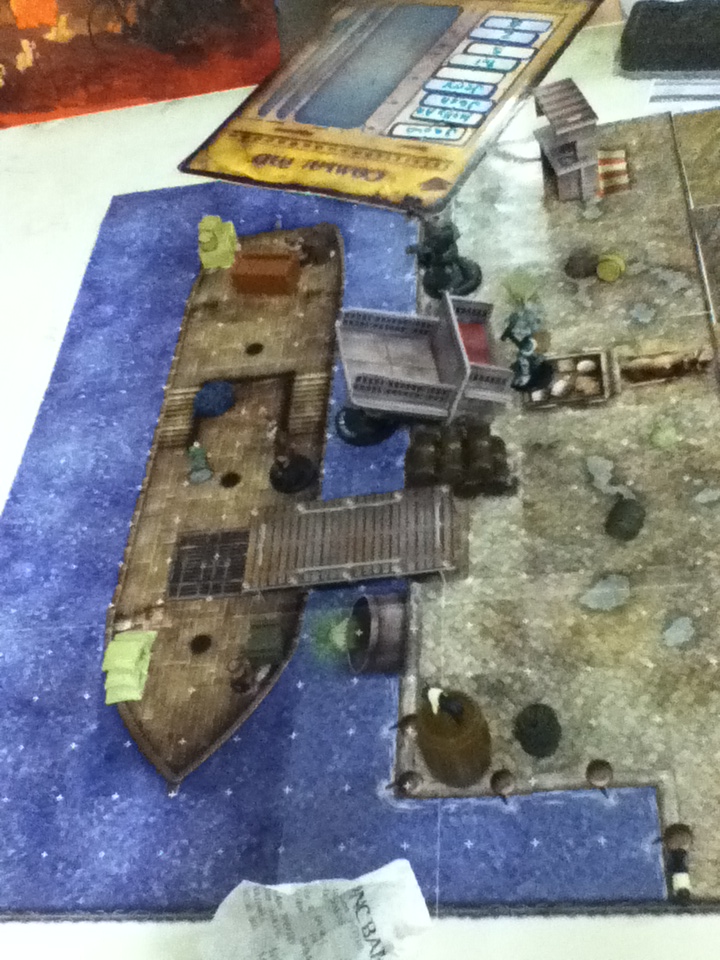
I did some prep for the game. Not the actual adventure of course, Instead I went through my miniature and props for stuff to use and to make the encounters visually exciting for the people attending. Here the results The ship encounter when the party first sails into Neverwinter. When this picture was taken, Josh's Goliath just pushed the wagon into the water on top of a zombie trying to climb onto the dock.

The climatic encounter in the graveyard.

The players really like this especially the newcomer who hasn't played with in my Swords & Wizardry sessions.

What was most uncanny of the whole session is what Kelly Anne, my wife, got for her character. See in the grab bag that Wizards has for each participant there is a theme care the player can use for their character. This one had to do with the character being a ex-member of the Brotherhood of the Rat (or something like that) give them an at-will power to allow them to change into a tiny rat.

Which makes this ironic is that we have adorable pet rats at home. Years ago I was skeptical and so was Kelly Anne when my youngest wanted to get some as pets. But they turned out to be great pets, a little like owning small excitable dogs rather than the boring gerbil, hamsters, and mice, Kelly Anne had when we were kids.


Initially skeptical at playing 4e, she was pretty exciting at playing her thief now. Especially when she had a +14 to her stealth roll as a first level character.

The session ended with one party member dead, two members down. Kelly Anne's thief was the only one still standing. The main bad guy was dead but his minions survived and dragged his body away. Overall the party was battered but succeeded in stopping the bad ritual.

While the session when well, the adventure was some of the worst crap I seen published for roleplaying in a long time. I understand constraints the authors have to operate under. I experienced some of them myself when trying to run good live action roleplaying events. The format imposes limitation on what you can do in terms of plot and the action. It results in a sequence of encounters that is a railroad. But if you write good plot and design inserting encounters the result can be fun for organized play.

But those limitations are no excuse for crap. And make no mistake Gates of Neverdeath is crap. The adventure hinges on the main guy stealing the McGuffin. The way it is written the bad guys just appears and there is nothing the PCs can do about it. Railroad combat is one of the things that will piss off players to no end.

I fixed it by bringing the bad guy on stage. I practiced the encounter the night before and so my version was fair. If the guy died I would dropped the graveyard as the location where some nasty things were setup and the guards asking the players to go and clear it out. Although this fixes the issue, it shows the problem in sharp relief. To pull this off requires luck and requires a highly skilled referee. My solution is not ideal for use in organized play where skill levels range all over the place.

To top it all off, some of the experienced 4e players were commenting how tough the monsters were. I don't play 4e on a regular basis so I had little to compared this too. But looking at the monsters afterwards, they were startled at how they are stated. The hallmark of Wizard's 4e offering is the combat encounter and I am left wondering if standards slipped on this.

Wizards should be ashamed at letting this go out with their name on it. And the limitations of the encounters format is no excuse.

Monday, February 21, 2011

Wizards needs to take leadership.

Mike Mearls has an interesting column called Legends & Lore . In short the article is about how we are all playing D&D and how we have more in common then we have different. And that it is important to consider where we been while building the future. That throughout its history D&D shared common elements that has appeal to all fans of D&D regardless of edition.

I respect the effort that went into this column but I think it misses the point of the current situation. It boils down to that people want to play D&D with the rules of their choice. Not something like it, or something that feel like it, but with a particular set of rules.

If you want to appeal to fanbase X then you need to use those rules. Otherwise you just facing the same issue as any other RPG company with a new ruleset in building a fan community. The difference between today and 1991 is that we have the Open Gaming License and the d20 SRD. The fans are now in charge of their own destiny and the success of Paizo drives the point home.

So what can Wizards, or anybody owning the D&D brand can do?

In short by taking leadership on ALL editions of D&D. Acknowledge that nothing going change the fact that people are going to play and buy material for all editions of D&D. State that while that while most corporate dollars is going to go into support for the current edition, that older editions will be included in future plans. Creating events on the Internet and in the retail chain where fans of all editions can come together and play D&D regardless of edition.

In the past this would be problematic as the technology of print runs and distribution make supporting multiple game editions costly. But now that we are in the Age of Internet there are lot more choices available making it feasible to have your cake and eat it regardless of edition.

By taking leadership on ALL editions will not mean every D&D players would be playing the latest edition made by Wizards. But it will create a friendly atmosphere like the club, convention, or store where everybody trying all sorts of things at different time. That will make not only easier to sell the current list of product also may find ways of making money off of the older material. For example rulesets or subscriptions for the VTT software.

In one version of this post I had numerous specific suggestions but realized most of them been hashed over and over again. (Like pulling the older PDFs from sale). Posting them would have just obscured the main point, that Wizards own all D&D editions and have customers for all D&D editions. If they want out of their current predicament they need to step up and take advantage of that.

And if they don't others will under other names. (Pathfinder, OSRIC, Swords & Wizardry, Labyrinth Lord, etc)

Friday, November 19, 2010

D&D 4e Virtual Table

Since it was announced several years ago I thought that a D&D 4e virtual tabletop hosted by Wizards would a major change in the hobby. If probably done it would make it easy for D&D 4e players to find each other and play when it convenient for them. Especially if it had on a server/meeting room front end where players could browse and find games to play.

This benefits the rest of the hobby as this helps keep the network of D&D players healthy. Which is where most other RPGs get their players from. Also by popularizing Virtual Table Tops this will draw attention to this type of software. Making it slightly easier for us who play other RPGs, like Swords & Wizardry, and use VTTs to find players. It will also spur innovation as other VTTs strive to exceed what Wizards offers.

After a long period, we have some news, a FAQ, and a Screen Shot. Of course nobody has a lot of respect for Wizard's programming team so we wait to see if they can actually pull this off right.

To me it looks like they are going 2D and integrating their token and tile art into the product. The earlier incarnation was going to be 3D which was going to be too big of leap. I think going the 2D route will leverage the advantage in art that Wizards has and provide an achievable goal.


Update:
The things Wizards will need to get right to be competitive in the long run will be
  1. Integration with Character Builder and Compendium.
  2. Use of Dungeon Tiles and other art assets,
  3. good game lobby to find other players.
  4. A regular release of precanned modules similar to encounters or delves so that even the most time pressed DM can get involved.
If they get these right they can be "good enough" in other areas compared to their competitors.

Monday, October 25, 2010

If you are roped into refereeing D&D 4e.

Combat takes longer. I can't stress this enough. Once you initiate combat you are committed for the next 1/2 hour or hour resolving it if fought to the finish. In a four hour session the most I seen somebody do was resolve three combat encounter between the same number of roleplaying encounters. This can be a big shock for somebody used to 1st edition AD&D or OD&D. I was used to it because of GURPS so it wasn't a big deal for me.

Wizards had opted for a specific style of presentation for 4e adventures. One that most of the 4e community has come to expect. If you use pre-made adventures they will seem constrained and linear compared other RPGs.

The good news is that the individual encounters are often well written, challenging and fun. Another benefit of 4e is that it lays out the math for you. So you can quickly come up with encounters of different power levels.

Remember you don't have to run 4e the way the Wizards presents it. If you have any experience with other RPGs with tactically detailed combat systems, whatever technique you had developed will work well with D&D 4e. How I managed GURPS worked fine with D&D 4e.

I typically run a sandbox campaign. And whether it is GURPS, Fantasy Hero, Swords & Wizardry or my original AD&D 1st, the setting is what it is and players encounter whatever was in the locale. What this means in practice is that around 5th to 6th level (or double GURPS starting points) most of the encounters are underscaled. Only when they go to truly dangerous areas or encounter experienced enemies will they find anything comparable to their current skill level. The effect the few D&D 4e game I ran is that most combat encounters are quickly resolved when the players reach mid heroic levels (5th to 6th).

Hopefully this illustrate that there is more than one way of running 4e than what is typically talked about. The only part of D&D 4e that is hard to work around is the how the power system makes everything seem like heroic high fantasy. But that is a minor issue. Again pretty any type of style or plot that you ran in AD&D 1st you should be able to do in D&D 4e.


Thursday, October 7, 2010

The Keep at the Source and some 4e reviews.

I was able to participate in D&D Encounters at The Source on Wednesday Night. They have a large groups of not only roleplayers but a table playing Magic the Gathering, a 3.X table (I think they were playing the Wheel of Time RPG), and two grognards slugging it out as Romans vs the Germans.

I had my dice with me but little else. Luckily they had pre-gen so I picked up a Eldarin Wizard to play. D&D Encounter are weekly with each session centered around a single encounter in a larger adventure. The current set of encounters is focused on D&D Esstentials adventuring in the venerable Keep on the Borderlands.

The session was refereed by Bryan, and my comrades in arms were Rachel playing a thief named Merrick, Caleb playing a priest named Hagen, Mike who played the lady fighter Eldits, and finally Rob who played a dwarf (I think) named Trollay. I played Berian, an Eldarin Wizard.

The session picked up where the last encounters lefted off which was picking up some cultists left in a grotto outside of the keep. It was noisy and I am partly deaf so it was a miracle that I picked up any of the back story. It appears there was some underground cult worshipping Tiamat in the Keep and the eventual goal was to bust it wide open.

Written from Berrian point of view.

So we picked up the cultist who turned out to be poisoned and so we had to hurry back to the keep. Nothing unusual happened and the person feeding the info was a herbal so she was able able to take the cultists under her care. Somehow it was revealed that the Banker was the possible leader of the cultists and one of his guards was a secret ally that we can turn too for help.

We retired to the tavern to eat and during this several of the party noticed a halfling keeping a careful eye. I believe it was Hagen and Trollay who noticed this first and decided to approach him. The halfling bolted, the two raised a hue and a cry and the chase was on.

We stepped out of the tavern and we were ambushed by several rogues, the halfling's buddies. Every body but Merrick and I charged into the town square to battle the ambushers. When it came around to me, I decided that halfling needed a little lession in etiquette. I succeeded on calling on Mandos, and succeeding in weaving a Charm of Misplaced Wrath around the halfling. Stumbling in a daze he attacked one of his comrades successfully scoring a critical. Through his daze the halfling saw the threat of my power and tumbled (or something like that) and hit me with a fierce blow.

The next round Merrick came out and missed the halfling while the fight was raging several feet away in the town square. I stepped to flank the little scum, but decided my power was better used in the main fight. Calling on Manwe I unleashed a Fountain of Flame in the midst of the Ambushers severely burning several of them. Unfortunately before Merrick could strike the wily halfling tumbled away. I moved around the edge of the main battle calling on Eldereth to unleash Arc Lightning which killed several of the Ambushers.

The halfling ran through the still gushing Fountain of Flame to attack me one last time leaving me bloodied. Hagen was aware of my plight and was able to heal me of my wounds. The rest of the party charged the halfling and in a few quick blows brought the little beast down. Calling on Eldereth one last time I sent Arc Lightning down on the few remaining survivors and smote them down.
Bryan and the player did a great job and a fun time was had by all. Mike generously let me use his Rule Compendium and it is a great reference to use during play. If you play D&D 4e you will find this book invaluable.

I got to look through the store copy of the Dungeon Master's Kit. Thanks to the Source staff for letting me do this. I It is $40 boxed set. Half the price is the DM book which give DM advice and goes into the nuts & bolts of creating encounters, adventures, and campaigns. The other half are the adventure books, counters, and maps also a solid $20 value. Combined you get the $40 price for the box.

The adventure books are about Harkenwold in the Nentir's Vale. One of the thing I thought that 4e missed out on was following up on the sandbox setting they laid out in the 4e DMG. The DM Kit corrects that oversight by giving you details on the Harkenwold area and a couple of linked adventures. I think a lot of 4e referees will be quite pleased at what in here. Harkenwold portions details a small sandbox region and while the adventure are organized in 4e fashion they appear to be more a natural part of the setting.

For myself I spotted a copy of Troll Lord's Fields of Battle for $20. I am fan of BattleSystem from AD&D days so I decided to pick this up for myself. I will review this in a later post.


Sunday, September 12, 2010

The Essentials of the D&D Starter Set.

It is not 4.5e. It is D&D 4e with new classes and some reworked powers (for example Magic Missile) Dealing with the changes will feel similar when getting cards with changes or errata in Magic the Gathering.

It not a full ruleset like Mentzer's Basic Dungeons & Dragons. It is designed to take somebody who hasn't played Dungeons & Dragons at all and teach them to play and referee. It has enough additional material to for a couple of sessions of play and for the referee to come up with his own adventures.

It is meant not so much to be read but to be used. From the beginning of the players books to the start of the last chapters of the Dungeon Master's book it is designed be read in order and has the reader doing stuff from the first couple of pages onward.

This places the Starter Set not in the Holmes, Moldavy, Mentzer lineage but in the various First Quest, and other beginning D&D set.

There is very little reference material, in fact for somebody experienced in roleplaying this books will seem tedious and confusing. Only references it has are the power/item/actions cards that are included and a small monster reference. They do get +1 for including two pages about Nentir's Vale in the back. I always like this mini-setting, felt it had great potential as a setting for a sandbox campaign.

The Twisting Halls is one of the places that the Starter Set shines. It is seven encounters that the authors made interesting and challenging. The dungeon for the D&D day is a follow up to this module. It includes a full color double sided battlemap with the Twisting Halls on one side and a some smaller encounters on the other. It has dice, some nice character sheets, and a full color set of counters to use for miniatures

Physically the box is one of the sturdiest I seen. There is a inset that you can remove that they use to package the contents. Once remove I can see that much of the D&D Essential line will fit into it. My D&D 4e referee screen likewise also fits.

The player book is setup in a choose your adventure style designed to teach a person about creating and playing one of the four iconic classes (Fighter, Wizard, Cleric, Thief). They use the standard array for assigning attributes.

The Dungeon Master is a more traditional read and has the usual 4e excellent advice on DMing followed by some encounters for a novice referee to try running, followed by the Twisting Hall, detail on creating your own encounters, the Monsters Reference, and finally two pages on Nentil's Vale.

The books are printed in full color magazine style as well as the paper (thick and glossy).

So what do I think about it. Well.... it not aimed at me, my friends, or the readers of this blog. They are not kidding about it being for 24 million players of D&D that are not currently playing. I can see a dad or a mom who hasn't played in 20 years going "oooo... this looks familiar" picking up the Starter Set and learning how to play D&D 4e. The Twisting Hall dungeon, shines as an example of 4e design filled with interesting and created encounters.

But I think it going to fail.

Why? It not because every single starter set failed where the Holmes, Moldavy, Mentzer, version succeeded. Because in the introduction they make the fatal mistake of taking D&D head to head with video games.
The Dungeons & Dragons game is the original pen-and-paper roleplaying game, the inspiration for generations of other games both on the tabletop and on computers and game consoles. If you've ever played Neverwinter Nights, Final Fantasy, The Legend of Zelda, World of Warcraft, Dragon Age, or games like those., you already have some idea of what the Dungeons & Dragons game is about. With this book you're about to experience the game in its latest and greatest incarnation.
In subsequent paragraphs they describe how you going to enter a fantastic world of adventure, take on the role of a legendary hero in a world filled with ancient ruins, vast caverns, and wild frontiers.

And so what? I can already do that with those computer games and with a lot less hassle. So what makes Dungeons & Dragon different today. I give D&D a pat in the head for being the progenitor of we see today but those 24 million players are not going to put with the hassles of running a tabletop rpg you got to make a case for it. And they don't do that. Instead it leaps into the details of the mechanics the games which dominates the remaining 96 pages. Yes there are a few pages of player and referee advice. Good advice in fact. But they are overshadowed but the sheer bulk of the encounter and stat blocks. And all the encounters are about combat and direct conflict.

The singular advantage of roleplaying games is in the human element. The human referee, the human players. The infinite imagination and creativity they bring to the table. And that doesn't come across with only 2 pages (6 and 7 of the DM Section) devoted to stuff other than the mechanics of the game.

The encounters the authors made for the Twisting Halls are interesting and well thought out but without the larger picture they are without soul and just pieces on the board for the players to kill. I feel bad hammering this because here and there I can see the authors injecting things that are great hooks for roleplaying. For a novice or somebody hasn't played in decades these are not obvious and there nothing written on how to use them if they do notice them.

Because of this game feels like more complicated version of pushing chess pieces around. It not a problem of mechanical complexity but a problem of presentation. There are plenty of RPGs with complex mechanics that do a great job of promoting roleplaying as well as combat. In today's market the human element of roleplaying is the only thing that separates the tabletop game from it's computer version and starter sets need to pound on that to make a lasting difference for their parent game.

I give Mike Mearls and the 4e team an A for the Starter Set as a tutorial to use the D&D 4e mechanics. But as a introduction to the roleplaying game it doesn't do Dungeons & Dragons justice.

So how can this be fixed with the D&D Starter Set?


With apologies to Mike Mearl and the 4e design team but I had to do it being the grognard that I am.

I will have a follow up on the actual play. It was a lot of fun and I got to referee another person's first roleplaying game.

Friday, September 3, 2010

One hundred and seventeen pages of Errata!?

As a general RPG site the RPG Stack Exchange Site reflects the make up of the general population of roleplaying gamers. D&D 4e questions dominate the site as D&D 4e has the largest gamer concern. It been a while since I read anything extensively about D&D 4e and for the most part the questions are the usual type you find with any game. But occasionally I read about errata, and additions. What made it unusual tho is the degree of change the errata seems to be making to the core 4e game. So I popped over to the wizard's errata page and took a look.

Their current complied rules update is 117 pages! Wow. So I just look at the update for the core set. It been two years since I ran a campaign in D&D 4e so I wanted to understand what I am in for if I ever ran one today. Between all three core rule books there are 37 pages!

Immediately I flashed back 20 odd years to the debut of GDW's Megatraveller. It was intended to be the end all to be all update to Classic Traveller. However one thing that brought it down was the sheer volume of errata to fix broken and misprinted rules. Not just little rules but needed changes to fix the combat system.

I also went through similar experiences with Star Fleet Battles and Battletech. I can tell you it is a source of frustration and a barrier for new gamers playing for the first time.

Bob: What do you mean it doesn't work that what?
Alex: Yeah it was broken so they changed in the errata here.
Bob: Thanks

This is of concern because if the mainline RPG (D&D 4e) sneezes we all catch cold. I really hope that Wizards doesn't have to do this with D&D Essentials. Because this volume of errata for any game is just a millstone around it's neck.

Wednesday, April 21, 2010

Dark Wilderlands, a campaign for 4th edition D&D.

When 4th edition came out I bought the basic three books. Not only because I basically a gaming geek but I didn't really know what I will be writing for at the time. So I figure it would be best to learn the current version of D&D. This was before Version 1 of the GSL. Little did I know.

After reading the three books, one thing that struck me about D&D 4e was that it as more oriented to a high fantasy feel than regular D&D. This didn't fit very well for my Majestic Wilderlands. I decided to run a 4e campaign and wanted to come up with a concept that fit the feel of the system. So I came up with the Dark Wilderlands

A GUIDE TO THE DARK WILDERLANDS

The Majestic Wilderlands is a campaign that I have run for over thirty years. Sometime in the mid 80’s I decided to destroy my campaign world. Using AD&D 1st edition and BattleSystem a short series of games was run where the Apocalypse happened and the players fought through the battles and short time after. After a few sessions I changed my mind and decided to continue the story of the Majestic Wilderlands as if the Apocalypse never happened.

D&D 4th edition talks about “Points of Lights” where players hail from outpost of civilizations in a wilderness filled with monsters. I wanted to try at least one campaign using the system. I decided to use not the Majestic Wilderlands I normally use for this campaign but rather the world that would have resulted from that Apocalypse I aborted all those years ago. I have a campaign arc that should span the entire level range from 1st to 30th along with side arcs for players to choose from.

The Story so Far
It is now the year 4458 BCCC, twenty years after the Demons escaped the Abyss and destroyed the Wilderlands in the Shattering. The Wilderlands are now a ravaged wasteland of shattered kingdoms and monster haunted wilderness. The Brimstone Warlocks remain to ensure that no new power emerges to challenge their demonic masters. Ruling from Viridistan, the Black City, they inflict a reign of terror on the survivors. Scattered in the Wilderness are outposts of the civilizations that once ruled the Wilderlands. The Gods send what aid they can but remain in constant battle with the demons besieging their realms.

For Existing Players
The Wilderlands for this campaign is the same up to the year 4438. The events that already occurred were.
1) Valeric became King of Nome
2) Blackstone becomes one the greatest wizards of the Wilderlands
3) Endless Star kills the last Emperor of Viridstan
4) Lord Divolic conquers the Halkmenan Empire becomes Warden of the Southern March
5) Dorvon the Dwarf and his companions travel from Harn, replaces the Ebon Crystal and become Lords of Viridstan.

Basically everything that was done using 1st Edition AD&D, Fantasy Hero, the 2nd time we used AD&D but not anything done in GURPS (except for stuff that fleshed out the overall background).

The Setting
The campaign will start in the old borderlands between the old City-State and Viridistan. More details will be provided later.

Characters
Races
Dragonborn (Reptile Men)
These are the mighty descendents of the Dragon Legion that journeyed with the first Ghinorian Colonists nearly a thousand years ago. They aided the city-state of Caelam in establishing the Dragon Empire. When the empire fell to the invading Tharian Barbarians they were forced to flee and inhabit the desolate wastes of the Quern Desert. Since the Shattering they have emerged from the desert and started wandering the wilds. At first they were taken for another minion of the demons. But since they have proven they are just as much an enemy of demons as the other races.

Dwarf
In Thunderhold Keep the Dwarves dreamed of retaking the their ancient home, the Majestic Fastness from the clutches of the dragon Ancelgorn. But in the Shattering that dream was taken away and dwarves forced scatter once more. They now exist in isolated forges and holdfasts hidden in the hills and mountains of the Wilderlands.

Eladrin
The elves had suffered much with the loss of Silverwood, renamed Dearthwood, to the Orcs. With the Shattering they lost their last refuge, Loshain and are now forced to live in scattered homesteads. Some of the survivors have all but given up on the Wilderlands and now have turned inwards. They are now intimately connected with a realm known as the Feywild and use it’s magic to protect the remaining survivors until they can all withdraw to safety. They adventure with other races to buy time for this to happen.

Elf
The shattering has reignited the passions of many of the surviving Elves. Now faced with the clear evil of the demonic hordes and their allies they now fight for the liberation of all the races. Although scattered in tribes and isolated homestead they work toward preparing refuges from which the races can regain their strength and strike back.

Half-Elf
Since the Shattering the Elves and much of humanity have become firm allies and friends. Some have chosen to ally on a more personal level. In the past twenty years a new generation of half-elves have been born combining the best of elf and man.

Halfling
Once the Halflings lived in tranquil lands living simple and pastoral lives. The Shattering forever changed that. Their lands devastated they are now forced to live a nomadic life using their natural skills to hide and evade the dark forces stalking the land. Many of chosen to hide along the shores of the numerous waterways of the Wilderlands to allow them to quickly escape any who threaten them.

Human
Once the most numerous race in the Wilderlands, humanity was divided into numerous cultures and nations. Elessarian, Tharian, Ghinorian have no meaning since the Shattering. Only echoes of their past now haunt the few scattered output left as former enemies now struggle to unite in the face of overwhelming odds.

Tiefling (Viridians)
The green skinned Viridian were the lone demonic race to escape the Abyss during the demon’s imprisonment. Once one of the weakest of the demons they carved out a mighty empire from their capital city of Viridistan. Centuries of assassinations, civil war caused their number to dwindle until the great paladin Endless Star killed the last Viridian Emperor two years before the shattering. The only legacy of the Viridian were thought to be the Tieflings; half-human/half True Viridian. Green skinned, sometime horned, their demonic heritage was apparent to all.

At first the Tieflings welcomed the Shattering and supported the arrival of the demonic hordes. But the demons viewed them as tainted by their human half. They were treated little better than slaves. In the last decade many have managed to overcome the distrust of the other races and have made common cause against the demons.


Classes
Cleric
For a time after the Shattering it appeared the gods themselves have abandoned the Wilderlands. The only divine powers that existed were the abilities granted by the great demon lords. However last decade has proved the gods still survive. Their ability to intervene directly is limited as long as their lands are under siege but they have managed to inspire a new generation of clerics lead their believers in the darkest hours of the world.

Fighter
This is the age of war and the fighter rules supreme. Their armor and weapons are at the forefront of battle as man and demon contend for mastery of the world.

Paladin
The vanguard of reappearance of the gods was lead by the the paladins. These champions strike out against the demons and all those who ally with them. Now champions of all the gods even those of Delaquain and Sarrath fight together.

Ranger
Some fights cannot be won head-on. Here the skill and stealth of the bow, and the quick strike of two weapons come into play. Those who walk the path of the Ranger live a difficult life but ultimately they may be what tips the balance in favor of the races.

Rogue
Some fights must end before even they start. Some secrets must be discovered in spite of the strongest locks. Here the rogue is in his element striking back at the demons by stealing their secrets.

Warlock
The gates of the Abyss are broken, chaos and hell alike reign across the realms. Once bound by the forces of creation the primal forces of the Wilderlands are now unchained. Some have discovered the secret of communicating with these beings. In pacts of blood and oaths of power they have channel their power for woe and weal.

Warlord
It is an age of war and the fighter reigns supreme. But there still must be those who lead and those who follow the Warlord’s both have undertaken the difficult challenge of wresting victory from the devastation.

Wizard
Before the Shattering the Wilderlands was a land of magic where wizards battled for supremacy among themselves and the powers of the world. The Shattering destroyed all that they knew. Mana, as they called magic, was gone with the arrival of the demonic hordes. The original primal force of magic was now dominant form. Over the course of two decades the wizards have managed to recreate effective battle spells and are now ready to met the demons as equal. The rest can only be accessed through an elaborate system of rituals that require specific materials , time, and focus to perform.

Sunday, January 31, 2010

The new Red box for D&D 4e

Well it not just the OSR that is into nostalgia packaging.

Mind you this appear and emphasize appears to be a distilled version of 4e. This is the product page is here.

Apparently starting in late 2010 they will be starting a second line of D&D products called D&D essentials as well as continuing the present product plan.

The key element whether this will be one of many failed starter set or truly be enough of D&D to play a full campaign. Given how 4e is organized it may be feasible to have four classes with everything needed to play the heroic tier from 1st to 10th. Even less levels (like say from 1st to 5th) wouldn't be bad as long it is the full RPG experience rather than the stupidity of the various starter sets.

Why this is important for the OSR is that a healthy mainstream D&D drawing in new roleplaying fans benefits everybody. By increasing the raw numbers of roleplayers we have more opportunities to find players for the games we like.

So to Wizards and the rest of the 4e team good luck with this.

The rest of the essentials line looks like an alternate path to play 4e D&D. The old thing is what they are not saying. There is little detail other than cover blurbs. I am wondering if they are doing what I advocated and that is distilling 4e into something closer to the older editions for the general audience. For example it could be 4e but instead of having the huge variety of powers and feats they could have "builds" that has most of it preselected for you. It would feel similar to older character class system in this regard.

There is nothing that needs to be changed for 4e to do this. I done this for GURPS using templates that revolve around a specific organization like the Paladins and Myrmidons. Doing this makes an otherwise bewildering array of choices easy for a newcomer to pick up. Then as they get more experienced they can go "off-build" and start doing things the way they want.

Work through the entire 4e array of powers, feats, and monster then maybe you have a RPG that very easy for the general public to pick up and learn. But not make them feel like they wasted their money later one and doesn't short them of the full experience of roleplaying.

The rest of the essential line seems to adopt the old building block method of Mentzer's BECMI series. That should be interesting to see how that plays out.

Thursday, June 4, 2009

Something positive about 4e D&D

Here at Dragonskull Mountain blizack make this comment.

One thing I was thinking about was that the encounter-design structure of 4e makes it hard to do a traditional, Wilderlands-style "sandbox" (or "hexcrawl") campaign.


My experience it doesn't effect sandbox play. Why? I ignored the fact that nearly all modules published are in encounter format.

If you read the DMG it gives the encounter format as a means of exposing the math behind 4e.

On one hand you can use it to make your game like the published module with everything tailored to the level of the characters.

On the other hand you can use it like I did. Just to get a sense of the relative power of the various entities I populate my setting. If the player run into Orcus, so be it.

Yes I realize that the advice in Chapter 3 to 5 (Combat Encounters, Building Encounters, Noncombat Encounters) has a stronger tone than the advice given in Chapter 2 Running the game. If followed literally it leads the encounter format published by many.

Yet look at Chapter 11 Fallcrest, followed by Nentir Vale you see the Borderlands/Wilderlands style in full flower with only four stat block sprinkled throughout 10 pages.

There is more to running a sandbox game than I can put in this post. I ran a couple of games in my Majestic Wilderlands using 4e. The characters felt more "Over the top" but other than that it ran like any other Wilderlands session using D&D 3.X, AD&D, Fantasy Hero, or GURPS

One thing I found that I liked about using 4e and sandbox play is that I would run off all the cards for the denizens of a region. Say Dearthwood east of City-State.

When I wanted the stats for something on the map. I just shuffled through the cards and pulled out the ones I needed. The 4e Stat Block format meant I didn't have to go into the rulebook like the other systems. The fact that the cards were truly complete ruleswise was really great.

Certainly this is possible for AD&D and earlier D&D. I recommend doing this for those games. But I like detailed combat systems and 4e is the first game since my AD&D days that I could hold everything in my hand without looking up stuff in a rulebook.

Ultimately what does 4e in for me is the "feel" of the powers. Not the mechanics. If somebody came out with a gritty 4e (warriors instead fighters, priests instead of clerics, etc) then I would be interested. Despite the feel 4e is fun and works for sandbox as well as encounter style.

Friday, May 1, 2009

Rating the DMGs

My personal ranking of the various DM Guides for D&D.
  1. 1st Edition AD&D DMG, 4th edition DMG (tied)
  2. -
  3. Holmes Blue Book (yeah it got the player stuff in it too)
  4. 3rd Edition, (gets a nudge over 2nd edition because of the NPCs Classes)
  5. 2nd Edition
The central problem of the 2nd and 3rd edition DMGs is that at their heart they were just lists of items for DM eyes only.

4th edition DMG breaks with this and returns to 1st Edition and the Blue Book example of actually teaching the referee something. The 4 edition DMG gets a A+ for it's advice on running the game and handling players, it gets a A+ for having an actual mini-setting and a complete town.

It get an solid A for exposing the math behind everything in 4e and explaining it in a way that a person doesn't have a degree in Star Fleet Battle, a masters in Advanced Squad Leader, and a doctoral in Hero System can understand. Of course they get critized for doing that by people saying that how the game must be played. I found those chapters a useful tool for fine-tuning my 4e NPCs and encounters.

However the weak Dungeon gets a resounding D- and Wizards gets a D- for ignoring nearly every example in their own DMG except for that one Dungeon.

However to be fair, it looks like Wizard's is recognizing the issue. We will see what next year brings.

Monday, April 27, 2009

From the Attic: The day I destroyed the Wilderlands

I wanted to ditch my Wilderlands campaign back in the mid 80's. So I decided to have it go out with a bang. This was done with AD&D.

In my version the Abyss is connected to the Wilderlands. The gateway guarded by a magical ward created by the gods and the wards were protected by permanent hurricane/maelstrom.

The "last" campaign involved signs and portents that not all was right with the wards. (like fireballs becoming 10 times more effective and then returning to normal) The adventures got harder and tension grew. Finally the ward blew allowing the demons free access to the Wilderlands.

The players were about 15th level or so and I used battlesystem as a background for a big epic battle between the PC forces and the demon.s Great fun was had by all but unfortunately they fought just a scouting party.

Aside: Back then If you bought everything for Battlesystem 1st edition you wound up with a ton of dragon counters because of Dragonlance's Battlesystem module.

So after that initial battle was over the PCs were preparing for the main force. I described the roar of the winds generated by thousands of beating wings. I then proceeded to line the edge of the table with the three dozen dragon counters I had.

The players took one look and ran.

They had fun because they knew the Apocalypse was coming and the world was going to end. They just didn't know how it would play out They were really impressed with the line of evil dragon laying waste to the land.

The campaign world I designed to replace the Wilderlands was not as cool and so I returned to the Wilderlands for the next campaign retconing the Apocalypse out.

Recently I did run a sequel using 4e where the players were catapulted into that version of the Wilderlands. It didn't get completed unfortunately. The players quickly lost interest in D&D 4e and we switched back to using the other 4e, GURPS.

My idea was to use the Tiers system of 4e to divide the campaign into distinct phases. Heroic was in my normal Wilderlands, Paragon will see the players thrown into the alternate Wilderlands to deal with the post Apocalyptic world.

If they succeed with their Paragon Quest then they will find a way to go back into time to deal with the demons before the Apocalypse. In ordre to try to prevent the Apocalypse from happening. I thought the high fantasy focus of 4e was ideal for this type of campaign. I may still yet try this on another group.

A plot like this can work with the sandbox fantasy style. The main issue is throwing the players into the alternate timeline. I The main villain of the heroic phase was a leader of a demonic cult and he was setting up a ritual to change the time line.

Now to ensure that this event happened, you need to cover the possibilities
  1. The PCs bag the villain before the ritual starts
  2. The PCs bag the villain during the ritual
  3. The villian completes the ritual before the PC bag him.
#1 is covered by never ever bringing the villian on stage until the last battle. Instead the PCs deal with a succession of every higher ranking minions. I used this technique effectively in the past and it works. Plus there the added advantage of tension because of this unseen menace off stage.

#2 is covered by the fact the ritual backlashes and the PCs are thrown into the alternate timeline.

#3 is dealt with the PCs finding items that will protected them from a successful ritual. It will protect them by causing to exist in newly created alternate timeline. They won't know what they are exaclty for other than they help protect against the cultists.

As for the transition from Paragon to Epic. The desire to escape the demon haunted Wilderlands should be more than enough to propel the players to travelling back into time to prevent it from happening in the first place.

If all this seems to game-like then D&D 4e makes it easy to start at any level. So you can start the campaign at Paragon with the players thrown into the alternate world.

The ideals of Sandbox Fantasy are just that ideals. When applied to the game table you need to be pratical about how you acutally apply them. Players don't like to be railroaded all the time. But if it is cool enough you can get it away with it as a interesting plot twist as long as it is plausible given the premises.

I learned to hone this while running fantasy LARPS. There time and manpower limitation force use to use this technique a great deal many times. I quickly learned what kinds of plots players would have fun with and which they wouldn't.

I don't do this all the time in table-top sessions but it is a nice tool to have in your GM Kit to keep your campaign interesting.

Tuesday, March 3, 2009

New GSL License

Wizards has released a new version of the Game System License here. Reading it over it appears that they fixed many (but not all) of the issues with the first version. The two most important are the removal of Section 6 the poison pill clause involving the OGL, and the fact you can now send in a notice of termination and get a 6 month grace period to sell off your stock.

One of the bigger outstanding issues is that you still can't copy any statblock or description from the core books. This means effectively you have to create all new content if you want to publish an expansion or a module for 4e. This hasn't changed from the first version. I will say that what been published by 3rd parties so far has many of the classic monsters renamed and changed in trivial ways.

Clark Peterson of Necromancer games has announced he going to start work on a project called 4e Classic. One advantage of a exception based rule system is that you can easily change the feel of the game by changing the powers. Clark intends to do this to produce a version of 4e that plays and feels more like 1st Edition AD&D.

Is the new license a good thing? Sure it will cause many that have been hanging back to publishing again particularly Necromancer Games. It not as good as the OGL which is sad. Some publishers will continue to avail themselves of the fair use doctrine. Most others will continue on an independent path like Paizo and Pathfinder.

The big news for this industry, sadly, is going to be the impact of the deepening recession. It still too soon to see how it plays out.

Monday, January 5, 2009

Encounter4zation

I am not sure if I spelled the title of this post correctly. The term is used by many to criticize the approach Wizards have taken to the 4th edition D&D. A short summary of my opinion on 4th edition is that it is a fun RPG but it is not D&D. Over on the RPG Pundit's blog there has been a series of posts criticizing 4th edition.

Ryan Dancey had a long comment talking about the amount of playtesting 4th edition got. One comment stood out to me.

RyanD
I haven't played enough 4E to know - what's the community cosensus on the monster powers and abilities? Does it look like a rush job, or is everything really well balanced?

My initial was "So what why this even a consideration for monsters?"

The emphasis on balanced encounters and adventure paths are almost the antithesis of my approach on sandbox gaming. Sure it is nice to know the math behind the monsters and treasure so you design the various locales of your setting to your liking. Whether a Level 9 Orc Solider is really 8 or 10 is meaningless in my book. As long as it is in the ballpark is adequate to decide how to use it in my setting.

Wizard making this the core approach of their RPG is a mistake. Most gaming doesn't occur in conventions, or tournaments but rather with a group of players having the undivided attention of a

GM.
In the past 25 years of gaming both tabletop and live-action. I found that the players have the most FUN when it is THEY that set the direction, the goals, and the destinations. To able freely wander and explore exploits the greatest advantages of RPGs. The flexibility of human imagination is an advantage over computer MMORPGs will have difficulty doing for a long long time.

That is as long we make realizing what the referees imagine easy and quick. That where I feel the strength of 4th edition lies. In the history of RPGs there have been several approaches to this. Many revolve around rule-lite systems. Original D&D was very rules light and many continue to play it to this day because of this.

However many players like rules with a more tactical feel where the combat options are part of the rules rather at a referees whim and recall. Many try doing this and often wind up with less than stellar results. It takes a very good game designer, like Steve Jackson of SJ Games, to make a solid set of rules that is through and easy to play. Yet GURPS has a fatal flaw in that it prep time is enormous compared to that of Original D&D.

Therein lies the appeal of 4th edition D&D for me. That it combines ease of play, ease of prep, but a tactically rich set of rules. The reason it works for 4th edition is that it uses Magic the Gathering system of a simple set of core rules but a lot of exceptions spelled out clearling in the descriptions of the powers. So everything can be combined on one card or section and you can play it without looking at the rule book.

This is just a toolkit for a referee to present a vision of his setting and adventures for his players. Of course the parent company, Wizards, is going to use the toolkit to present their own settings and adventures. And here one of the areas that Wizards fumbles the ball.

I agree with the RPG Pundit that all of their adventures are setup like they are going to be used for tournaments. The adventures suffer for this. In terms of content vs price, plot complexity, etc. Oddly enough most of the 4e Settings I read, Fallcrest, Nentir Vale, are written very much in the older style with sparse stats and lost of good content vs page count.

The adventures simply don't need to be written that way. If you need 4 Orc Soliders, 1 Shaman, and 1 Leuitenant. You can just pull out their cards and have every thing you need. I found in refereeing 4th edition that the monster stat block have everything I need and I don't have to go diving in to the rule book. A section of the DMG guide even talks about solo adventures where you have a stack of monster cards and use that as a random generator.

What I would be doing is making everything a drop-in add-on. Designed work in some random referee campaign. Need a Orc Lair buy O1 Lair of the Orc Warlord. Need a slum neighborhood complete with thieves guild. Buy TH1 Skullgrave Quarter. Do this from the small scale to the large scale like my own Points of Light. Make dozens of interchangable pieces that referees can combine to create their own unique setting Make each piece easy to use and understand.

If they ever get the GSL revised I may do just that.

Monday, October 6, 2008

A tale of two 4th editions.

I like crunchy combat rules. I got started with Board and Counter wargames in the late 70s before playing the Holmes edition of D&D. I love rules heavy games like Star Fleet Battles and Battletech. Around 1987 I adopted as my main RPG one with the heaviest of rulesets, GURPS. Flash forward 20 years and I still play GURPS using the latest edition (4th). 

But a new 4th edition has arrived in the form of Dungeons & Dragon 4th edition. I got Dungeons & Dragons 3.0 when it hit the hobby like a storm in 1999. Like many others I wasn't looking forward to D&D 4th when it was announced. I would have given it a automatic pass. But when you are starting out in publishing you need to take any opportunity that comes your way. Since D&D is the most popular system I needed to learn it. So I bought the books. I found several things
  • Fourth edition is not the Dungeon & Dragons Game system.
  • It is High Fantasy 24/7
  • It takes away the character customization found in 3.X
  • Open Licensing is gone, gone, gone.
  • Combat is one of the crunchiest I seen.
  • Everything else reaches earlier than AD&D 1st and reflects the spirit of OD&D than any other modern edition.
  • The DMG is the best since the 1st edition AD&D DMG
  • The design of the combat system works and plays well.

A lot of these points are almost custom designed to cause fans (both causal and hard core) of older editions not to move on to the next edition. Wizards is placing a huge bet that they can attract an entirely new audience.

It is a good game. That's my short review. I am not going to stop using GURPS as my main fantasy RPG. While D&D combat is as crunchy as GURPS I like the gritty feel of the GURPS rules as well as the extensive options for customizing characters.

When the 3.0 edition came out I used it to run a pair of short campaign to learn the system and then returned to GURPS. Recently I started a D&D 4th edition campaign with the same goal.

The first two sessions used Keep on the Shadowfell and they didn't go so well. The whole thing felt like an exercise in pure wargaming. My good friend, Tim, said "Look Rob I want to learn 4th edition as much as you but next time just run it like you do your normal GURPS campaign. Don't use precanned stuff." A couple of weeks later I ran a games for a bunch of friends in Pittsburgh. Instead of using any published modules I used my Majestic Wilderlands and winged it. It went great. So did my subsequent sessions.

For a long time my normal mode of GMing has been to let my players wander about my campaign world doing whatever their characters want to do. I keep the game from being rudderless by immersing the characters into the game world. They have contacts, patrons, and friends that serve as hooks for various plots they can pursue. I keep a stack of NPCs, generic locales, and specific locales (sometimes includes published modules) by my side. Pulling out whatever I need when the players decide where they go.

One of the features D&D 4th was the ease of prep. I decide to really push it and just wing the whole thing straight out of the Monster Manual. Also this session used 9th level character instead of the 1st level characters of the previous tries.

And it worked great. The only issue is that I wished I had a stack of monster cards instead of flipping through the manual. My monster manual had numerous bookmarks sticking out of it by the session's end.

A lot of people complain about the rigid nature of the encounter system of 4th edition and parcel system of treasure. I found it a useful guide and didn't feel particulary bound by it. It helped me craft the type of encounter I wanted at any particular time.

This is important because my campaign isn't just a bunch of static locales. I try to protray a dynamic setting by having players encounter people about their daily business or just random stuff happening. Most of these are pretty mundane power wise. But a few are very dangerous and the encounter system help figured out how to use the monster to get the effect I was going for.

The game took place in the Forest of Dearthwood just outside of City-State. It is a huge forest covering several hundred square miles. It was once an elven kingdom but now is the home of a dozen or so nasty orc tribes. The players were searching for a lich named Darkon because they uncovered a plot that he was uniting the Orc Tribes. A very bad thing for City-State and the surrounding communties.

The adventure involved the characters tracking down Darkon's lair. They finally wound up in an old elven ruin where some of Darkon Minions were working. The dungeon was pretty basic consisting of an outdoor encounter outside of the entrance, a upper room, a upper store room, a lower chamber, and a long stairway down to the lower chamber, along with a secret passageway connecting the upper chamber to the lower.

If that seems redundant it because the stairways WAS sealed and WAS trapped. Darkon Minions cleared out the traps when they broke in. I do stuff like this from time to time to give a sense that the players are part of world with people and entities going about their businness outside of what the players are doing. Also all of the players were Eldarin so a despoiled Elven ruin made the situation a little more personal for them.

So there were wights in the upper chambers. A mix drawn from the several types presented in the Monster Manual. I always thought the level drain ability of the original was too nasty. The new version steal healing surges, and it is a very effective way of instilling fear into the players.

In the outdoor encounter that I ran previous to this, it was very obvious that 4th edition combat is a back and forth affair. The players will get beaten down, the clerics, paladins, and second winds start flying and hit points go back up. Sometime a perfect storm will happen and a player will go down before they are able to get any healing. However this doesn't last forever as all of this is moderated by the healing surges avalable. Once you run out for the day characters are very vulnerable.

Wights taking Healing Surges away was a morale breaker for these guys. They won the fight in the upper chamber. Found the secret passage, but when they found there were more enemies in the lower chamber. They retreated to the secret passage, sealed both ends and cast a ritual to return to a arcane circle in the Guild of Arcane Lore in City-State.

Which brings me to the hidden gem of 4th edition D&D. The ritual subsystem. This subsystem should looked over carefully by DMs as much of it has implications for how a campaign world works. For example there is a ritual that allows you to recall a chest to you from anywhere in the world. A smart party that is a member of a guild or has a well organized setup can use this to supply themselves even when they are several levels down into the dungeon. Phantom Steed, the teleport back to a arcane circle, and more all have stuble impact on the game world.

All of this can be used by any class fairly easy by taking one or more feats. It can be used as many times you need as long as you have a supply of components (rated in gp). Overall the ritual system is a win.

The combat system was fun to run and the standard, move, minor action regulated the actions quite nicely. The exception based power system works as well as it does in Magic the Gathering which is very good. However like the monster, I wished I had cards for a lot of this. Things would have been a lot quicker to look up.

However the packages of powers that make each class is what makes the game feel like High Fantasy 24/7. Previous editions of D&D weren't exactly paragons of realism but the oldest edition were so berefit of description that you could impose a specific feel by how you DMed. 3.X could generate a particular feel due to fact it allow extensive customization of characters.

I think a variant of 4th edition where there were warriors, priests, thieves, and mages combined with powers giving a gritty feel to the game would solve this problem for me.

The final word on D&D 4th edition, It not D&D but it is a fun game. If you like action and high fantasy, you won't go wrong with this edition. Otherwise stick with 3.X, or one of the older editions. Note that there are several retro-clones and you can get PDFs of the original material including the 1974 rules.