Long-time readers of my blog know I have a long-standing abiding interest in space exploration. One of my hobbies is flying space simulators and writing realistic add-ons for them. Artemis II launched a few days ago and is now heading to the moon for a fly-by. The flight's purpose is to check out the Orion capsule on a multi-day mission. Rather than just orbit the Earth the whole time like Apollo 7, NASA decided to use the time to perform a flyby of the Moon. The mission's various orbits have been cleverly designed so that, even if the capsule's propulsion system failed, the crew could return to Earth, including the lunar fly-by.
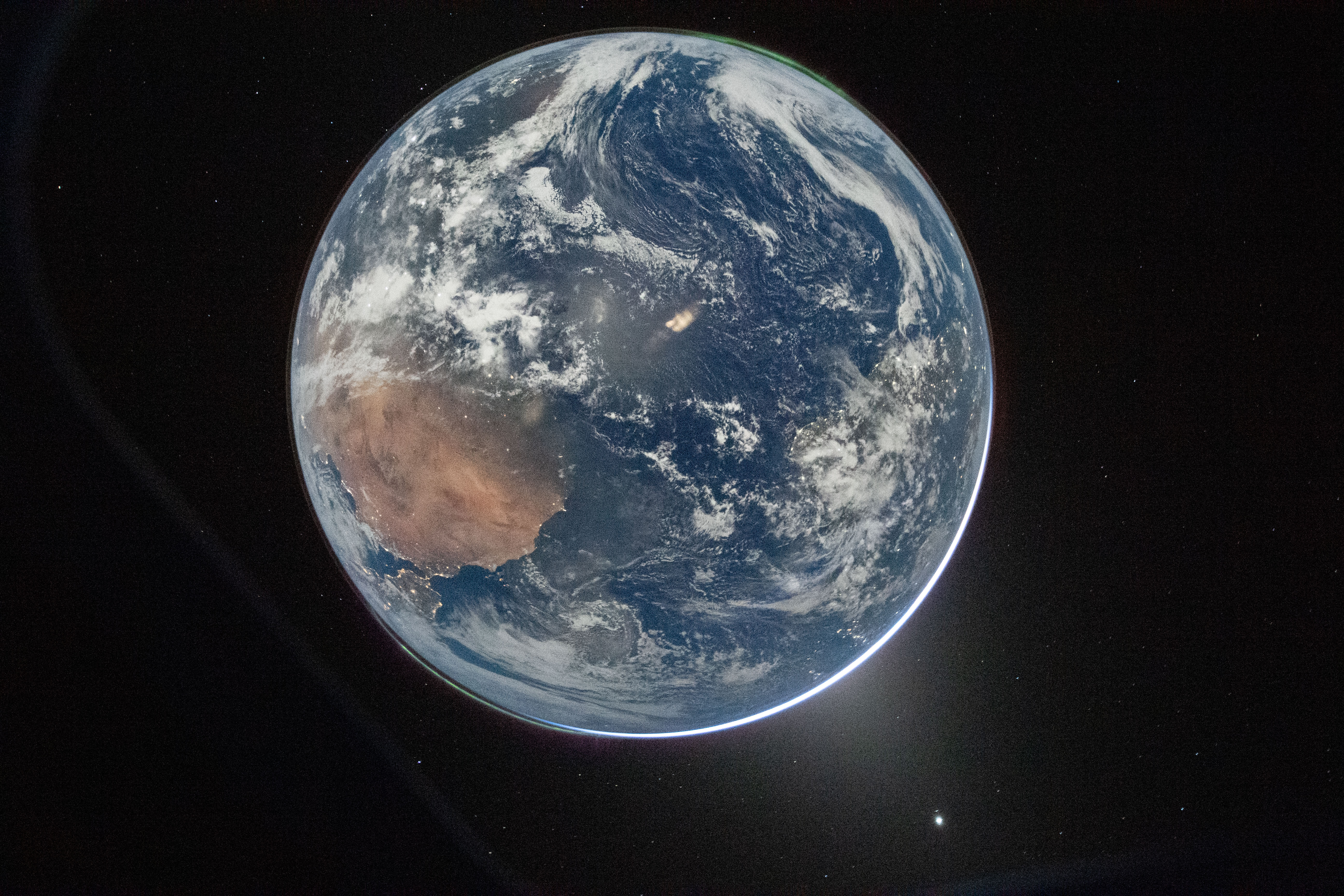
Because of the mission profile, the only time of the month Artemis II can be launched during this part of the year is during the full moon, as that is when the moon's orbit places it closest to Earth. Because of the the astronaut had a first-of-its-kind opportunity to take a picture of the entire Earth.
What you are seeing is a photograph of the entire Earth. It is not lit by the sun, which is behind our planet. But lit by moonlight. The camera settings were set to longer shutter times and other settings to allow more detail to be visible in the photo.
Some unique features you can see in the picture include the stars surrounding Earth. And you can see city lights as well. In the lower right, you can see the zodiacal light. At the bottom and top, you can see the green auroras hovering above the poles. And looking carefully at the edge of the Earth, you can see the edge of the atmosphere outlined by the sodium line caused by meteors burning up in thin air.
Enjoy, and Godspeed, the crew of Artemis II


2 comments:
"Earth By Moonlight" is a pretty great name for a piece of art.
I hadn't even thought of the lighting effects of the full moon launch until now, was mostly wondering if there was an extra step in the crew's medical check-ups to make sure no one was a latent were-creature. I'm halfway surprised no one's announced a schlock movie based on the premise. "An American Werewolf In Orbit" or something.
It’s an incredible photo and a testament to the capabilities of modern digital camera sensors- tech that isn’t out of reach to modern enthusiasts. I haven’t done a deep dive into the minutia of the EXIF, but if I recall the ISO was 52000 at 1/4 second exposure time. Totally doable even with a handheld shot using ubiquitous in-body-stabilization features. On might expect a very grainy photo at such a high ISO, but post processing tools to remove this have gotten very good. Out cameras can literally see in the dark and it’s used here for spectacular effect.
Post a Comment